Showing posts with label Louisville. Show all posts

Sunday, October 28, 2018

Waverly Hills Ghost Hunt

This blog post has several sections:
1. Introduction
2. Equipment
3. Building History
4. Haunted History
5. Evidence

1. Introduction:

After our adventure at the Crescent Hotel (Crescent Hotel Ghost Hunt) we knew we would go on another hunt. We just needed to find the right location. At first I was thinking of going to Bob Mackey's haunted restaurant but then I realized how close Waverly Hills Sanatorium was to us. Louisville was only a four hour drive which would be great for an overnight hunt because we could leave our house late enough so that we wouldn't be as tired as we were at the Crescent. Although to be honest I believe something at the Crescent was draining us of energy. We should have been ok with a two hour nap and been up and walking around. Instead as my alarm went off I could barely open my eyes and hit the snooze button. Neither of us ever got up during the night either for a drink or to use the bathroom. Looking back it is odd.

Anyway there were things that we learned from the Crescent. First: that we wanted a continuous voice record of the events. The video of someone crying, "Help me" at the Crescent was getting louder. Maybe if the camera had continued recording we would have heard more. However the camera was looking for motion and since there was none it cut off. Second: we wanted to make sure that the cameras all had the time and date stamps correct. I set the time and date stamps the day before we left for Waverly. However some of the cameras didn't save it once they were turned off and since I was turning them on and off throughout the night that proved impossible. But we tried.

I already know there are lessons we have learned from Waverly. First: the recorders that we had worked, but we need to get an arm band or something that will hold them without us having them in our hands. There are times where there is static and it is probably me moving my hand over the microphone. Also whenever I had to switch a camera there is a lot of noise. Which brings me to the next thing we learned from Waverly. Second: I need to be more organized. I had all the equipment in a back pack so every time I stopped to set up equipment I had to dig to the one I needed. Now part of the problem is that because it was a group hunt I couldn't just set a camera and leave it since I didn't know everyone on the tour. Third: I needed to have just the equipment I planned on using. I had two video cameras that do not have night vision on them so they were useless in the dark Sanatorium.

2. Equipment:


I added a second hunting camera because the first one had been so successful at the Crescent. I had the mini tripods on them so that I could stand them up quickly. There were also a couple of times where, after having them sitting in a room with us, I would just pick them up and walk with them by holding the tripod. One good thing about that was, because the camera is boxed in, the screen didn't affect my eyes so they could adjust to the dark however it did affect the quality of the sound recording. The small video cameras also had night vision on them but their batteries drained very quickly. The two larger voice recorders were the ones we carried with us the entire time. The smaller one was for if we wanted to do a burst EVP session. I had a battery backup to charge equipment if needed. Finally our newest piece of equipment was the seek thermal camera. I plugged it in to the bottom of my I-phone and using my phone's camera I could take photos and video of thermal changes.

3. Building History:

Just like with the Crescent Hotel I started doing some research about the building a few weeks before the trip. Waverly is listed on the US National Register of Historic Places. Originally the property belonged to Major Thomas H. Hays, who purchased it in 1883 to build his family home. The home was far away from any school and so the Major hired Lizzie Harris as a teacher and opened a school nearby for his children and the other children in the area. Miss Harris was a fan of Walter Scott's Waverley novels and so named the school Waverley School. Major Hays liked the name and so called his property Waverley Hills.

In the late 1800s and early1900s the entire country began to experience outbreaks of Tuberculosis and Louisville's location along the Ohio River resulted in an especially devastating outbreak. In 1911 Louisville was updating the City Hospital and decided to open a separate Tuberculosis hospital. The Waverly Hills property was selected. At first an administrative building and two open air pavilions were erected which could house 40 patients deemed to be early cases. In August of 1912 the current Tuberculosis patients from City Hospital were transferred to Waverly. In December of 1912 a hospital for advanced cases was opened that could hold another 40 patients. By 1914 a "children's pavilion" was added with enough room for 50 beds. Waverly could now hold at least 130 patients and still the outbreak demanded more rooms. More buildings were added throughout the years.

In 1924 construction on the five story, 400 bed, structure that stands today was begun. A little over two years later in October of 1926 the building was opened.

Photo by Meghan Keohane

Some country wide estimates report that over 400 people died every day from Tuberculosis and Kentucky was particularly hard hit.

Kentucky TB Association Ad, 1945.

The second, third, and fourth floors consisted mostly of patient rooms with a few variations. One side of the building (seen here) had a long exterior hall. This was because one of the primary treatments for Tuberculosis at the time was fresh air. Patients' beds would be rolled into the hall, called the Solarium, and left there sometimes for months. Most rooms had two beds but some on the upper floors had up to four. On the other side of the building were private rooms and terminal rooms. Patients who were not responding to the fresh air treatments could be wheeled across the hall and given more privacy.

Photo by Meghan Keohane

On the fifth floor there were two wards. One side was for children and included an outdoor playground on the roof. The other side was for patients who suffered from Tuberculosis of the brain.

Besides fresh air and sunlight, Heliotherapy, the other main treatment for Tuberculosis was nutrition.  If those two treatments failed on the fourth floor was an operating room. To us today the treatments and operations performed on Tuberculosis patients sounds barbaric. However that is given the information we now know and medicine has made huge advancements since even the 1960s. One thing I found very important to keep in mind was that as terrible and painful as the operations sound they were done by doctors and nurses who truly believed this was the only way to try and save their patients. Some of the surgical treatments included removing ribs, inflating lungs with balloons, and the worst involved cutting open the back and sides. The surgeries had two aims. First: to try and kill the bacteria by depriving it of oxygen. Second: to give the lungs room to expand.

The first floor is where the morgue was located. In 1945 records indicate that over 162 people died at Waverly. Using that it is assumed that realistically 6,000-8,000 people died from Tuberculosis over the years the hospital was functioning, though some reports will give numbers in the tens of thousands. Nearby the morgue is a tunnel called the 'body chute' or 'death tunnel.' When the Sanatorium was first built so was the tunnel with the purpose of providing easy access for supplies to be brought inside during winter and inclement weather. Eventually however as the death numbers rose the tunnel began to serve another purpose. Rather than having hearses or ambulances pull up to the Sanatorium every other day bodies could be taken through the tunnel to the train tracks that brought the supplies.

Photo by Meghan Keohane

In the 1940s the battle with Tuberculosis took a positive turn with the discovery of streptomycin and by 1961 the Sanatorium was no longer needed. Afterwards it was used as a Geriatric Hospital for some time but has mostly sat empty. The current owners have plans to turn it into a hotel but I hope they don't. Right now they have different tour and ghost hunting options for those looking for information and at Halloween they turn the first floor into a haunted house attraction.

Now despite the fact that I did research beforehand I still signed up for the two hour ghost tour. I wanted to hear the stories from those who would know best, to make sure the info I had was correct since I saw conflicting reports. Our tour guide's name was Dale. Let me say this - I would take a tour any day of the week with him. He was so knowledgeable and personable I couldn't have asked for better. For those looking at this though let me stress this - tickets say you are not allowed to take photo or video during the two hour ghost tour. Now there were two instances when we were allowed but that was only because we were ahead of schedule on the tour. This is probably for several reasons. First: if I videoed the entire tour then someone could just watch that video instead of actually taking the tour. Second: is probably for the privacy of the tour guides and other people on the tour. Third: is because they don't want people hanging back to get a good photo and holding up the tour. All three very good reasons. If you want to take pictures and video then go on the ghost hunt. I highly recommend you go on both.

4. Haunted History:

Room 502 - As the stories go a nurse who was unmarried became pregnant with a doctor at Waverly. He refused to leave his wife and so she hung herself outside of room 502. Now there are variations. Some say she had also caught Tuberculosis from the patients and so hung herself to avoid the illness. Other reports say there had been an illegal abortion attempt, or that the baby was still-born, and out of grief she hung herself. Either way it is on record that a nurse hung herself. There are also stories (unconfirmed) that a second nurse jumped or was pushed to her death from room 502.

The fourth floor - Stories tell of shadow figures that haunt this floor. There are several different types among which is the Creeper, a hunched over figure that moves up and down the halls, walls, and ceiling. Also there are reports of the operating room door closing itself. One of the treatments basically involved cutting open the back and leaving the patient ribs exposed. The thought was it added more room for the lungs to expand. Most died during this operation and it was definitely a last ditch effort to save a life. I think this is the origin of the creeper since the hunched over figure would be the permanent position of anyone who survived this surgery.

The third floor - This one is an all over type story. Apparently a child named Timmy has been identified as haunting the location. As a result there are toy balls all over the place and at various points they start rolling around on their own. Timmy was first encountered and the name attached on the third floor but due to numerous investigations there are balls on every floor.

Photo by Meghan Keohane

2nd floor - On the second floor is a room that belonged to sisters Lois and Audrey Higgs. Audrey recovered from Tuberculosis and eventually went home. Lois, however, passed away at Waverly. There are reports by investigators of hearing Lois calling for her sister. Also on the second floor is a kitchen and cafeteria. There are reports that sometimes visitors smell bread baking and capture EVP, electronic voice phenomenon, in the cafeteria.

1st floor - Obviously the morgue and body chute have attracted a lot of attention from paranormal investigators and for good reason. Shadows seem to move and close in on people in the body chute.

Overall - Throughout Waverly people report hearing doors close, breaths, wheezing, and temperature fluctuations.


5. Evidence:

Having decided this is something we like doing and plan on continuing doing we are trying to set up good habits. It has been time consuming but I think it will be worth it. We have created a transcript of everything from the two voice recorders that we were carrying so we have a continuous 6 hour dialogue. We then took the cameras and small voice recorder to match it up with the transcript so that in that document will be every sound and occurrence that we documented.

As far as bad feelings go for the most part we were both ok. Each time we were in the operating room we both felt as if there was a pressure on our chests, with Meg being more effected then myself and on the recording you can hear her coughing. Also there was one point on the fourth floor hall when we both felt uneasy. In order to try and interact with the residents there are a series of normal questions to ask like for example, "is anyone here with us?" Well on this particular occasion Meghan asked, "Is there anything here?" It stood out because in the entire six hours that was the only time we referred to a 'thing' rather than addressing a person.

On the voice recorders we were carrying I have numerous times where we heard breaths, wheezing,  whistling, and also clicking or crackling that is similar to some of the noises made by diseased lungs. A search on youtube called the crackling sound Rales. Here is a video from youtube of the sound:


We also heard numerous doors slamming but that could have been others slamming doors so we never really spent time on that.

Meghan had one photo that was taken early in the day when the tour guide allowed us a few minutes to take photos.

Photo by Meghan Keohane

In the second window from the left and about a foot above the people standing in the fifth floor room there is what looks like half a face floating.

Floating face close up

On the fourth floor Meghan was taking multiple pictures in a row and seems to have caught shadow/mist moving.


In the picture above the hall is clear illuminated by the red of an exit light. In the picture below I have put a box around where a strange mist moves across the camera field of view. These pictures were taken one right after the other.


I also had some success with the thermal camera, though I was hoping for more it was enough to make us keep the thermal imager.

First is a video that really has nothing to do with the thermal except it caught a sigh on it that was not myself or Meghan.


The second video has a small round shape at the far end of the third floor hall that seemed to be playing with me and moving around. Now some of the movement is from me trying to center the shape in my camera and get a thermal reading but beside that it seems to bop around a little bit. It made me think of a child peering around a corner playing hide and seek.


Before the investigation the group was split in half. Our group was sent to the upper floors and then split in half further. We began on the third floor and after a little over an hour we moved to the fourth and fifth floors.

Third Floor

I have two videos of our findings from the third floor. Now nothing here will change the mind of the skeptic but I still invite you to listen/watch because it is interesting. What I consider an EVP the skeptic will say it is matrixing or pareidolia and my ears just making sense of the sounds. When I write that I see an orb to the skeptic that will be a piece of dust or insect. I realize that. Some of the EVPs are hard to hear. I don't have a good editing software so I can not remove background noise and for some of these I am listening with the volume up while wearing a head set to try and make out words. Others are more clear. One thing you will hear over and over on the videos is us asking about who is with us and their stories. To us that is the interesting part. These spirits are people who lived lives with friends and family and for various reasons are still trapped here. We wanted to make contact and learn about them.


At some point I switched cameras because my batteries kept draining and turning off. I have this short video made up of several clips.


Next is a video I made of the recordings from the third floor. The background picture is a picture I took when it is my recorder and a picture Meg took for her recorder. The video is chronological of our investigation on this floor and has title screens to give an idea of where we are in the building (day room/ halls/Solarium.) I will also have text on the screen commenting on what we are doing and warning when I hear something. Then there will be a break and I will have text that says something like, "Did you hear? Go back to listen again or keep watching for what I heard?" this gives time for people who want to go back and try and hear on their own before I write what I heard. Now just to be clear about some of the terms I use when I refer to an intelligent EVP it means I think the answer is reacting to what we have said or done as opposed to a residual EVP which could be a repeating EVP like a place memory that is repeating past events. The last note about these videos is that at times you hear other voices and that is the other people in the group. For the most part I have tried to rule out others when I point out EVPs.

Specifically about the third floor we had a good time on this floor. I don't remember feeling unwanted as we walked around the floor. We had some fun experiences and I really wish I had done more burst EVP sessions, where I ask questions and listen back right then and there because I think we have times where spirits are responding to us. Especially on this floor at one point when Meg was taking pictures. I think for the most part on the third floor the spirits were more playful and welcoming.


Fifth and Fourth Floor

After the third floor we moved to the fifth floor. There Meg stopped to read a children's story while she was sitting where the playground was located so long ago. We had mentioned as we walked on the third floor that we would be doing that for any spirits who may have wanted to listen especially since the ghost child Timmy is associated with the third floor.

As Meg was reading I had a camera set on her as well as I walked around with a different camera. As I moved around and recorded Meghan reading I kept thinking I was seeing movement in the shadows but could not catch anything on camera. I also upon playing back the recording heard phantom breathes, which actually happened throughout the night. The hand held camera had a lot of trouble. At various points the recording skips time and misses part of the story. I used this camera at the Crescent Hotel as well as on other road trips and have never had that problem before. In this next video I actually catch a small light anomaly just before the video skips time again.


Here is a longer video of Meg reading the story. During the video I call out when we hear EVPs or see something strange like an orb, small ball of light. 


Hopefully it would have been nice to any children still roaming the halls of Waverly to have a story read to them like I would assume parents and caretakers had done when they were alive. I think it was a success and some of the EVPs make me think of the way small children would just randomly call out.

After reading her story we went over to room 502 where we captured another EVP.


There was a strange moment on our voice recorder where I seemed to be confused and unresponsive to Meg asking me questions then I basically began narrating what I was doing as if filling Meg in on what had happened when she was standing next to me the whole time.

Fourth Floor

Next we went to the fourth floor where we had one of our strangest experiences but I don't have video from it. I include it in full on the fourth/fifth floor voice recordings from my voice recorder.  We were walking along the solarium and we felt as if something moved between us.  There was a bang that others in the group heard and they thought they saw something. They chased it and ended up by us. At this point I got several strange EVPs on the recorder. Also on the thermal camera I saw a cold spot on the ceiling above us as if something was absorbing the heat. Our experience corroborated what the others had seen and chased.

As I said before the fourth floor had the operating room which greatly affected Meg. As we walked around that floor shadows seemed to twist and move. I really wanted something to happen in the Operating Room but Meg could only stay in there a short time. Also there were others from the group there and I felt like I was intruding on their own investigating. Again that is part of being in a group investigation. When I go back I will probably try and return to the operating room even though it also caused me to feel as though I was having trouble breathing, but not as badly as it affected Meghan. I wanted to try and make contact with patients or even doctors who still remain. One thing that struck me as I researched the Sanatorium and old treatments for Tuberculosis was how painful and brutal some of the treatments seemed. With the knowledge that we now have of the disease the old operations seem more like torture than actual treatment. But TB was a mystery at the time and these were operations done with the thought that it was the only chance a patient had to recover if they were not doing well with the sun and nutritional treatment. Another name for TB was consumption because the disease seemed to consume the whole individual. Had we been able to spend more time in the operating room I was going to try and empathize with the doctors who took an oath to do no harm to their patients and must have, I assume, felt conflicted about the pain and damage they had to cause in order to try and save a life.  I also wanted to try and communicate with patients and did at a later point, but not as much as I originally planned, by asking if they were aware of the vaccine that had eventually been discovered for Tuberculosis and if it gave comfort that perhaps studies done on them helped save countless lives.

Here is the video of all our recordings from the fifth and fourth floors.

First Floor

After the fourth floor there was a half hour break to use the bathroom and have a drink or bite to eat. Then the groups swapped and we went to the first floor. The first floor has the morgue, body chute, and the area that is set up for their Haunted House at Halloween. I again do not have video from this area. One cool thing about the first floor was that our group stayed together a bit more and we got to know some of the others. One of the members of the group had a "spirit box" app or white noise generator on her phone and I think we managed to confirm some of what her app gave us with the EVPs we captured on this floor.

In one of the small storage rooms I kept feeling someone touching my arm like a child trying to get attention and on the recorder there are several EVPs I hear that sound childlike. It makes me want to go back to that room next time and maybe spend some more time there trying to communicate.


Second Floor

Next we went to the second floor where I wanted to go to Lois and Audrey Higgs room. This is where having multiple voice recorders really helped. On one recorder we got super excited when we thought we had an EVP of Lois saying "my sister" a different recorder debunked that as being me speaking saying "like stay still". It certainly helped us with accuracy.  We did however get our best video. Again nothing that will change someone's mind but watch this video as we capture what could be a spirit manifesting itself.


At some point we begin questioning who we may be speaking too since obviously many patients would have had that room not just Lois and Audrey. After spending a good amount of time in that room we went out into the halls to find the cafeteria. Here we continue to get some good intelligent EVPs and actually some of my favorite EVPs. We also got a bit of a jump scare. Finally we ended our night in the cafeteria where we have heard good EVPs have been captured and sometimes people smell bread baking. We didn't get much there but it was the very end of the night, practically morning.


I do know in the future I want to do more short burst EVP that we can listen back to on the spot because I think there were times where they answered and interacted but we didn't know until much later. Overall it was a great experience and I hope to add more haunted locations to future road trips.

Monday, August 6, 2018

Cave Hill Cemetery Louisville, KY

Part of my research for road trips, once I pick an area or city to travel, is to look up cemeteries to see if there are any famous/notable burials in the area. The first road trip I used this on was years ago when during a trip to Green Mount Cemetery in Baltimore Maryland where I stopped to see the graves of John Wilkes Booth and Elijah Jefferson Bond, the man who patented the Ouija board.

In Paducah Kentucky I stopped at Oak Grove Cemetery and spent hours looking at the different tombstones. Oak Grove Cemetery

In April Meg and I spent hours at Elmwood and Pinewood cemeteries in Charlotte, NC admiring the many different styles of head stones. Elmwood and Pinewood

Now in Louisville I had found Cave Hill Cemetery. Originally the property was part of William Johnston's Cave Hill farm, and it kept the name despite different uses. In the 1830s there were plans for a railroad to go through the property but those fell through and residents continued leasing land to farm. 

In 1846 Mayor Fredrick Kaye appointed civil engineer Edmund Francis Lee to design a cemetery for the property. Lee had experience with the garden style cemetery that had gained popularity in Europe and saw the natural landscape of the hills as a perfect fit for that style. 

After a night of ghost hunting and a brief one hour nap Meg and I drove in the Grinstead Drive entrance of the cemetery. I had a list of graves I wanted to try and find for various reasons and Meghan had the cemetery map which listed other notable graves of figures famous in Louisville or Kentucky. Meghan used the map to plot a path that would help us cover as much of the cemetery as possible, keeping in mind the areas where we wanted to see particular graves. 

Now in Kentucky I had been enthralled with the many tombstones to wood workers and in Charlotte I had found many scroll designs. In Louisville we saw many tombstones which made use of stained glass in the center to mark a beautiful reminder of the lives lived. 


The idyllic garden style of this cemetery with light catching the stained glass was beautiful. While I have seen beautiful work done with stone cutting the designs in the glass seemed to have endless possibilities for expression. There is such beauty in seeing the personal works of art for lost loved ones. Top right is a beautiful Celtic Cross that at the right angle of light would illuminate the plot and those around it. I took pictures of these and first noticed them for the stained glass but even in these there is more details about the people they represent. I don't know much about Scott A Thompson (top left) however at his name on the base are two crossed hockey sticks maybe he played or maybe he was just a huge fan of the game.

Dr. Robert Greenberg has a glass Star of David on his grave, a poem he has written, and then at the very bottom are two dinosaurs named Tex Rex and Broncilla. Through research I have learned that he wrote a series of children's books about Tyrannosaurus Tex, a young T-Rex from Texas. Dr. Greenberg was originally from Brooklyn and spent a lifetime concerned about mental health both as staff at hospitals and as a professor at a number of institutions. He also served in the army medical corps during the Vietnam War and reached the rank of Colonel in the Army Reserve Medical Corps and further received the Legion of Merit for activation during the Persian Gulf War.

The last picture I have at the bottom right is a young man named Ross Ruffra who was only 16 when he was killed in an automobile accident. In honor of his accomplishment and drive in his young life a scholarship has been set up by his parents so that other students from his school of South Oldham High School who show the same drive and love for academics, sports, and other activities can defray some of the cost of college.

It wasn't just the tombstones that had beautiful stained glass designs. The Mausoleums also had intricate designs inside. I found two with depictions of Leonardo DiVinci's Last Supper.


The most famous memorial that we found early on was Muhammad Ali's grave site. It was easy to find because the cemetery, in a great move that definitely encourages visitors, painted lines on the paths to connect the two main entrances and to help point to Ali. That and the nicely spaced boxes with maps certainly made this a great cemetery to travel around.


Ali's memorial featured a beautiful stone path leading up to a well cared for flower garden. His words on the black granite monument prove a fitting tribute to a man who transcended a sport and made himself into a leader and hero to many.


One of the important historical figure we found buried in Cave Hill was General George Rogers Clark. He was a Revolutionary War hero and founder of the outpost that would later become Louisville.

We also stopped by Major William Croghan, brother in law of George Rogers Clark, grave. He was an Irish immigrant who arrived in the United States in 1768 around the age of sixteen. He too served during the Revolutionary War and was present at the crossing of the Delaware as well as several battles: Princeton, Brandywine, Trenton, Germantown, and Monmouth. And if that wasn't enough he was also present at the surrender by Cornwallis at Yorktown.


One of the most interesting and beautifully planned family plots we found was the monument for the family of Edwin V Thompson. At the center of the plot is a stone tree and around it for the other family members are logs with the name and birth and death dates.


There were many unique graves throughout the cemetery that were easy to see from the driving paths.


This monument to Dr. Thomas Willett Hagan has hands reaching from the top of the stone in various positions. Since my visit I have learned that he had a private practice for plastic and reconstructive surgery and had at one time served as the Chief Surgical Resident for the University of Louisville Hospital. And he was also a Commander in the U.S. Navy during the Vietnam War where he served as a flight surgeon.


Early on in our travel through Cave Hill Cemetery we found this idyllic scene of two birds resting on top of an indented area of the stone with a small dam beside them. A tree stands beside it offering a safe landing and nesting spot for real birds. The name on the stone is Billips and the plaque beside it gives a little more info: Charles E Billips was a Captain in the U.S. Marine corps and lived form 1934-2000. I can't find any more information on him but judging by his resting spot he loved birds.


I took this picture of  the Dillon family plots after seeing several graves with ivy growing over it acting as a year round grave blanket protecting their resting places.


Another grave that caught our attention from afar was the grave of Miguel and Hildegard Lagunas. Miguel, still alive, is originally from Mexico City and came to the United States as a teenager to study engineering. His student visa eventually allowed him to apply for a Green Card and he then became a US citizen. At some point he served in the US military for three years.  After retiring from  Louisville Gas and Electric he now spends most of his time helping the community and Louisville in general. In March of 2008 he was awarded the Mayor's International Award for his contributions to Louisville's multicultural community. I am guessing that the single cross on the left is for Hildegaard, also an immigrant from Costa Rico. She passed away November 16th, 2001. Unfortunately I have not been able to find any more info about her.

As we traveled around the cemetery we saw lots of other people out walking around, reading, and enjoying the peace. The garden cemetery creates a welcoming space for people to come relax and remember those who have passed. I would think that it became popular partly because it removed some fear of death. It makes death seem more peaceful as you can walk around lakes and amazing trees in a way that connects one to nature. For example we found this amazing Ginko along one of the paths.


We had been in the cemetery for a couple of hours and Meg was waiting at the car for me to come back from walking around one of the sections looking for a particular grave when out of the corner of my eye I saw something move.


A beautiful deer was walking among the headstones enjoying the peaceful quiet. I was stunned. He watched me for a moment before he continued on his walk-a-bout.  We also saw a lot of birds enjoying the protection of the varied trees or swimming around the lake.


There are a lot of baseball players buried in Cave Hill so I picked one to look for the grave of and that was Pete Browning, owner of the first Louisville Slugger. he played in several different baseball leagues during his career. In 1887 while playing in the AA (American Association League) his finished with his highest career batting average .402. After that he went to the Player's League and lead that league in batting but it closed after only a year. He spent the remaining five years of his career playing for several teams in the National League.  His career totals are:

Games Played 1,183
Hits 1,646
Runs 954
Home Runs 46
RBIs 659
Batting Average .341

His career batting average places him in the top twenty all time for batting average.


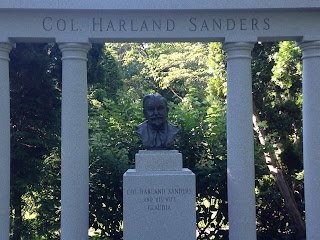
Of course we stopped by the Colonel's grave stone. Harland Sander's rise to Fried Chicken King took a lifetime and is a true story of American enterprise. His father passed away when he was only six years old and he began helping his mother with his younger siblings. One of the ways he helped out was to cook meals for the family. He then began working at ten doing a variety of jobs until thirty years later when he was working at a service station and selling chicken to people who stopped at the station. Well more and more people began coming just for his chicken and his 'secret' recipe. Eventually he moved his food service business across the street to an old motel.  By 1935 he was officially made a Kentucky Colonel by the governor. In the 1950s a new interstate was being built that would divert a lot of the traffic away from his location and so he sold the building and at 62 found himself having to start over. He tapped into one of his past jobs as a salesman and hit the road. He believed in his recipe and the value of his chicken and he was determined to start a franchise. His recipe and determination paid off and today there are over 18,000 KFC restaurants in over 118 countries.


I'm not sure why people throuw change on his grave.


The next grave we saw from a distance and as soon as I saw it I said "that has to be the grave of an magician" and it was; Harry Leon Collins. Harry was born and raised in Kentucky and had become interested in magic as a teenager. After graduating from high school he joined the Marines and served in WWII. His father had passed away in his mid teens and he helped support his mother and younger siblings including sending his entire paycheck home when he was at war. As a result he helped put his younger siblings through college. After being injured in Saipan he got the attention of Bob Crosby and performed in Crosby's variety show called "This is the Army Show." He returned home after WWII and became a salesman for Frito-Lay by day and Mr. Magic by night.


Next up was a hard one to find. Big James Porter's grave is nestled into the side of one of the hills. James is a folk hero known for his height, which made it onto his headstone at 7 foot 8 inches. He is also called Big Jim and the Kentucky Giant. As the legend goes Jim was a very small and sickly child he began working as a jockey when he was 14. Then at 17 he began to grow and by the time he was 20 he stood at his full height of 7"8'. He worked as a coach driver and when Charles Dickens came to visit Louisville he wrote that:

"When he had shown himself and talked awhile, he withdrew his pocket instrument and went bobbing down the cabin, among men of six feet tall and upwards, like a lighthouse walking along lamp-post."

He died peacefully in his sleep probably due to heart problems caused by his size.


Another interesting grave was the grave of D. H. Davies (David Henry.) I don't know anything about him beyond his name, birth, and death date.


I assume he was a sailor or boatsman of some kind maybe on the Ohio river because of the anchor on the grave monument but it could just be symbolic of who he was. On the back is a cross so he was religious. It also has a plaque that states his life was the "illustration of goodness and purity."

Some of the most beautiful monuments and the saddest are those for children or infants. One of the graves that I went knowing about was that of three year old Samantha McDonald. Samantha, Sami, passed away tragically in a home pool accident. In memory of a beautiful and vibrant life gone too early her parents had this monument built showing her on a swing held by Jesus. I know they also have a charity called Sami's Rocks for parents and families who have experienced similar sudden loss.


Some other example of infant/child graves showing lambs or a sleeping child.


Another stunning monument I found was to two brothers: John and Dodie McMillan. John passed away at two years old when his older brother, Dodi, was six years old. Dodi also died young, years later at only 21. Above their graves is this testament to two brothers who are now reunited. 


As I said at the beginning for some of these graves I was looking for them others just caught my interest and I would go home and research the people. One grave that caught my attention was Patti Hall Eittel.


It was the poem written by her husband and note at the bottom from her children that got my attention. I saw that she was young, only 43, and the stone said 'torn from us'. At the time I assumed she was sick or had been killed in a car accident. But that was not the case. She was shot by a disgruntled employee leaving work one day. The shooter pleaded innocent by reason of insanity. She was found guilty and sentenced to life with parole in 25 years. That means four years from now she will be eligible for parole.  For me this is one grave that is going to stay with me. Every death leaves some one behind some friend or family who will always remember the name on the stone as a living person with a particular laugh, or smile, or favorite food, or favorite movie, or with hobbies and talents. For me this was the first one I have researched that was a murder. Reading the trial statements and article summaries really affected me. 

In contrast to the trees, curving rows, and varied headstones of the garden cemetery also in Cave Hill is a section of a National Cemetery. The uniform headstones in straight lines are, to me,  striking and overwhelming. The National Cemetery began in 1861 when Union Soldiers who died in camps and hospitals around Louisville where buried in one of the lots at Cave Hill.


Along the road of the National cemetery were plaques with the different lines from Theodore O'Hara's Bivouac of The Dead. Theodore originally penned this in honor of Kentucky troops killed in the Mexican War. Since then it has been used by many and is at the entrance to Arlington National Cemetery. Meg found a recording of the song set to music by Char Seawell. Her is her version as well as the full poem below.


The muffled drum's sad roll has beat
The soldier's last tattoo;
No more on Life's parade shall meet
That brave and fallen few.
On fame's eternal camping ground
Their silent tents to spread,
And glory guards, with solemn round
The bivouac of the dead.

No rumor of the foe's advance
Now swells upon the wind;
Nor troubled thought at midnight haunts
Of loved ones left behind;
No vision of the morrow's strife
The warrior's dreams alarms;
No braying horn or screaming fife
At dawn shall call to arms.

Their shriveled swords are red with rust,
Their plumed heads are bowed,
Their haughty banner, trailed in dust,
Is now their martial shroud.
And plenteous funeral tears have washed
The red stains from each brow, 
And the proud forms, by battle gashed
Are free from anguish now.

The neighing troop, the flashing blade,
The bugle's stirring blast,
The charge, the dreadful cannonade,
The din and shout, are past;
Nor war's wild note, nor glory's peal
Shall thrill with fierce delight
Those breasts that nevermore may feel
The rapture of the fight.

Like the fierce Northern hurricane
That sweeps the great plateau,
Flushed with triumph, yet to gain,
Come down the serried foe,
Who heard the thunder of the fray
Break o'er the field beneath,
Knew the watchworld of the day
Was "Victory or death!"

Long had the doubtful conflict raged
O'er all that stricken plain,
For never fiercer fight had waged
The vengeful blood of Spain;
And still the storm of battle blew,
Still swelled the glory tide;
Not long, our stout old Chieftain knew,
Such odds his strength could bide.

Twas in that hour his stern command
Called to a martyr's grave
The flower of his beloved land,
The nation's flag to save.
By rivers of their father's gore
His first-born laurels grew,
And well he deemed the sons would pour
Their lives for glory too.

For many a mother's breath has swept
O'er Angostura's plain --
And long the pitying sky has wept
Above its moldered slain.
The raven's scream, or eagle's flight,
Or shepherd's pensive lay,
Alone awakes each sullen height 
That frowned o'er that dread fray.

Sons of the Dark and Bloody Ground
Ye must not slumber there,
Where stranger steps and tongues resound
Along the heedless air.
Your own proud land's heroic soil
Shall be your fitter grave;
She claims from war his richest spoil --
The ashes of her brave.

Thus 'neath their parent turf they rest,
Far from the glory field,
Borne to a Spartan mother's breast
On many a bloody shield;
The sunshine of their native sky
Smiles sadly on them here,
And kindred eyes and hearts watch by
The heroes sepulcher.

Rest on embalmed and sainted dead!
Dear as the blood ye gave; 
No impious footstep here shall tread
The herbage of your grave;
Nor shall your glory be forgot
While Fame her record keeps, 
For honor points the hallowed spot
Where valor proudly sleeps.

Yon marble minstrel's voiceless stone
In deathless song shall tell,
When many a vanquished ago has flown, 
The story how ye fell;
Nor wreck, nor change, nor winter's blight,
Nor time's remorseless doom,
Can dim one ray of glory's light
That gilds your deathless tomb.


Another monument in the National Cemetery is a common one across the south and middle of the country. A monument to unknown soldiers, in this case Union, killed in nearby Civil War battles.


The Civil War has always been a time period that interested me. I remember studying it and reading about different battles in grade school. The Civil War has left scars across the country. It is a terrible thing when the citizens of one Nation have to turn to War against each other- neighbor against neighbor. Some estimates say 620,000 soldiers others are as high as 800,000 soldiers lost their lives in the battles that stretch from Pennsylvania to Florida and west to New Mexico. These monuments and cemeteries and battle sites hopefully serve as a reminder that we should never allow our country to become so divided that war against each other happens. Remove that idea from thoughts and minds. I think the list of those killed- and the unknown number of survivors who were never whole again should prove that this should never happen again.

In 1867 the remains of 11 soldiers who had been buried at a nearby battlefield and this monument, the 32nd Indiana Infantry Monument were relocated to the National cemetery.


The 32nd Infantry was nicknamed the 1st German regiment because it consisted primarily of German immigrants. On December 17th, 1861 the 32nd Infantry and Confederate Soldiers fought over a bridge that crossed the Green River (called the Battle of Rowlett's Station or the Battle of Green River). 13 members of the 32nd were killed in the battle and 11 were buried at the battle site. The regiment remained camped nearby in Munfordville for two months after that battle and in that time a Private name August Bloedner carved a monument from the limestone to mark the graves. August was born March 1st 1827 in Altenberg, Germany. He was trained in sculpture before moving to Cincinnati, Ohio in 1849. On the frieze is a Bald Eagle holding cannons with American flags at either side. The inscription below it, written in German, translates to:

"Here lie the men of the 32nd First German Indiana Regiment sacrificed for the free Institutions of the Republic of the United States of North America.
They fell on 17 Dec. 1861, in an Encounter at Rowlett Station, in which 1 Regiment of Texas Rangers, 2 regiments of Infantry, and 6 Rebel Cannons, in all over 3000 Men, were defeated by 500 Germans."

It was put in place in January of 1862 and later moved to Cave Hill. The soft limestone wore away overtime and to protect the monument the original was moved to the Frazier History Museum where it is safe from weather and climate controlled. Still on display there it could be the oldest Civil War monument. In December of 2011 the new monument was installed at Cave Hill. And the English translation was added to the back. 

Since the main reason for the trip was our Waverly Hills Sanitarium Investigation I did look to see if I could find burial records in Cave Hill with place of death listed as Waverly. I found two: George A Mattingly 1896-1932 and Chrisler Ervin "Christy" Risinger unfortunately I was unable to find their grave markers at the cemetery.

There were many more beautiful monuments throughout the cemetery. It was a beautiful way to spend our early Sunday morning. I love seeing the monuments and learning about the many different people and their stories, whether they make it into this blog or not. 

I have joined a website called Find A Grave which is how I get a lot of the information about graves. As a member I can upload pictures as well as leave memorials to the graves I visit. Whether a grave makes it into my blog or not for everyone that I stop and visit I look up and add information if I can and leave a note. To me it is one of the things the internet gets right, an electronic record that a person lived and has value.