Ever since watching Ghost Hunters "Haunted Lighthouse" episode in 2006 we knew we wanted to visit the St. Augustine Lighthouse. Jay Hawes and Grant Wilson pioneered paranormal investigations on TV and brought it to the attention of a much broader audience. Many today would not be where they are if not for this show.
In January we got to visit the St. Augustine and the Lighthouse for a quick trip. We knew we could not stay long and we wanted to use this chance to explore the eventful history of the city and Lighthouse that inspired many to join the paranormal field.
The History of the Town:
In 1565 the Spanish crown sent Pedro Menendez de Aviles to destroy the French held Fort Caroline on the St. Johns River in what is now Jacksonville, Florida. On the feast day of St. Augustine of Hippo (August 28th) his crew spotted land and on September 8th he claimed the land in the name of Philip II and named the city St. Augustine in honor of the Saint.
In 1586 Sir Francis Drake, an English privateer and explorer, brought the Anglo-Saxon War to St. Augustine. At the sight of his fleet approaching Governor Pedro Menendez Marquez ordered the residents to evacuate. Drake's forces seized some artillery, robbed the garrison, and razed the town to the ground.
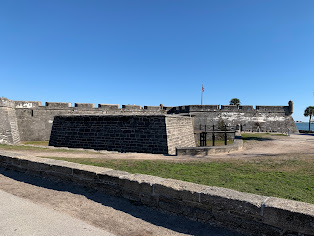
In 1686 pirate Robert Searle sailed his ship, the Cagway, to St. Augustine. In the fight 60 citizens were killed and Searle and his men raided storehouses, churches, and the homes of the residents. After this and looking at the history of attacks on the small settlement Spain began building the Castillo de San Marcos on the western shore of Mantanzas Bay to defend the city.
It was completed in 1695 and is the oldest masonry fort in the continental US. In 1702 James Moore, Governor of the Carolina Colony, moved to attack St. Augustine. After a 58 day siege and still no progress taking the fort Moore's forces set the city on fire and retreated.
In 1740 James Oglethorpe governor of Georgia again tried to take the city and fort but again they held on and the fort did not change hands.
At the end of the Seven Years' War Great Britain, France, and Spain signed the 1763 Treaty of Paris and in that Treaty Britain finally took control of Florida including St. Augustine. Control was short lived though and through the 1783 Treaty of Paris Spain regained control of Florida. Spain maintained control for 40 years before signing it over to the United States.
As more settlers came to the area skirmishes increased between them and the Native Seminole, Creek, and Miccosukee people. There were three Seminole Wars with the longest being the Second War between 1835 to 1842 during that time American settlers forced the Natives first to a four million acre reservation in Florida and then to Oklahoma. During the wars Seminole prisoners were held in the Castillo de San Marcos.
In 1861 the American Civil War began and Florida ceded to the Confederacy. In 1862 Union troops took control of the city and held it for the duration of the war.
Today it is also known as the Ancient City....
It has been raised, sacked, sieged, burned, and fought over by the Spanish, French, English, Pirates, and both the Confederate and Union armies. Its place as the oldest European city in the United States is evident in the architecture of its oldest buildings.
Pictured above is the original gate of the city built in 1739. Those gates withstood 150 years of raids, regime changes, siege, and a Civil War.
In 1883 St. Augustine would be changed forever when Henry Flagler came to visit the Ancient City. Henry Flagler, co-founder of the Standard Oil Company, came to the city in 1883 and spent the winter in the more temperate Florida sun. He liked the town and saw room for growth. In 1885 he formed the Florida East Coast Railway which he would continue to build upon for years: at first buying existing railroads and then beginning to lay his own track. He saw the east coast of Florida as an area ready for growth and a great escape for wealthy northerners looking for some place to visit and relax.
By 1887 he also completed work on two large luxury hotels the Hotel Ponce de Leon and the Hotel Alcazar. He used Spanish Renaissance Revival and Moorish revival architecture to keep the old world feel of the city. Soon tourism would become the primary industry of St. Augustine. Wealthy northerners would come for the winter and many others would stop in St. Augustine before continuing to other luxury resorts further south. The invention of the car and increased popularity of family road trips and brought families to St. Augustine for fun vacations.
Today St. Augustine is still a popular tourist destination. Walking through the original gate you enter into a series of buildings that have been reconstructed to their original look. They are filled with small boutique stores, restaurants, and a lot of ice cream shops!
The History of the Lighthouse:
When the Spanish had first settled at St. Augustine they built a watch tower or beacon at the end of Anastasia island that was documented by Baptista Boazio in 1589 when he drew a map of the area showing the raid of Sir Francis Drake.
In 1737 they upgraded the wooden structure to one made of coquina, a rock composed of fragments of shells from various shellfish. In 1780 the tower was noted in a Jacques-Nicolas Bellin engraving "A Plan of the harbour of St. Augustin."
In 1824 a new tower was built on Anastasia Island and in the early 1850s it was upgraded to a Fresnel Lens which improved the range of the light. However tragedy struck in 1858 when the Lighthouse keeper Joseph Andreu was on scaffolding to white wash the Lighthouse. The scaffolding gave way and the keeper fell to his death. He was buried in the Tolomato Cemtery, Catholic Cemetery, in St. Augustine.
His distraught wife, Maria Mestre de los Dolores Andreu took up the role of lighthouse keeper and became the first Hispanic-American woman to serve in the Coast Guard. In 1861 at the start of the American Civil War the prized lens was removed by Confederate sympathizers and hidden to avoid Union forces from taking control of it. The lens was not restored until 1867. Around this time Dr. Allan Ballard, who owned the property and the Lighthouse sold the property to the government partly out of fear that it was going to fall into the ocean and because the state told him if he did not agree to the price they would take the property.
As erosion continued to threaten the Lighthouse a new structure was started in 1871 and completed in 1874. During the building of the Lighthouse tragedy struck. Hezekiah H. Pittee was the superintendent of Lighthouse Construction and moved with his family to St. Augustine. In 1873 three of his children and a local friend were playing in a rail car that was used to bring supplies to the worksite. As the rail car approached the end of the track the brakes failed and the children were thrown in to the sea and pinned under the cart. Mary age 15 and Eliza age 13 as well as their friend were drowned before they could be rescued. Only four year old Carrie was rescued from the accident.
On October 5th 1874 William Russel, who served as light keeper at the old and new Lighthouse lit the new first order Fresnel lens. It could be seen between 19 and 24 nautical miles depending on the weather. The new tower was well timed as the old one fell in to the ocean in 1880. The ruins still exist underwater and is currently an archeological site.
In October 1875 William Harn after a career in the military where he lead troops in several major battles including Gettysburg became the light keeper until his death from tuberculosis in 1889.
In 1901 Peter Rasmusson took over as light house keeper and has the longest tenure of any keeper at 23 years. He and his wife Mary frequently had visitors to the Lighthouse from Flagler's hotels who would stop by to see the 165 foot structure. In a memo sent to the Light-house inspector in Charleston SC Rasmussen listed the increase in visitors over several years.
The tourists came from Flagler's hotels using the wooden bridge that was built across Matanzas Bay connecting St. Augustine to Anastasia Island and the Lighthouse. In 1904 it was renovated to allow for a trolley to run over the bridge further facilitating tourism. The Lighthouse did close to visitors from February 6, 1917 till after the end of WWI when Peter received orders in the name of national security. A few years later in 1924 Peter Rasmussen retired from his role of keeper and John Lundquist, who had served as an assistant keeper previously in 1893-1901, became the head keeper.
In 1936 Cardell D. Daniels was the keeper at the Lighthouse when on March 1st it was electrified. The Lighthouse keeper would no longer have to make the long trip up 219 steps to the top carrying buckets of oil or kerosene.
In 1981 the Lighthouse and Keepers' House were included on the National Historic Register and became protected buildings. In 1994 thanks to the hard work of the Junior Service League of St. Augustine, the Keepers' House and Lighthouse were opened to the public as a museum and for the first time ever visitors could climb to the top of the Lighthouse.
And finally as mentioned above, and what started this journey for us, in 2006 the tv show Ghost Hunters, about a team of paranormal investigators, filmed their highest rated episode at the Lighthouse. During the episode they captured on camera a shadowed figure peering over the rail in the Lighthouse.
The Paranormal History:
The whole area of St. Augustine has a deep history filled with turmoil and strife. Th'e historic city gate, Castillo de San Marcos, old Huguenot Cemetery, and the old Catholic Cemetery stand today as reminders of that past. Specifically there are several stories on the Lighthouse property. The first is the possible ghosts of Maria and Joseph Andreu. When Maria heard about her husbands death she ran to the top of the Lighthouse and cried. Then as the story goes she heard a voice tell her to 'take up the light' and she recognized that voice as her husband. Maria is rumored to have been seen on the grounds by visitors to the Lighthouse and numerous pictures have been taken of a woman in white with long dark hair at the top of the Lighthouse. Joseph is often thought to be one of the possible inhabitants seen as a shadow figure in the Lighthouse.
Another possible spirit is Dr. Allan Ballard, the previous owner before the state took control. It is said upon hearing the low price offered he replied: "I will never leave this property."
There are numerous stories of playful spirits and children's voices as well as wet footprints in the Keepers' House. These could be the spirits of the two young girls who drowned in the accident.
The smell of cigar smoke in the Keepers House is sometimes attributed to William Harn and other times Peter Rasmussen. Both men could also be the figure captured on film by the Ghost Hunters or it could be William Russel, the first keeper who is seen standing to the right in this photo.
Our Findings:
While we did not do a full investigation we did take lots of photos and I looked around with my Seek Thermal but did not see anything strange. We did take this awesome photo which shows the shadow of the Lighthouse cast on the overcast night sky, not paranormal but very cool looking.
And while we were at the top about to come down we both heard a male voice despite the fact that at the time there was only us and one employee who was female in the Lighthouse.
The Huguenot, Protestant Cemetery, and Tolomato, Catholic Cemetery contain graves of some of the earliest residents of St. Augustine including several of the Lighthouse Keepers. Both are only open one Saturday a month so we know we will be making at least two more trips to St. Augustine to see those locations. Each time we plan to explore the Lighthouse and the city more.
Looking at the map of the states I realized it wouldn't take much to add seeing all the Great Lakes in one year to our plans. Most of the lakes were going to happen naturally because of other destinations I had planned on but Lake Huron was proving difficult. So even though Meg and I had already been to Michigan I planned another trip to the 26th state to see the Lake and so my Mom could also cross it off her list.
I was planning on going on a road trip the weekend 7/10-7/12 because on 7/11 the convenience store chain 7-11 has given customers free slurpees; and I miss slurpees. There is no 7-11 near us. I know there are some in KY and I have seen a bunch in NC but I don't know of any in TN. So I searched for 7-11 in Michigan and found one in Canton. I now had two stops for the trip, and that is how road trips are born.
I made more painted rocks two were stop specific and two were in general Michigan.
Before we could get to Michigan we had to drive through our old friend Ohio and stopped for lunch in Findlay, Ohio (AKA Flag City.) The town nickname started in the 1960s when one resident, John Cooke, decided that on Flag Day 1968 every house and business would display an American Flag. With the help of the Sons of The American Revolution 14,000 flags were purchased and proudly flown at each house. Again in 1974 the Woman's Division of the Chamber of Commerce worked to ensure that the city would show its patriotism and filed papers with the Ohio Legislature to officially designate the town as Flag City. The town was really interesting and there were a number of buildings that grabbed my attention. At first I was going to walk around to look at the buildings but decided that we will return next year during Lent to visit the Catholic Church in town and explore further. For today though we stopped at Findlay Brewing. At first we built two flights but we were enjoying their beers so much we made a third to get a full sampling. Also the food was delicious. We had the pretzel appetizer and I ordered FBC Burger and Meg ordered the Glazed Donut BLT. She had seen similar choices in other places but never actually tried them.
I was super excited for our first stop, The Uni-royal tire. It's a giant tire on the side of the highway but it has a past. It was a ferris wheel built by the US Rubber Company for the 1964 World's Fair in NY. It was relocated to Allen Park, Michigan in 1966. The 'tire' is actually made of concrete, steel, and a fire proof resin. Estimates say the 12 ton structure had over 2 million passengers during the course of the fair.
As we were driving we kept hearing mention of "The Palace at Auburn Hills" which was being demolished on 7/11/2020. It was a multi purpose arena that housed several sports teams including the Detroit Pistons and the Detroit Shock. From 1988-2017 the arena housed multiple sporting events from basketball, hockey, soccer, as well as concerts. I looked up a picture of the building and it looked beautiful. So we figured we would drive over and see it before it was demolished. Well what I didn't realize was that they had been deconstructing the arena before the demolishing. So while I expected this...
We saw this...
We then got back on the road to drive to Fort Gratiot, Michigan, and the Fort Gratiot Lighthouse situated on Lake Huron. This is the oldest lighthouse in Michigan as it guides vessels from the Lake to the St. Clair River. The light house was built in 1829 and the light was automated in 1933. I love seeing the Great Lakes with their ocean-like waves and currents.
Next door to the Lighthouse is a Coast Guard Property and there was some information about the Coast Guard. I didn't know that the creation of the Coast Guard was actually the joining of two other organizations: The United States Life Saving Services USLSS and the Revenue Cutter Service.
Originally we were going to stay in a hotel near the lighthouse but most of the hotels that allowed dogs were full. There was one that did allow dogs but the hotel looked a little off and we opted not to stay there. I haven't been pre-booking hotel rooms for these trips because I don't really know exactly where we are going to stop. As you can tell we add stops at a whim so it makes it hard to judge. No problem we decided to drive towards our next location to find a hotel on the way. We ended up at a Comfort Inn and Suites in Ann Arbor. The staff there was so friendly and welcoming and the room was very comfortable and clean. It was late, we were exhausted and really needed the rest. The suite also allowed Gypsy to sleep in one room with Meg and myself while Domino and my Mom took the other room which was good because the two of them, like the fuzzy toddlers most dogs are, like to get on each other's nerves.
The next morning we slept in again and didn't leave the hotel until nine am. Meg found a spot to get coffee and breakfast- Zingerman's Coffee- which is just one in a series of businesses started by the very successful trio of Paul Saginow, Ari Weinzweig, and Ronald Maurer. I got a regular cup of their Columbian blend coffee and Meg had their mocha. For breakfast they didn't have donuts as we have had on the last few trips but they did have... I don't know if I should call it craft or artisanal but it was the best toast I have ever had.
Next door was their bakery where my Mom went and got a cook book, challah bread, and really delicious graham crackers. Across the street they had a building where they hold business management/training courses. I will assume that each business had their books as well. We purchased the Lapsed Anarchist's Guide to Being A Better Leader and I look forward to reading it. Clearly they have been very successful. Later we went by their deli but did not stop because the line and wait was too long.
Now the theme of the 1964 World's Fair was World Peace so it seemed fitting to visit our next stop on the same trip. In Ann Arbor at the absolutely beautiful campus of the University of Michigan John F. Kennedy first introduced the idea of a Peace Corp. It was during a campaign visit on October 14, 1960, when Kennedy stood in front of the Student Union and proposed the idea to cheering students. The idea carried through in his inaugural address when he stated: "Ask not what your country can do for you but what you can do for your country."
For something completely different a few blocks away in Ann Arbor proper we found an amusing wall mural. It is Gene Kelly in his famous dance number of 'Singing in the Rain.' But to add extra fun a light pole placed a few feet in front of it can be lined up perfectly to become a part of the mural.
And then the moment the day was named for: 7-11 Slurpee Day. Now it has been a recurring promotion that on 7/11 they give out free small slurpees. I planned on getting my free slurpee and probably buying a big slurpee for the road cause I love slurpees so much. Just one problem. The promotion changed. I guess I should have seen it coming. On one website we saw that instead of anyone able to get a free slurpee you had to have the app and were sent a coupon. However when we got there the clerk said there were no free slurpees. Apparently to keep crowds down there wasn't free slurpees. But even better any size slurpee was a dollar. So I got the largest one I could for a dollar which is still a win in my book.
Now at this point we were supposed to drive home.
That was it.
The road trip was over.
But it was still early and my Mom kept noticing the beautiful bridge on the Michigan license plate. Now the bridge was the Mackinac Bridge in the very north of Michigan... way too far to drive to at this point. But the name sounded familiar and we tried to think of if it was in a song. The song we were thinking of was America by Simon and Garfunkel which does not mention the bridge but it does mention Saginaw. We looked up Saginaw and it was only around two hours away. So we changed course for Saginaw.
On the way there we saw a large pick up truck completely covered in a tarp. It must be the new line from one of the big auto manufacturers but which one?
As we approached Saginaw we began searching for breweries to get something to eat. We did find a brewery, Loggers Brewing Company, in fact I am drinking the growler we brought home right now. As the name sounds the inside looked and felt very rustic. Out back they had a small seating area where we were able to sit with the dogs. Unfortunately they didn't serve food and the local places were busy because delivery would be almost an hour. So we enjoyed one flight and then left to see two sites in Saginaw before heading home for real this time.
Our first stop was the home of Theodore Roethke (1908-1963). He was born and grew up on the family farm in Saginaw. As we were driving to the brewery we had passed the home which had a large sign about the friends of Theodore Roethke and "Save the stone house." So we pulled in to the drive to check out the info. The white house where Theodore grew up has been preserved. However next door is his brother's home which is not preserved. So the sign to save the stone house was urging people to help donate and support preservation.
I looked up several of Roethke's poems but one that really stood out to me was My Papa's Waltz. Theodore lost his Father young and you feel his sense of loss in his poem. I lost my Dad when I was in my twenties so not nearly as young as he was but there are major life moments I can't help but think about how different they will be without him here. The biggest one for me is obviously when ever I finally find a guy, settle down, and get married. One barring some miracle from my past the guy I marry will have never meet my Dad, but two the thought of who will walk me down the aisle comes to my mind every so often. Anyway here is the poem and I highly recommend taking a look at his other writings as well:
My Papa's Waltz
The whiskey on your breath
Could make a small boy dizzy;
But I hung on like death;
Such waltzing was not easy.
We romped until the pans
Slid from the kitchen shelf;
My Mother's countenance
Could not unfrown itself.
The hand that held my wrist
Was battered on one knuckle;
At every step you missed
My right ear scraped a buckle.
You beat time on my head
With a palm caked hard by dirt,
Then waltzed me off to bed
Still clinging to your shirt.
We also saw signs for the Castle Museum so we drove over to take a look. We didn't have much planned since I hadn't looked up anything in Saginaw and we had the dogs so going inside places is impossible. The castle is a museum with multiple exhibits, some permanent and others rotating, that give insight into the history and people of Saginaw. The building itself was built in 1898 as a post office. William Martin Atkin was the chief architect and he used a chateau finish to tip his hat to the original French settlers and trappers who moved to Michigan. The building was earmarked to be destroyed in the 30s but several petitions saved it and in 1935 it was remodeled to make it larger and more capable of handling the mail for the growing city/area.
We started home but ended up stopping in Delphos, Ohio for the night. We got up early to try and see the comet C/2020 F3. It was supposed to be visible right before sun rise at the time. Meg set her camera up to try and capture it and while she got a few gorgeous sunrise photos we did not see the comet.
After packing up the car we took a ride to Dayton to get coffee at Ghostlight Coffee. Their food menu was severely limited because of either less business or trouble with shipping due to Covid. Either way I had a regular coffee with oat milk and an old world bagel with butter.
There was another coffee place called Boston Stoker Coffee which Meg found listed as best coffee in Dayton for 43 years. It was closed so we will have to return to Dayton to try that sometime because best coffee for 43 years means something for sure!
Now as I sit here finishing this blog up and drinking my Loggers Brewing beer Meg is watching Jelle's Marble Runs on youtube sponsored by Last Week Tonight Week With John Oliver and the winning team just had a donation made to a south east food bank in Michigan and I said: "hey we were just there." so if you haven't discovered the beauty of marble racing check out this video.
Our next trip will get us state number 15! The first big trip will be in less than a month and I am super nervous for it. Wish us luck, please.