Showing posts with label Painted rocks. Show all posts

Sunday, December 27, 2020

The Big Skies of Montana!

Looking at the map of the 30 states we had already visited one might ask why we didn't just dip north into Montana and North Dakota while we were so close and saved ourselves the return trip. A fair question. The reason is because the week long drive to Montana had been one of my original road trips planned long before Covid 19 and quarantines. My Uncle Michael served in the military when he was young and at one point was in Berlin. Every two years the Berlin Brigade hold reunions around the US and in Berlin. In 2018 the reunion had been in Berlin. In 2020 it was supposed to be in Billings, MT.  After a trip to NY my Uncle said he wasn't going to fly anymore so I began working on a driving route to MT with regularly planned stops at roadside attractions and points of interest I thought he would like. This way he could go to the reunion. Now because of Covid 19 the reunion was cancelled. However I still had the vacation request in at work and decided to keep the trip as it was.

So about two weeks after returning home from the Great West Trip we were back in the car again. This time heading north to Alton Illinois the location of the seventh Lincoln Douglas Debate. I knew that we were going to be spending the night in the car because we had left Nashville close to 7pm and the drive to Alton was a little over 5 hours. So as we were driving we were googling info about Alton and crime rates etc. One website described Alton as if it was a dangerous crime ridden area and the other website said it was one of the best places to live in Illinois so we gave up on googling and found a Walmart and we parked at the back where the truckers parked. We woke up to bright lights coming through the back window. I guess the driver of the truck we were next to must park his truck there and then take his pick up truck home for the night. He had returned planning to park next to the big truck and found us there. He started his truck and then moved his pick up away. We thought about trying to go back to sleep but no one was really that comfortable anyway and we were all wide awake so we went to a gas station and got some coffee and pastries for breakfast before finishing the drive to the statues of Lincoln and Douglas. 

There was a series of debates between Abraham Lincoln and Stephen Douglas in 1858 as they ran against each other for the Senate seat. The last took place in Alton on October 15th and attracted 6,000 people from several states to hear the two speak primarily about slavery. The debate was three hours long with the Stephen Douglas opening for 60 minutes, Abraham Lincoln speaking second for 90 minutes, and then the Douglas with a 30 minute rebuttal. Lincoln would end up losing the Senate seat to Douglas but the Debates helped bring him to National attention and helped with Lincoln's Presidential bid. 


I liked Alton I mean we didn't get to see much of it but it had a beautiful steam boat mural which made sense given its position along the Mississippi river. And we followed that river to our next stop in Portages de Sioux. Alton and Portage des Sioux like many towns along the river were sometimes under threat of flooding. In 1951 the Mississippi river was rising and citizens of the town prayed to Mary "Our Lady of the Rivers" to save their homes. The flood waters receded and in 1957 the townspeople erected the statue and placed it on a base overlooking the water. 


Our next stop was at Westminster College in Fulton, MO where on March 5th 1946 Winston Churchill gave his famous speech about the "Iron Curtain" falling across the continent. At the college is the Churchill Museum however due to Covid 19 restrictions the museum was closed. We were still able to go to Latshaw Plaza and see "Breakthrough" by Edwina Sandys, Winston Churchill's grand daughter. The sculpture which was dedicated by November 9th, 1990 by Ronald Reagan is 11 feet tall and 32 feet wide made up of a series of 8 slabs of the Berlin Wall.


The Berlin Wall separated East and West Germany for 28 years serving as a physical and Ideological barrier during the Cold War. On August 13, 1961 a fence of barbed wire was erected over night for 28 miles. After that the concrete panels were added to further secure the divide. After the reunification of Germany the wall was removed and pieces of it can be found around the world. 

Our next stop was a much lighter stop and Roadside attraction gold..... a giant ball of string. It is unclear if this is the largest and some dispute whether a ball of string or a ball of twine are the same thing. However this 3,000 lbs ball of string with a 19 foot diameter was featured in the 1974 Guinness Book of World Records and is the work of one man, Finley Stephens. Today it sits on the back patio of O'Malley's Irish Pub which was perfect for us because the restaurant is also the site of Weston Brewing Company, a wonderful combination of two of my favorite things- craft beer and roadside attractions. 


We continued on to Omaha Nebraska where technically I had a stop planned to see Union Pacific's largest Steam Engine "Big Boy" and Centennial #6900 the largest Diesel Engine however they are only accessible by theBotanical Gardens which were closed. They were visible from the highway so technically we saw them... just didn't get a good look because obviously eyes on the road was the primary focus. After securing a hotel room Meg and I went to Thunderhead Brewing Company to get a growler and then we stopped to get some food to bring back to the hotel room while my Mom stayed with the dogs. This was actually the start of a good tradition where instead of getting empty growlers we would get one filled every so often to drink in the hotel. We also had to get some cans of their Thunder Punch because while we were drinking a flight to pick our growler multiple people came in asking about it and ordering it. It was very grape which could be a bad thing but not this. This was awesome!


The next morning we turned north towards Sioux Falls, South Dakota to visit the Security National Bank which on March 6, 1934 was robbed by the notorious Dillinger Gang. The plaque at the door describes a wild scene with Dillinger and five others entering wearing hats and long coats to hide their faces and submachine guns. They ordered bank employees and customers to stand against the wall and fired their weapons to keep law enforcement away. After using five employees as shields the gang escaped with over $49,000.


On our way to our next stop, also in Sioux Falls, we stopped at a gas station for gas and sodas and my Mom saw a display of Busch beer with cans labelled Busch Latte. She came out and told us about the cans and Meg looked it up. At first we thought it was a coffee flavored beer like Pabst Blue Ribbon has... then we learned it was way better. Apparently in the Dakotas and Montana the morning drink of choice for hunters is Busch Lite. The company heard that it was jokingly called Busch Latte and made a Folger style commercial and labelled the beers to match for a good laugh check out the commercial. Also we picked up some of the Busch Latte cans to add to our growler/crowler collection. 

Our next stop was the USS South Dakota... well the outline of the USS South Dakota BB-57. Serving in WWII the battleship was in many major battles, including the Battle of Guadalcanal,  and was well decorated. Since moving the entire ship was not feasible there is a concrete outline of it with the original ship, bell, anchor, and propeller and some other pieces to provide a stunning memorial and museum. We walked around the 680 foot outline reading informational markers near the different features of the battleship.  As we walked around we saw a line of wood boards surrounded by brick. A sign above explained that they were some of the original boards from the battleship salvaged and sunk in to the ground at the memorial the sign encouraged visitors to imagine the courage and sorrow of the men who had once walked these boards. A door sits mounted in a concrete block salvaged from the ship it was a part of the conning tower and would have been 35 feet above the deck. It also included the story of how some of the pieces were transported to South Dakota, like the story of a collection taken at a Veteran's reunion that allowed for the installation of the 16 foot guns. It was definitely well worth the stop and walk around. There is a small museum which was closed I assume due to Covid restrictions but again with the dogs we weren't really looking to go inside anyway. 


We hopped on to I-90 and began driving west across South Dakota to our next stop. It was several years ago on CBS Sunday Morning when I learned of the Dignity Statue in South Dakota. 


Dignity of Earth and Sky was a gift from Norm and Eunabel McKie to the state of South Dakota in honor of the 125th anniversary of statehood. The McKie family has a deep connection to the state. In an interview Norm told how his Grandfather had come to South Dakota in a covered wagon in 1891,  two years after it had become a state, and his family had been there since then. Sculptor Dale C Lamphere, South Dakota's Artist Laurette, was an obvious choice to bring the project in to existence. Also involved in the creation of the statue was Albertson Engineering who designed the tripod base that would support the stainless steel statue weight and keep it secure in its place when winds pulled and pushed at the quilt atop a bluff looking at the Missouri River. Work began in 2015 and on September 17, 2016 the statue was dedicated. The plaque on the bottom has a quote from Dale Lamphere:

"Standing at a crossroads, Dignity echoes the interaction of earth, sky, and people. She brings to light the beauty and promise of the indigenous peoples and cultures that still thrive on this land. My intent is to have the sculpture stand as an enduring symbol of our shared belief that all here are sacred, and in a sacred place."

Having a connection to the Native populations was very important to Lamphere. He wanted to use the star quilt on the statue since it is an honored symbol in the Lakota tradition and he wanted to show that "that sense of honoring the native culture here in South Dakota is on the rise." There are over 128 blue and sapphire diamonds in the quilt to that interact with the sun and wind. 

The face of Dignity is made up of more than 100 pieces of stainless steel. Dale started with a composite sketch of three native women and then created a clay mold. From there he began working on the size and shape of the steel pieces that would be fashioned together to show her courage and determination.  Lamphere explained the expression would come from the eyes and mouth and he worked to create "a real life and presence in this figure." 


Seeing this statue was a long time coming. There had been other times where I had looked up the distance and time needed to travel to Chamberlain, SD but it was never the right time. So when I decided on traveling to all 48 contiguous states this year this was a must have stop. We saw her from the highway. I parked and began walking around the statue. She has an amazing gaze of pride and strength that never falters. Every angle of this sculpture is filled with the silent strength her name implies. I think the attention to detail in her face, hands, and quilt shows the dedication the artists and all involved had not only for the project but what they hoped to convey through it. She stands looking out toward eastern sky to me she is welcoming the day and what it may bring. Her quilt is her culture and tradition protecting and strengthening her. She is truly beautiful and her face expresses so much to the viewer. I stopped and just stood and looked at her for a long time enjoying the detail in her and her quilt. 

The rest area also has a display about Lewis and Clark and their journey of exploration. Some day when I have time to do it right I want to trace the Lewis and Clark trail as it is we kept crossing paths with it and finding different places they had explored but I think actually following the path would be well worth it. 

Our next stop on the trip down I-90 was the Minuteman Missile National Historic Site. The Minuteman Missile development began in the 1950s when research showed that a solid fueled rocket could be fueled and left for long periods of time unlike liquid fueled rockets which needed to be immediately fueled before launch. The name Minuteman was given as a reference to the colonial militia members who fought for independence in the early years of the United States, the Minuteman. The Missiles were seen as a way to assure the country was ready if there were any attack on American soil during the Cold War. Missiles could be loaded with fuel and left ready at various locations and military bases in the midwest. The museum, once a launch control facility contained info and lots of memorabilia about the national defense program.  

From there we took an unplanned detour to Badlands National Park a 242,656 acre park with some of the most amazing terrain I have ever seen. The name Badlands can be traced back to the Lakota people for any number of reasons like the rugged terrain, low water, and varied temperatures. While it may not be the ideal place to set up a home it is definitely an amazing place to visit and today is one of the best locations for archeology and recovering fossils. The Lakota found fossilized turtles and seashells which lead them to conclude the area was at some point under water. Currently the White River runs through the park. On March 4th 1929 President Calvin Coolidge authorized the creation of the Badlands National Monument and the completion of a 30 mile highway through the park, which is probably the same or an early version of the route we drove. 


By the way if you think my Mom has a slight look of concern on her face it is because there is nothing behind us, we were totally safe but I am surprised she came that close to the edge.

We took the drive through the park where we saw some amazing color variation in the rock caused by the different minerals and conditions the rocks were comprised of and exposed to. Also there is a large herd of Buffalo that graze throughout the park and absolutely adorable little prairie dogs all over the place. 

Once we left the Badlands we continued to Wall Drugs which when I asked people where should I stop in South Dakota Wall Drug was always on the list. In truth even if it hadn't originally been on the list it would have been added because we had been seeing signs along the highway for over a day counting down the miles to Wall Drug.  Wall Drug Store is series of gift shops, hotel, a wild west style building, 5 cent coffee,  fresh made donuts, craft and novelty stores, a chapel, one of the largest collections of Western oil paintings, a T-rex,  a giant Jackalope, and free water. The story of this roadside attraction that welcomes people from all over the world starts in 1931 when Ted and Dorothy Hustead opened up their drug store in the tiny town of Wall, SD population 231. Business started slow and seemed to be in trouble and then Dorothy had an idea... free water. Not only that but she had written a little jingle that they could place on highway signs to help advertise 

"Get a soda ... Get a root beer... Turn next corner.... just as near...To Highway 16 and 14.... Free ice water... Wall Drug."


I made a jackalope painted rock and left it near the big jackalope. This was one of my favorites and I was sad to leave it but hopefully it has a new home by now.


We left Wall and drove to Rapid City, SD to continue our tour through South Dakota so that we could walk around the town and see their "Presidential Walk." My Mom's neighbor had told her about the series of statues that are spread out around the downtown area. We parked in front of a small bookstore and began walking around trying to find the Presidents. We did not find all 43 statues but did find most.


As we walked along we also found this beautiful sculpture of an Lakota Indian that I later learned was also the work of Dale Lamphere, for more of his work and info click here. The sculptures name is Mitakuye Oyasin, a phrase that encompasses the interrelatedness of all life.


This was probably one of our longest days on any of the road trips. We pulled up to our final stop of the day the Alpine Inn in Hill City, SD at about 9pm. This restaurant was another recommendation that my Mom had gotten from a neighbor because of the delicious desserts. 

The building was originally known as the Harney Peak Hotel and was purchased by a German immigrant named Waldraut Matush in 1974. Over the next ten years several businesses operated there until in 1984 Wally opened the Alpine Inn.  The website talks about a welcoming spirit that Wally envisioned for the Inn and she certainly did it. From the moment we walked up to the steps we felt welcomed. I was a little concerned because we were arriving so close to closing time I thought this would be rushed dinner. It wasn't. We ordered the bacon wrapped filet minion with a baked potato, wedge salad and homemade ranch dressing, and Texas toast. Our waitress was great, I am sad I can't remember her name. She told us about her kids and hunting and all the meats she was in the process of preserving. Then came time for the desserts I ordered the Tiramisu, Meg ordered the Grasshopper Ice Cream Pie, and my Mom ordered the Berry Tart. First every single one was amazing and the reason we ordered three desserts was because from the descriptions we couldn't decide on one. Second they were huge servings and we really should have ordered one to split. 


So not thinking anything of it we asked for boxes to bring the dessert back to the hotel thinking that after the drive back to the hotel we might finish the desserts or they could become breakfast- don't judge its a road trip and there are no rules during road trips. Which leads us to one of those rare road trip moments you will only have if you can laugh at getting irrationally angry and spend a lot of hours in the car. This may not be as funny to those reading this who weren't there but trust me it was funny. Anyway I was driving and my Mom was in the front passenger seat holding the packed desserts. So we were on the road and it was dark so as I was driving I was watching for wildlife on the side of the road. Then all of a sudden out of nowhere what I could only describe as a tribble from Star Trek...


So naturally not wanting to run over the Tribble I swerved. Wellllllll...... when I swerved everything swerved including the desserts which had ice cream with them.... and the ice cream was melting. So we went from laughing and being confused as to what exactly the Tribble was (note I did not hit it the swerve was successful) to my Mom all of a sudden yelling to pull over and find napkins because the ice cream was now melting and spilling all over her. I started trying to find someplace to pull over with a trash can so we could throw out the ice cream and it took a bit but we found a building with a dumpster next to it. So my Mom gets out to throw out the bag and then we saw a large dog or wolf... it really looked like a wolf circling around the building. So while Meg tried to keep the dogs from barking I kept watching the wolf dog until my Mom got back in the car. 

Then we drove in silence for awhile.

And then we started laughing about the Tribble again, decided ice cream should never be brought home again, and began exaggerating the story and size of the wolf dog. 

Also in case you are wondering the Tribble was most likely a porcupine. 

The next morning we got up early even though we hadn't gotten to the hotel until midnight but we were excited to see one of the most iconic landmarks in the United States. 


Mount Rushmore located in the Black Hills of South Dakota features the faces of four American Presidents chosen to represent the birth, growth, development, and preservation of the United States.  Doane Robinson, a South Dakota historian came up with the idea of carving the faces of historic figures into the Black Hills to increase tourism. At first it wasn't Presidents that he was going to put but rather historical figures like Lewis and Clark. Gutzon Borglum  thought the monument should have wider appeal. My Mom will tell you in true Italian American fashion that an Italian made Mount Rushmore and she is correct Luigi Del Bianco was the chief sculptor/carver of the monument which began in 1927 and ended in 1941. In total over 400 sculptors worked on the project.


Before it was Mount Rushmore it was called the Six Grandfathers by the Lakota people and was a sacred place. In the Treaty of 1868 or Fort Laramie Treaty established an area for the Sioux that included the Black Hills. However the Treaty is short lived and when gold was discovered in the Black Hills the government forced the Sioux off the land and claimed ownership.  As much as I loved seeing Mount Rushmore and the faces of four of our Presidents representing the best of America I don't want to ignore the history of the monument. The fact is that land was promised to the Lakota because it was thought to be of no value by the government but then when they decided it was valuable they took it back. A short distance away in the Black Hills is another sculpture being built in honor of Lakota Leader Crazy Horse. The sculpture will have Crazy Horse on horseback charging out the side of the mountain. For more info about the Memorial including information about upcoming events, future plans, role in education, and how to donate click here. The Foundation is completely funded by visitors and donors and has taken no federal or state funding. The memorial is the largest mountain carving of its kind and has over one million visitors every year. The goal is to "protect and preserve the cultural, tradition and living heritage of the North American Indians."


After leaving Crazy Horse we began driving north to North Dakota. Now this is one pattern that we discovered throughout the west and mid-west there are a lot of really great highways going across the country from east to west but there was a serious lack of dedication to north and south. Most of our drive north was on small roads and at one point dirt road. 

It took a bit but eventually we reached the Enchanted Highway: a series of large scrap metal sculptures created by a single man Gary Greff who we also got to meet when we stopped in his store. Technically we drove the highway backwards which was a little sad because when he asked which was our favorite we couldn't answer yet. At that point the only one I knew of was the Geese in Flight which is the current World Record Holder for largest scrap metal sculpture. Mr. Greff first began work on the project in 1989 to help revive Regent and bring in tourism traffic. At each of the sculptures there is a parking lot, picnic area, and sign listing the names of donors and information about the sculpture. Meg donated to his next work of art so when it is finished we will definitely return.


We very much enjoyed the 30 mile drive up the Enchanted Highway. It was filled with beautiful sculptures taken from the prairie life and definitely worth the drive.

From North Dakota we traveled west to Montana and our first stop was the Battle of Little Bighorn which would have been one of the planned outings if my Uncle's Berlin Brigade reunion had not been cancelled. Back in our senior year of high school we had an amazing American History teacher who gave out awesome projects. One project was to write a fictional story. Meg and I wrote it together. I believe we called it Till The Day I Die..... And After. Anyway the main characters name might have been Zeke. he was a young man who had been in Custer's Army but had been sent away to try and get help from one of the other Generals. And so was not present at the battle... looking back right now we really skipped on the American History part. Zeke was traveling to see the wife and children of a man maybe Gavin (it has been a long time) he had been friends with to notify the family that he was dead and to tell them how much he meant to him having become a father figure to Zeke who had no family. Anyway the whole way there Zeke is just remembering stories Gavin had told him about basically being a better human being and being kind to others even those who are different from yourself. And the story continues from there... I know we have it printed out somewhere I saw it recently....


We also visited Pompey's Pillar where General William Clark carved his name and the date July 25th, 1806 on the 150 foot tall sandstone butte he named for Sacagawea's son. Clark's signature is the only physical evidence that remains from the famous expedition. Also inscribed on the rock are Native American Petroglyphs and the initials of other early travelers on their way west. The visitor center was closed due to Covid 19 but the staff was available for questions and they had moved some displays outside. Unfortunately the pillar was also closed due to structural repairs being made, so we could not walk up to see the actual signature. 


There is evidence of over 11,000 years of human life around the pillar probably due to its position along the Yellowstone River and the fact that at 150 feet tall the butte was visible and easy to be used as a way finding point. 

From there it was only 25 miles to Billings MT where our first stop was a shoe store, Al's Bootery. Yup it may seem like a long way to go to visit a shoe store but this one housed the show of the World's Tallest Man, Robert Wadlow. Robert was born in Alton, Illinois to Harold and Addie May Wadlow on Feb 22, 1918. At birth he was 20 inches long and weight 8.5 lbs. Due to an issue with his pituitary gland his body produced large amounts of human growth hormone which caused him to grow at an accelerated rate. At five when he started school he was already over five feet tall. By nine he was over six feet tall and 180 lbs.  Robert graduated from high school at 8 foot 3 inches and 380 lbs in 1935. In 1936 he went on tour with Ringling Brothers Circus and in 1938 he also went on a promotional tour for the International Shoe Company, who provided him with shoes. Robert's long term goal was to go to college and study law. Unfortunately he developed an infection in his leg from one of his leg braces. He passed away on July 15th 1940 at only 22 years of age. Robert was 8 foot 11 inches and is officially listed as The World's Tallest Man in the Guinness Book of World Records. There is a statue of him at the Alton Museum of History and Art. This shoe is a size 32. 


We left the Bootery and booked ourselves a hotel room in Billings then we returned down town to get something to eat and drink and look around. We stopped at Thirsty Street Brewing which did have an outdoor patio but dogs were also allowed inside so we sat inside. The brewery has two locations. We were at the Garage which is their main brewing location and also a music/comedy venue. We really liked the interior especially the light fixtures which were repurposed kegs. I want to say our bartender names was Matt- he was awesome. Great personality and knowledgeable about the place and Montana in general- he was super patient with our random questions about things we had seen from the highway. He also introduced us to the Montana Brewery Passport which had we known about that this trip could have been very different. Meg immediately wanted to get to as many breweries as possible and although we did reach a few we did not make a dent. So I guess we will have to come back some time :-)

I enjoy listening to a weekly Podcast called Drinking alone, with Friends! The podcast features three friends who grew up together in CT but have now spread out around the country. As a way to celebrate their friendship and love of beer/spirits they put together the podcast where from their homes they all get together discuss what they are drinking and whatever else may come up. If you are interested in craft beer, travel, alcohol, podcasts, friendship or almost anything.... I recommend their podcast. One of them moved out to Montana so I asked for a recommendation while we were in Billings. He gave a few suggestions and the one that fit best with our schedule was Uberbrew. Unfortunately they are not dog friendly so we knew we couldn't sit and hang out but I wanted to try their beer so I popped in real quick and explained I was on a series of road trips driving around to all 48 contiguous states and asked if I could only try one beer that they made which would they recommend. My plan was to get a growler and bring it back to the hotel. I like to start out with as little detail about my beer preference as possible so I can allow the bartender to make his/her own suggestion because there are different paths they can take. One way of answering that question is to offer their personal favorite beer which makes perfect sense they are suggesting a beer that the brand backs and supports or else it wouldn't be brewing it and they are giving me an insight into what they like, sharing a bit of themselves. A second route could be to offer me the most popular beer they have "Top Seller." Also a good path because it is obviously a tested favorite. Close to this but slightly different would be giving me the beer that they have entered into competitions and won the most awards with. I like these paths. The risk here being it could be a style I don't like. However I am open to tasting many different styles of beer and while I realize there are styles that are not my favorites I can also recognize a good beer in those style. That's just me on the beer app Untapped my ratings are pretty high because even when I have beers I don't like if I don't like it because it isn't my style I won't grade it down I try and judge it as that style. The last option is for the bartender to ask me some questions and aim a specific beer at my taste. Now I am not generally that helpful because I explain that I like most styles and enjoy trying different beers. The only hint I give is that while I am not a huge fan of IPAs I really like Double IPAs- something about the one two punch with the different bitters. Anyway they recommended a wheat beer called White Noise which they describe as 
"Steadfast among radical trends of craft brewing, White Noise is our staple wheat beer. A timeless classic, it's been around the block and back- and even won a few awards along the way."

So Uberbrew slogan is "superlative beer" and while I was only able to try one the slogan is true! All three of us enjoyed the beer.

The next morning we started out early and we were basically driving in a circle around Billings because the things I had looked up in Montana circled around Billings since I thought we would be there for a few days while my Uncle was at the reunion. 

Our first stop was in Lewiston, MT and it was a Veterans Memorial Park. Inside the Park was a Howitzer and Statue of Liberty replica. What I had come to the park to see was a LGM-30A Minuteman I.


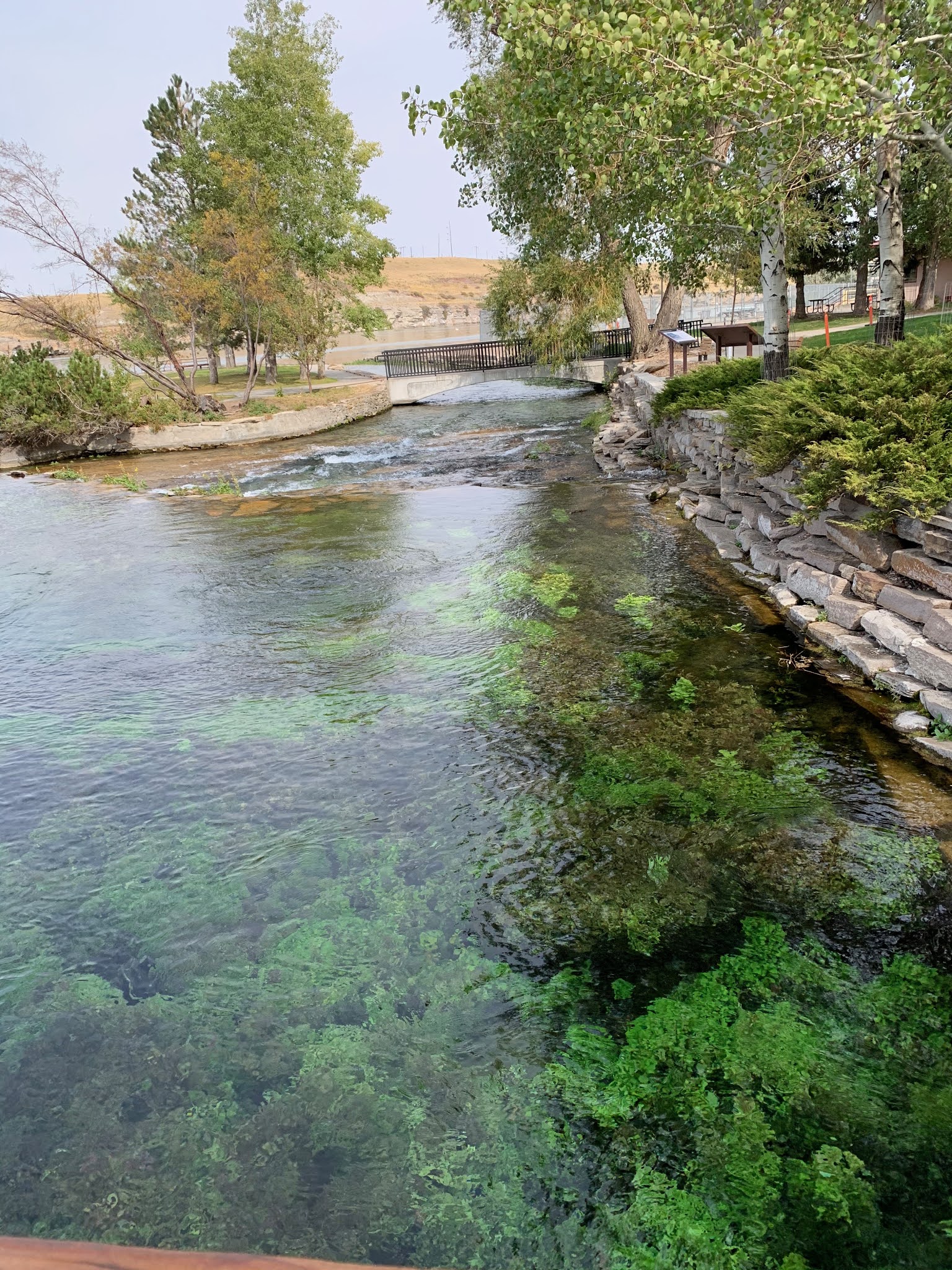
We left Lewiston and drove to Great Springs State Park to see one of the shortest rivers in the world flow into one of the longest rivers. There the Roe river runs 201 feet at it's longest and has been named by the Guinness Book of World Records as the shortest river in the world. It runs into the Missouri River which is 2,540 miles long. The river is part of a small park that includes a fish hatchery and was a real nice spot to hang out and relax for awhile. The water was beautiful and so clear, really very peaceful to sit and watch. I left a painted rock there of a silhouette of a fly fisherman standing in a river.


We stopped for lunch and while we were stopped we talked about the rest of the day. See I had some other planned stops like a giant boombox on the side of the highway but to reach each of the stops would make it a very long day. I proposed we return to Billings for the night and make it a regular day. We all liked Montana and agreed we would come back to visit, my Mom even wants to buy a summer home there- she wants no part in the winters that is for sure. I proposed we leave the stops for another time. So we got back in the car and began driving back to Billings. 

Unfortunately as we were on the road going back a deer ran out of some brush onto the small two lane road and right in to the front driver side of the car. Once the car was safely on the side of the road I walked back to get the pieces of the bumper that were in the road, I don't know where the deer went. A truck that had been behind us and saw the accident pulled over and asked my Mom and Meg if everyone was ok. We were and he continued on his way. As I got back to the car with the bumper in hand we were trying to call the non emergency police number because we weren't sure what we needed to do but we were also experiencing bad cell coverage when a sheriff pulled up behind us. Now if it weren't so serious I would have laughed because when he pulled up my Mom looked up at the sky raised her hands up then brought them back together locking her fingers together as if in prayer as if she were thanking God for the sheriffs existence. He also asked if we were all ok, which again thankfully we were. We told him what happened and got our ids, insurance, and registration and all that good stuff while he began filling out the report and taking pictures of the damage. Then he leaned over the car to take a better look. Being a hybrid there were all these wires and electrical components and a hub that looked very important but was loose. I got a bungee cord and strapped it in place so that it wouldn't move. He had me try and turn on the car and luckily it started. I put the pieces I had taken from the road on to the cargo carrier we had attached to the back of the car. He followed up for a little bit as we drove down the road before he turned around, I assume to look for the deer who had to have been badly injured or possibly already deceased. 

At a gas station I stopped just to check on the hub that I had bungeed and make sure it was ok. Things looked ok and we again started back to Billings. We were feeling a little better about things since the car was driving well. My Mom commented that we were lucky the sherif pulled up and Meg and I agreed. She said he was very nice, we agreed. And I said well he couldn't be mean after you thanked God for his existence. My Mom said what do you mean And I said aloud her reaction that I typed up above.  I am almost positive he went home and told his wife about the woman "who literally turned her eyes to God and thanked Him" when he pulled up.  And then we were all laughing. 

Luckily at this point in the trip we were going to be heading home anyway. But we were 1,900 miles away from home with a vehicle that could only be driven during the day. 


We thought about going straight home and cutting out any other stops. But they did not add more than 2 hours time total and were spaced out pretty well to where we would have needed to stop anyway. Still we left it a game time decision to see how the car was doing and honestly how we were feeling because as time went on we did start to feel some aches and pains from the collision. 

The next morning we came out to the car to discover that overnight a crack had started in the windshield.  I don't remember seeing a crack after hitting the deer but it must have started and then just grown with the temperature cooling off. We began driving home with our first stop in Kaycee, Wyoming. There we stopped to see "Good Ride Cowboy" a statue in honor of Chris LeDoux. It shows him riding Stormy Weather in the 1976 World Bareback Championship in Oklahoma City where he won the gold buckle in the final round. Chris LeDoux was born October 2, 1948. His father was in the airforce and they moved a lot when Chris was young. In his teenage years he began bareback riding and competing in rodeos. He won the Wyoming State Bareback Championship twice while still in high school. In 1970 he became a professional rodeo rider and began composing and recording songs to help make extra money and cover rodeo expenses. His songs were about his life and he recorded over 20 albums under his own record label, American Cowboy Songs and would sell them at rodeo events. In January of 1972 he married Peggy Rhodes and they raised five children together. In 1976 he won the bareback championship and in 1980 he retired from the rodeo. Chris and his family moved to Kaycee and he continued self recording albums and playing to audiences. Then in 1989 Garth Brooks released a song called "Much to young (to feel this damn old)." In the song he references a "worn out tape of Chris Ledoux". Well the song was a top ten hit for Garth Brooks and the first of many singles. I remember hearing Garth Brooks talk about seeing Chris LeDoux in concert and Garth was blown away by the style and energy of the show. Garth Brooks wanted to take that same style and energy into his career and he did. In an interview Garth Brooks said of Chris LeDoux "Chris was exactly what our heroes are supposed to be." Well from the first time she heard that song Meghan became a Chris LeDoux fan and she wasn't alone. She knew about his rodeo career and his music career. When we bought our first car, a 99 Ford Taurus with a cassette player in it, we went to a music store and found a Chris LeDoux tape. On March 9th, 2005 Chris LeDoux passed away from cancer. He was a championship rider, sculptor, and award winning musician. On top of all that and most important to Chris LeDoux he was a good man, husband, and father. I have seen him quoted in several places, including the plaque at the statue saying 

"What I want to be known for, on top of everything else, is that I was a good husband and family man." 


Everything I have ever seen from people who knew Chris LeDoux from personal friends, articles, business acquaintances, Garth Brooks, and his family that sums him up perfectly. People talk about his energy and positivity as well as hard work and dedication. There has been several times when we were down town at the Honky Tonks on Broadway and Meg will request her favorite Chris LeDoux song "This Cowboys Hat." but there is nothing better than hearing the song sung by Chris LeDoux and the passion in his voice.


I didn't stop anywhere to see actual dinosaur fossils, maybe another time when we don't have dogs with us we will get to see some of the many fossils discovered throughout the west and mid west. We did stop at Casper College to see the "Essence of Rex" statue. Half of the statue is the skeletal frame of a T-Rex and the other half is fleshed out. At night the statue is lit up from the inside to make the skeleton pop. We were there during the day and because of our travel restrictions we did not stay to see it at dark.


Our next stop was Douglas, Wyoming- the home of the Jackalope. There have been three attempts to name the Jackalope the state's "Official Mythical Creature" but they have not made it past the state senate. The Jackalope, or a rabbit with horns has been a mythical creature dating back to the 13th century. But the American variety is the creation of Douglas Herrick and his brother. They had been teaching themselves taxidermy and as a teen after a hunting trip for jackrabbits the brothers got an idea. They took a jackrabbit and added antelope horns and mounted it.  Jackalopes and stories of the creatures have spread throughout the west some of the stories say that the Jackalope favorite drink is whiskey and other stories talk about cowboys sitting at a campfire and hearing Jackalopes mimicking human voices.  Before we left town we stopped at the Depot restaurant for lunch in the historic Burlington RR Passenger Depot built in 1916. 
We stopped for the night in Cheyenne, Wyoming where we saw two statues saying hi to each other from across the highway.


The next morning we started out once the sun was up. The crack in the windshield was growing and our hood seemed secure, the clasp did not seem damaged but when trucks or large vehicles would drive past us it as definitely bouncing more than it used to. We tried to look up what we could do to stop the crack growing, one site suggested nail polish and another said super glue would help. We bought ratchet straps at a Walmart and strapped the hood down so that it was extra secure. I tried some clear nail polish on the crack and let it dry- it didn't work I was driving and saw the crack just shoot out another three or four inches into the windshield. 

By then we were in Nebraska we saw a couple of neat spots. At a pullover in Sidney Nebraska I saw a plaque that just ahead in I-80 there was a golden link embedded in the road signifying the completion of the highway linking east and west Nebraska. And Ehmen Park in Gothenburg, Nebraska where they had a monument and informational building for the Pony Express.

As we were driving the check tire pressure light came on. We stopped and the front tire had lost a lot of air. I couldn't see where air was leaking from but I assume the seal had somehow been broken. From then on at every stop we checked the air pressure.

We spent the night in Kansas City. We had driven through Kansas City on our way West and it took a bit but my Mom was trying to remember what song it was that was about Kansas City. Fittingly it was Kansas City by Wilbert Harrison which mentioned Standing "on the corner of 12th and Vine". I looked it up and there was a park at 12th and Vine so we started our morning by visiting the park. When the Harrison sang the song in 1959 12th street was at the center of a thriving community. Residents could find everything they needed there from grocery stores and convenience stores to theaters for music and movies. At some point a park was put in and some streets were reconfigured which changed the layout and took away the corner of 12th and Vine. Luckily for us the corner was restored in 2005 with "Goin' to Kansas City" Park. At the center of the park is the Grand Piano shaped Plaza. There was also a series of information plaques above piano keys and of course a sign marking the spot where 12th and Vine meet.


Then it was time to gas up and head out. At a gas station right before we jumped on the highway I had possibly my favorite interaction with anyone on these road trips. I was filling up and a young man, probably early 20s was walking back to his car at a pump near mine. He saw the magnet and asked "what is drivethe48?" I explained and then added 'I realize this wasn't the best time for it." Honestly I was feeling a bit down with the damage to the car and the stress of driving it home hoping nothing else went wrong. "Carpe Diem" he said. I didn't fully catch what he said so I said something like "what" or "huh". And he repeated "Carpe Diem- seize the day sometimes you gotta do what you gotta do." He was just what I needed at that moment. 

We only had two more stops and then we would be home. 

In Chesterfield Missouri we stopped at Faust Park to see the Butterfly statue and Carrousel. 


And our final stop was one I had been looking forward to for a long time. "Awakening" a giant seemingly coming out of the ground.


From there we finished the drive to my house outside nashville and spent the night. The next weekend we took Ice to a repair shop the insurance company recommended. The answer was what we expected. The car was considered a total loss. It was a great car with lots of adventures, beyond just these trips,  and it will be missed.


You were a good car Ice.


Writing this post has taken me for a long time and part of it was because while I was researching the history of the areas that we were in and the events that had happened I realized that I was very uncomfortable or hesitant about writing about Native American history. I didn't trust the sources to not just gloss over or exaggerate various details. So I am checking out some different sources so I can better understand history: too late for this post but not for me.
Monday, September 7, 2020

The Great West Trip Part 1

When I started planning the Great West trip I broke it into three sections to make the planning more manageable. The first part would be our northern route to Utah so that we could approach the Hoover Dam from 70 and 15 which I was told by numerous people was an amazingly beautiful drive. And then of course arriving at the Hoover Dam. Part 2 of the trip would have us drive through CA and to the coast before turning south and east through Idaho to return to Utah and Great Salt Lake. Part three was a crazy turn north to Minnesota and Wisconsin before turning south to return home.  

First the prep: this took a long time. I looked at each state that we were visiting and began researching to find out what we should see. Every state has so many different sites whether they be historic locations, beautiful scenes of nature, fun roadside attractions, or marvels of human ingenuity. The task was to keep us on an efficient route and see as much as possible. It was a lot of looking at state's webpages, roadsideamerica.com, and Atlas Obscura to name a few. It also involved being open to talking to others and getting suggestions from them on where to visit or what route to take. For example my original plan had us taking the first leg on I-40 and traveling straight west to the Hoover Dam. But when three separate people told me about the 70-15 route I decided the added hours and miles were worth the view. Then looking at the map I tried to figure out what could we reasonably travel in a day while accounting for stopping for gas, walking the dogs, and stopping to eat. I also looked up some hotels just to have an idea of where we could stop but I didn't make any reservations so that we weren't forced to get to certain points. This way if we did fall behind missing a hotel check in wouldn't be an added stress. I also picked some of the cities we would be traveling to in order to monitor weather. Not that it mattered much. If the weather was bad we were still going but at least I would know what to expect... and what we expected was a very dry drive and a huge swing in temperature with a high of over 100 and a low in the 50s.

For some fun prep I also painted rocks to leave at various stops some were for specific states and stops and others were just generic rocks. 


We left Thursday right after work to get a head start for the trip and took a ride through some repeat states: Kentucky, Illinois, and Missouri. As we drove through Illinois the roadways were lined with beautiful flowers and we took note. At a rest area I noticed a sign explaining about the "Corridors for Tomorrow" project. In an effort to replace some of the lost prairie and wildflower lands the Department of Transportation is planting the highway right of ways with natural prairie grasses and wildflowers. We drove till roughly 1 in the morning and then stopped at a rest area for the night. 

On Friday morning we started off early and drove for a couple of hours before stopping in Odessa, Missouri which was platted in the late 1870s and named after Odessa Ukraine.  There we stopped at Black Box Coffee for breakfast. I had to place the order online for pickup since they were closed inside due to Covid 19 restrictions. That was a shame because inside looked very welcoming with a high coffered ceiling and large arm chair with a bookcase in the very far corner. As I waited outside for the coffee a speaker played music from the light post and a sign out font of a different business read "Thankful Friday Thank you Odessa." I ordered the Lavender white chocolate which was very tasty. I really could taste the lavender and the white chocolate complemented it without making the drink too sweet. 

Once we got back on the road it wasn't long before we crossed in to our first new state of the trip: state #18 on the year Kansas. We also made our first unplanned stop in Topeka when we passed the Monroe School which was involved in the court case Brown Versus The Board of Education: the case that would eventually result in a unanimous decision by the Supreme Court in 1954 that school segregation was unconstitutional and break from the precedent of Plessy Versus Ferguson that resulted in a "separate but equal" theory. Oliver Brown was the main plaintiff but in reality the case involved 13 parents and 20 children. The case was first heard in the Topeka court system in 1951 when the Brown's daughter, Linda, was denied enrollment in the closer white school and instead was sent by bus to the Monroe school. While the case was denied in the regular courts the Supreme Court opted to hear the appeal (along with four other similar cases) and on May 17, 1954 ruled that: 
"We conclude that in the field of public education the doctrine of 'separate but equal' has no place. Separate educational facilities are inherently unequal. Therefore, we hold that the plaintiffs and others similarly situated for whom the actions have been brought are, by reason of the segregation complained of, deprived of the equal protection of the laws guaranteed by the Fourteenth Amendment."


The Monroe school now serves as a community center and in 1991 was added to the National Historic Landmark Registry as a site of national significance.

Next we detoured to Junction City, Kansas named so because of its location at the confluence of two rivers, the Smokey Hill and Republican Rivers, which join to form the Kansas River. There we found a memorial to the 9th and 10th calvary units stationed at Fort Riley, The Buffalo Soldiers. These soldiers served in multiple wars, protected and escorted wagon trains, safeguarded railroad crews, as peace keepers, and as park rangers from the end of the Civil War until the integration of the military in the 1950s. During that time over 20 soldiers were awarded the Medal of Honor for their service to the nation. 

Next we reached our first planned destination of Abilene, Kansas. Abilene began like many western towns as a stage coach stop. In 1867 the Kansas Pacific Railway came through Abilene. That same year a large hotel and stock yard was built in the area which made Abilene a center of the cattle trade. 
On September 5, 1867 the first stock cars filled with cows left for market in Chicago. It is estimated that between 1867 and 1871 almost a half million cows were herded to Abilene by cowboys and shipped off.  The history of this town made perfect sense for why we would find the world's largest spur there.


With two dogs most of our activities and planned stops were things I could count on being dog friendly, so outside. I didn't look at any museums as a result while the Eisenhower Presidential library is located in Abilene we didn't detour to see it. 

Less than an hour later we found ourselves in Salina, Kansas. The town got its start in 1858 and served as a stopping point for prospectors heading west to Pike's Peak and emigrants on their journey west.  In 1867 the town changed when the Kansas Pacific also added a stop there turning Salina into a cattle town which lasted for two years. The next major industry was wheat and flour. In 1889 Lee Denim Company opened up its original factory there. 

We were there to see a memorial in honor of Steve Fossett's non stop flight covering 22,936 miles in 67 hours. The flight began February 28, 2005 and ended on March 3, 2005 beginning and ending at Salina Regional Airport. Steve Fossett was a businessman and adventurer who set numerous travel and speed records in balloon, ship, and aircraft. Growing up he was a Boy Scout and his time as a scout set the tone for his life not only of adventure and leadership but as a focus on inspiring others. With the flight from Kansas he insisted on having local students aid his flight team. His numerous records and dedication to fostering an interest in flight is what earned him multiple awards including: Induction into the Aviation Hall of Fame, a Gold Medal from the FAI, Induction into the Balloon and Airship Hall of Fame, and in 2002 was named Yachtsman of the Year by the American Sailing Association. 

Sadly Steve Fossett was killed in September of 2007 when the plane he was piloting crashed after being effected by strong downdrafts. I left a painted rock at the base of the monument, it was a helicopter in honor of the work of Rex Maneval who built an early helicopter in 1939.


We stayed in Salina to get lunch at the Blue Skye Brewery and Eats. The brewery had a nice but small outdoor patio area. It worked for us as the dogs got a break out of the car with enough shade to keep cool. The inside of the restaurant/brewery was nice with the wood burning stove serving as an attention grabbing center piece. We built a flight of most of their beers and ordered their signature pizza: cream cheese, house made pork chili verde, tomatoes, black bean and corn mix, house blend cheese, and red pepper flakes.  The crust was made out of spent grains and they gave us honey to sip the crust in which was unique. I will admit I was skeptical at first but gave it a try and it was delicious. 


An hour drive later and we were in Wilson, Kansas the Czech capital of Kansas. The town was established in 1871 along the Kansas Pacific Railway Line which we were following as we drove across Kansas. In 1874 Francis Swehla became the area's first Czech settler and he worked to attract other Czechs to follow his lead. They did. In 2003 local artists with funding from the Czech Embassy built and decorated a giant Czech Egg or kraslice. In July the town of 800 hosts an after harvest party celebrating their Czech culture that attracts over 1000 visitors. 


Next was another unplanned stop in Victoria, Kansas when we passed a sign for the Cathedral of the Plains: The Basilica of St. Fidelis. The Church was first called Cathedral of the Pines by William Jennings Bryan, although it is not a Cathedral. It is however the fourth Catholic Church in Victoria, Kansas. The first church was built in 1876 connected to a house of one of the parishioners, the second Church built in 1877 was the Mother of Sorrows, in 1884 it was replaced by St. Fidelis Church which could sit 600, and in 1912 that was replaced by the Basilica which could seat over 1000 parishioners. In 1971 the Church was added to the National Historic Registry for its architecture. In 2008 the Kansas governor Kathleen Sebelius declared the building one of the 8 wonders of Kansas, a list I didn't know existed but will now have to visit the other seven. And in 2014 the church became the 78th American Basilica and first in Kansas. 


We continued crossing the Central Plains on I-70 which earlier this year celebrated its 50th anniversary of completion in Kansas until we reached Colorado.


It was almost 10 pm when we reached the Laquinta in Limon, CO where we planned to spend the night. Despite our extra stops we were on track. I left Meg and my Mom with the dogs at the hotel and drove a block away to Oscar's Bar and Grill to get us something to eat. It had been a really long day and we were all feeling pretty spent.

Day 2 started with us finishing the drive to Longmount, CO. While campaigning Theodore Roosevelt took to the rails on what was called the "Whistle Stop  Tour." On September 25, 1900 Roosevelt stopped at the rail yards in Longmount. 


This was the first sculpture in a series that we found that someone had placed a mask on to cover the mouth and noise. A bit of an amusing joke the first time but it started getting old. I slipped the mask off to get a picture of the art work before returning it for a fun picture with Gypsy Rover. I also left behind a painted rock with a train on it in honor of Teddy's love for trains and their early role in shaping the country.

We walked around the downtown area filled with shops and restaurants to La Vita Bella for some coffee and breakfast. There I had a bagel with their very own home made vegetable cream cheese. We also stopped to check out another shop Winchell's Donuts. Inside Winchell's they had a number of signs showcasing their love of donuts and a history of the company which started in 1948 in California as a walk up donut shop. The company expanded in California and then in 1961 ventured out to Colorado and Arizona. In 1964 the geniuses created the first apple fritter in donut history (so the sign says) and I thank them for it!
 
Next stop was a strange one to find in the middle of the Rockies because it was a building built to resemble a Coney Island Hot dog which as soon as I read about it I knew my Brooklyn born Mom needed to go there. Next door to it was a gift shop that had several different local artists products and the artist took turns manning the shop. We have a similar store like that in the Opryland Mall. It helps to get artists a shared store front and exposure to lots of travelers. 

We were on a small highway driving up and down the Rockies. They were stunningly beautiful. At one point in Lake George we pulled over at an overlook. There was a historical marker that I went to look at. It named the road as the Ralph Carr Memorial Highway. Carr was governor of Colorado from 1939-1943. After the attack on Pearl Harbor when Japanese Americans were being held in internment camps Governor Carr apparently was outspoken against the camps. The monument quoted him as saying:

"When it is suggested that American citizens be thrown into concentration camps, where they lose all their privileges of citizenship under the Constitution, then the principles of that great document are violated and lost."

The monument was dedicated in 2010  through donations from the Colorado Asian Pacific American Bar Foundation. It also quoted a Japanese American Lawyer who had fought for his Civil Liberties and the rights of others about Carr saying 

"one voice, a small voice but a strong voice, like the voice of a sandpiper over the roar of the surf."

We then drove through the small town of Fairplay Colorado where their old courthouse and jail still stand along the main street where they have story boards telling the history of the town. The town was founded in 1859 during the rush to Pike's Peak. The town's name was in reaction to the large amount of land given to early prospectors and a promise that it would be split up more fairly to newcomers. We also passed through Alma, CO the highest incorporated town sitting at 10,578 it owns the record of highest post office in any country. 

We continued into Breckenridge, Colorado where we saw some beautiful scenery and stopped at the Broken Compass Brewery. 


Broken Compass is a small brewery that doesn't mass produce which means if you don't get it locally you aren't trying it at all. Which is one of the coolest things about the way we travelled ate and drank our way across the country. We definitely got to experience as much as possible. This was also one of the locations where we got to interact with people. A couple, visiting from Iowa, sitting at a table near us started up a conversation about our puppy, Gypsy Rover, from there the conversation morphed and changed into a conversation about craft beer and road tripping. In a cool brewery exchange they told me about one of their favorite breweries in California so I told them about one of my favorite breweries in North Carolina and with any luck we will all be able to eventually visit those breweries!

Next we were on our way to Glenwood Springs however part of I-70 was closed due to the Grizzly Creek Fire that was burning near the highway. As a result we had a long detour onto highway 9 and 131. While it added almost three hours to the drive time it took us through some beautiful landscapes.


The pictures don't do justice to the differences in color of the rock and stone and the lines caused by weather and time on the mountains. As we drove the canyon was filled with a cloud of smoke from the fire. Meg had brought her camera to try and take some star trail photos but it didn't look likely with the haze caused by the fire. 

It was almost 10 pm when we rolled in to Glenwood Springs having been able to rejoin highway 70 a little further west and taken the road east to get back to Glenwood Springs. There we stopped by what was once the Glenwood Hotel where famed Gunslinger Doc Holliday died on November 8, 1887. I had a painted rock with a spade on it and the words "I'm your Huckleberry". I left it on the window sill of a Doc Holliday themed store. It was Val Kilmer's amazing performance in Tombstone that made me want to stop here. In my opinion that is one of the best movies ever made and Val Kilmer's performance steals every scene he is in.

The next morning as we drove further west on I-70 we reached the peach capital of Colorado, Palisade and some more breathtaking views. 


And then Colorado became Utah as we drove along the Colorado Plateau. We stopped at a welcome center in Moab, Utah to take in the view. There a man was cleaning and picking up trash. He told us about a hawk that he had seen and some tricks to spotting the antelope that roam the area. 

The Arches National Park was too much of a detour from our path so we know we will have to return some day. We just had to settle for the rock formations that we passed. 


Throughout the trip we relied on my Mom's freshman year Earth Science course for basically all of our geography questions. And I have to say her knowledge held up very well. 

As we drove we scanned the radio for country music stations to listen to the Top 40 countdown and we found The Eagle 101.5 and Fitz. During the countdown he told the story of Jack and Sheila who met on their way to college with some other friends. Before heading out towards the west coast one of them referenced the Jo Dee Messina song "Heads Carolina, Tails California." Years later at a party Sheila saw Jack at a party and referenced the song again. And they have been together ever since. It was a good story and because we were driving we got to hear it twice since miles later when we lost the first station we picked the count down up again just before that story. 

Now I had been told this was a beautiful drive and it was true. We approached the San Rafael Reef from the east and as we approached it was amazingly striking. It is 75 miles wide made of Navajo and Wingate sandstone featuring fins, canyons, and domes. It was in 1957 when the decision was made to extend I-70 through the reef. The canyon we drove through was originally so narrow that early workers could stand and touch both sides. Workers removed 3.5 million cubic yards of rock to create the 8 mile stretch we were about to drive through the reef. 


Once on the other side of the reef we stopped again to look back at the western side and Devil's Canyon where we got Domino, my Mom's dog to pose for a great photo. 


As we continued along I-70 we saw more and more rock formations and the fantastic site of the painted rocks in multiple shades of red, orange, gray, and some that were even taking on a green hue. 


The different colors are created by oxygen levels and mineral make up of the sandstone as the area changed and developed throughout time. At one of the pull offs I left behind a rock I had painted to look like a post card on it was a quote from the American poet Wallace Stevens:

"The most beautiful thing in the world is, of course, the world itself." -Wallace Stevens

It seemed a fitting spot. Also at the area was a memorial to Linda Louise Terry Barnes who had served as a custodian to the I-70 rest areas for over 25 years and had sadly passed away in 2010 from cancer. The plaque honoring her was a nice tribute to her with a picture and a brief description of her personality and dedication:

"Her work was more than just a job. The area, the constant change of scenery, and meeting many travelers along the way were part of her... Linda was a beautiful woman who had many hobbies, including rock hunting and fishing. She was dedicated to her family and always wore a smile."

The words on the memorial made me think back to the gentleman we had meet at the welcome center in Moab who was also quick to pick up a conversation and welcome us to the area while he worked to prepare it for the day's visitors. 

A bit down the road we stopped for gas and discovered some tanks painted to look like giant soda cans. Looking back at this picture it is kind of ironic because my Mom spent the better part of this entire two week trip asking for Coke only to have wait staff respond "Will Pepsi be ok?"


We also stopped for lunch at Mom's Cafe in Salina, Utah where we ordered salads and burgers to go and ate them at a road side table. Two hours later and finally heading south on I-15 we saw a sign for the Parowan Cafe which claimed to have the best cinnamon rolls in the west. The billboard did its job and we pulled over for dessert. I bought one cinnamon roll and we split it. It was very good with a thick cream cheese frosting and raisins. 

We were approaching the end of our time in Utah, though we would be returning later in the trip to see Great Salt Lake. As we were driving we had noticed that it looked like there were bee hives on the highway signs. Apparently the beehive is a state symbol connected to to the hard working reputation of bees. Some how I missed that on my early research or I probably would have attempted to draw a beehive on one of my rocks. 

Our next stop was a statue of wild horses in a traffic circle. I had seen a picture of part of the sculpture and was very much looking forward to seeing the full sculpture. This was one of those stops that I hadn't mentioned much about because I wanted my Mom to be surprised when she saw it, I knew she was going to love it.


A short drive later took us to another spot I had been anxious to see: Ancestral Puebloan or Navejo petroglyphs, rock carvings with tribal and cultural significance to the ancient culture who made them. They could be markings of religious or cultural importance or they could be indicating important events and travels. Unfortunately there was no informative plaque at the park which is really an open area in a subdivision to explain what tribe made the markings or the history of the rocks which I assume were moved here. 


Next we entered Nevada and Arizona to see the Hoover Dam. It was built between 1931 and 1936. Before being renamed for Herbert Hoover it was named the Boulder Dam. The Dam would help to control the Colorado River, prevent flooding, provide irrigation, and provide hydroelectric power. Unfortunately the dam was closed for visitors due to Covid 19 restrictions- I understand they want to prevent large crowds and gatherings but there is definitely a way that the dam could be safely viewed. We tried to drive the highway to view it from there but a large concrete barrier made the dam impossible to see. While I knew the visitor area would be closed I thought there must be a way to view it. I stopped the car in the shoulder and walked along to try and see over the barrier and kind of got an ok look at the marvel of engineering that is the Hoover Dam.


The reservoir of Lake Mead sits high above the dam and a beautiful sunset was well on its way above me. We left the dam to get dinner at Boulder Dam Brewing. I had looked the location up before leaving and already knew that it was dog friendly and the food looked really good. As we ate we listened to the Vegas Knights playing the Canucks. The Knights won that game 5-0 and went on to advance to the next round where they are facing the Dallas Stars.

We went to our hotel for the night and ended part one of the trip. We were a little behind because of the added stops and the fire detour. But there was extra time built in to the trip and we were definitely still on pace. It was Sunday night. We were further west then we had ever been before and had travelled through nine states in less than 80 hours.