Sunday, May 8, 2022

Part 1: Indiana State Sanatarium Haunting Beauty


In 2021 we began seeing reports that the Indiana State Sanatarium which had been closed in 2011 was opening to the public for paranormal investigations. Meg and I were excited at the opportunity to investigate a location which had only just recently been opened and so reached out to book a date in early 2022. 

The History of the Indiana State Sanatarium in Rockville Indiana.

Long before European settlers came to America the area now known as Rockville, Indiana was inhabited by the Piankeshaw Indian tribe a subgroup of the Miami Tribe. Once a thriving community by the 1800s their numbers were falling as hostilities between the Tribe and the new settlers as well as harsh winter followed by draught took its toll. In 1805 the Piankeshaw were forced to cede their properties in Indiana and move West to Missouri joining with other Native Tribes. 

In 1821 Parke County was formed with the Wabash River serving as its western boundary. Three years later Rockville was laid out and the following year it became the county seat. In July of 1854 the citizens voted to incorporate the town. 

Property records show that the land where the Indiana State Sanatarium would eventually be built was registered to Jonathan Garrison on March 12, 1831. It would then change hands multiple times. At some point there was a distillery on the property, the furnaces were found while building the administration building, however the name and owner of the distillery is unknown though it is believed to date to the 1830s. 

What is known is that in 1907 Parke County began looking for a property to build a sanatarium due to the rising number of tuberculosis cases. They had a list of demands for the property ranging from access to railroads, height above sea level, and landscaping. This helped narrow the choices down to a few properties. On October 9th, 1907 the committee tasked with finding a suitable property came to visit Rockville. For its part the town and residents of Rockville did everything they could to show why they should be selected. They saw the addition of the Sanatarium to their community as a great opportunity to sell their farm fresh goods like eggs, milk, and meat. The building of such a large building would also provide a boost to the economy as jobs both in construction and eventually healthcare would become available. Their efforts paid off and the local paper on May 6, 1908 declared that the Little Raccoon site, named for the river that ran through it, was selected by the Hospital Commission and Governor. 

Before construction could begin the property had to be purchased. The entire tract was divided between seven different land owners: Edgar Adams owned 130 acres, Gary Connelly owned 126 acres, John Adams owned 80 acres, Theodore Jessup owned 49 acres,  William and Charles Bullion owned 44 acres, Claude Kent owned 41 acres, and James Myers owned 39 acres. Either the Bullions never wanted the Sanatarium or they soured on it after the fact but their property was eventually marked condemned as they would not agree to the proposed sale price. Finally in 1909 the first cornerstone of the multi-building facility was set and construction continued over the next two years. 

On April 1st 1911 the Sanatarium opened as The Indiana State Tuberculosis Hospital and began receiving patients. At first the mortality rate was very high but within just a few years it lowered. For example in 1914 the annual report showed 53 deaths, in 1915 there were 24 deaths, in 1916 there were 30 deaths, and in 1917 there were 31 deaths. The staff worked to keep patients highly educated and involved about the disease and their treatment offering lectures 3 to 4 times a year about the disease, phases, symptoms, and treatments to help people understand and prepare for the duration of their stay. Some who recovered would help care for others. In fact the Sanatarium itself was self-sustaining with farmland, orchards, a hen house, and dairy to also help provide food for the residents.

In 1919 the name was changed to the Indiana State Sanatarium which would remain its name until 1968. 

The property consisted of the Administration Building which had doctor's offices, exam rooms, the surgery, and all records. On either side of the Administration Building connected by an enclosed passageway was a tuberculosis ward, one for men and one for women. The wards consisted of long open hallways to allow fresh air and sunlight, two of the main treatments for tuberculosis at the time, to fill the patients' rooms. Originally each ward was built to house 140 each however that number increased and eventually they also had a waiting list of over 400. 


Credit: Indiana State Historical Society

In 1913 the State Sanatarium Bridge was added over the Little Raccoon creek to help aid in travel to the hospital. The bridge is a Kingpost Truss Burr Arch structure spanning 154 feet designed by Joseph A. Britton. 


Unfortunately the tuberculosis wards no longer remain because they were removed and repurposed to build the nursing home. Only the tunnels below them used to access the steam pipes remain. Those steam pipes were heated by the coal burning power plant built on site to power the Sanatarium. As we drove around the area it was the smoke stack of the power plant that told us we were getting close, which makes me sad to know the stack is being removed due to structural issues.


As time passed more buildings were added including a children's ward and schoolhouse that at its height served 100 children. 

Indiana Historical Society

A five story building, Adams Hall, was also added in the 50s as staff housing and that building still remains having been repurposed over the years.

Around 1922 the Superintendent's Residence was added to the property. This two story structure had multiple entrances indicating that it may have been split between multiple families/staff. 


In the late 1800s and early 1900s many large facilities like the Indiana State Sanatarium opened throughout the country. Tuberculosis was a rising disease that had a lot of fear surrounding it because little was understood about it and treatment was very limited. For the majority of patients that came to Rockville the main prescription was clean air, sanitary conditions, and good food. However there were other treatments that today seem cruel. For example in 1914 they injected nitrogen between the chest wall and lungs in order to collapse the lung and allow it to "rest" and slow the spread of tuberculosis. In five of those they also removed the ribs to help collapse the lung. According to the Superintendent W.A. Geckler "[n]o patients are subject to [surgery] who have any possible chance of recovery without it. Surgery in diseases of the lung is and must remain a last resort." For the doctors and staff at the time I imagine the balance between  "do no harm" and also trying to save and preserve life weighed heavy on their minds. 

With the development of streptomycin to treat tuberculosis in 1943 by Selman Waksman, Elizabeth Bugie, and Albert Schatz large Sanatariums like the one at Rockville began to empty. The property was taken over by a conglomerate and renamed Lee Alan Bryant Healthcare Center. The five story building originally used to house staff became Adams Hall, a mental institution. On the first and second floor coed patients were housed, the third floor was reserved for woman, the fourth floor for men, and the fifth floor supposedly housed more dangerous patients. Between Adams Hall and the original Administration building a single story cross shaped 120 bed nursing home was added. 


Unfortunately as good as the Indiana State Sanatarium was at treating its patients Lee Alan Bryant was bad. There are allegations of abuse, suicides, escapes, and a murder suicide. There are reports of patients running away in the middle of the night and dying from exposure in the surrounding woods. There are stories of a woman who ran away and climbed to the top of the water tower. She was found frozen the next day. Some patients would be lost in the woods their remains found days or more later. Looking back now it looks like the whole situation was out of control for patients and staff. There are reports of attacks between patients and patients and staff. There was a murder suicide between two employees near the power plant with multiple stories about the dispute whether it was over a promotion, raise, drugs, or something else we are not sure. Throughout the building there are passive aggressive notes hanging on the walls warning staff and patients about acceptable and unacceptable behaviors. In 2012 after multiple complaints the state came to Lee Alan Bryant and shut it down. Patients were released or moved to other facilities. Staff were sent away. 

Today nature has worked hard at reclaiming the buildings. Vines grow through the windows and birds nest in the vents. Suitcases, personal belongings, pay slips, and hospital equipment remain. Drywall has fallen down and paint peels from the walls. 

Part 2 Coming Soon.

Tuesday, March 15, 2022

An Overdue Roadtrip

 It had been awhile since we hit the road and took a drive so it felt nice this weekend to get up at 4am and put the finishing touches on house chores and loading the car. 


The real reason for the trip was an overnight investigation at the Haunted Indiana State Sanatorium in Rockville, Indiana. I will have a blog about that later once we go through the 90 plus hours of audio recording, 40 plus hours of video recording, and over 900 photos. 

We left from Nashville on I-65 heading towards Louisville and made good time as traffic moved well through Tennessee and Kentucky. In Louisville we jumped off I-65 quick to drive through downtown and avoid the toll bridge because tolls are silly.

A few hours later of smooth sailing with the exception of Indianapolis and the highway being closed due to construction we made it to our first stop in Crawfordsville, Indiana. 


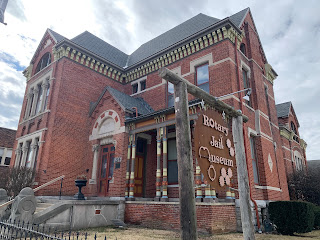
The rotary jail was a strange phase in jail building in the midwest where the cells actually rotate to the opening rather than having individual doors that open. The design came from architect William Brown and was built by an iron foundry company in Indianapolis, Indiana. Brown explained in the patent:

"The object of our inventions is to produce a jail in which prisoners can be controlled without the necessity of personal contact between them and the jailer or guard... it consists, first, of a circular cell structure of considerable size divided into several cells capable of being rotated, surrounded by a grating in close proximity thereto, which has only such number opening as is necessary for the convenient handling of prisoners."

The design was not a success and many of the jails were very quickly retrofitted with doors and the rotating mechanism was disabled. The exception to this was the rotating jail in Council Bluffs, Iowa which we stumbled across during a previous road trip. This rotating jail was the last to close in the 1960s. As of now only four are still standing though none are jails. Most have been turned into museums like this one in Indiana. In fact this is the only one where the rotary mechanism still functions.  

Our next location was a spot I had saved ever since our massive amount of road trips in 2020 (Drive the 48


The ball is the work of Mike Carmichael and his family. On January 1, 1977 Mike and his son put the first layer of paint on a baseball. His wife would also join in putting coats of paint on the baseball. They would paint it multiple times when it was small. Today it hangs from a suspension system in a specially built barn beside their house. Meg and I got to add layer 27,765. Mike had it primed and when we pulled up. We chose a nice light blue color and for a period of time we were World Record holders. As we painted the ball he told us about the history of the ball, the fact that this wasn't his first ball of paint, and how the barn was built for the over 8,000 pound ball.


If you would like to visit the Largest Ball of Paint check out Mike's website Largest Ball of Paint

Next was a mad dash down several dirt roads as we made our way to to Terre Haute, Indiana. That was where we were spending the night but also it was Ash Wednesday and I had found a Catholic Church there and the goal was to arrive in time for 6pm mass. 


After mass we checked into our Laquinta and then went looking for dinner. First we stopped at Terre Haute Brewing but they did not have food. So we purchased a flight to try several beers and pick a growler before going down the road to M Mogger's Restaurant. Both buildings are on the property of the original Terra Haute Brewing Company which opened in 1837 and around the turn of the century it became the seventh largest brewery in the USA and its flagship beer Champagne Velvet spread in popularity. The brewery compound covered several blocks and had multiple buildings including a wood shop where they would custom make bars for locations selling their Champagne Velvet. Despite Prohibition and a series of ownership changes the brewery has persevered. They no longer make Champagne Velvet and the current brewery is housed in just one of the original buildings. The taproom is welcoming and when we entered there was live music just finishing up their last set. The growler we chose was their Crossroads beer, a nod to Indiana calling itself the "Crossroad of America".

The next day we left the hotel a little earlier than originally intended and went to Highland Lawn Cemetery. We had used the website Find a Grave to look up notable people buried there and planned to spend some time exploring the cemetery that was opened in 1884 and placed on the National Registry in 1991.


The first stop we made in the cemetery was the mausoleum of M.A. and S.C Sheets. As the urban legend goes Martin Alonzo Sheets had a fear of being buried alive and so had a telephone installed in his mausoleum. He also was buried with a bottle of whiskey so that if he woke up he could call a taxi and have a drink while he waited. Of course there are stories of phantom phone rings and when Susan passed away in 1929 it is said that she was found at home clutching her telephone. 


Next we stopped at the tomb of Chauncy Rose. He was a businessman and philanthropist in Terre Haute. Through his success in business and especially in the railroad industry he was able to fund several projects like the Providence Hospital, the Rose Orphan Asylum, and the Rose Polytechnic Institute (Rose-Hulman Institute of Technology). 


The next grave we stopped at is the grave of Eva Mozes Kor, a Holocaust survivor and truly inspiring woman. Born in 1934 in Romania her and her twin sister Miriam were held at the Auschwitz Concentration Camp and subject to cruel torture and experimentation by Josef Mengele. In 1984 she founded CANDLES (Children of Auschwitz Nazi Deadly Lab Experiments Survivors). The goal of the organization is to educate others about the Holocaust and the power of forgiveness. A 2006 documentary "Forgiving Dr. Mengele" was made about her and her story focusing on her use of forgiveness as a path to self healing. In 2015 she traveled to Germany to testify at the trial of Oskar Groning where she thanked him for testifying to the events. Her story has been told through several documentaries like "Voices of Auschwitz" and "Incredible Survivors" and recorded  for the University of Southern California's new "Dimensions in Testimony Project." Just the fact that she survived these experiences is inspiring but her ability to survive and share that experience with others to help educate them is amazing and her ability to forgive those who tortured her is truly amazing. Despite her early life to me she has a connection to humanity that goes beyond most. 


The cemetery was well cared for which is why as we were driving when Meg saw several graves covered in moss it stood out. 


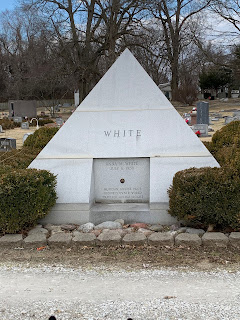
On the way out we noticed a pyramid and stopped to see whose tomb that was. It belongs to Anna White who is a musician, pilot, and archeologist and also very much still alive. 


After leaving the cemetery we stopped at the Vigo County Museum. The side wall was painted with a large mural showcasing the connection Terre Haute has to Coca Cola. Apparently the glass bottle made famous by Coca Cola was made in Terre Haute by the Root Glass Company.


From there it was time to prepare for an overnight Paranormal Investigation at the Indiana State Sanatorium in Rockville Indiana. I'll say here it was an amazing investigation with slamming doors and disembodied voices throughout the night. As we finish our review of over 90 hours of audio recording, 40 hours of video recording, and over 900 photos I will make another blog post with more about it. 

On the way home we had two more stops. The first was Upland Brewing because they now own the rights to Terre Haute Brewing's Champagne Velvet beer. We stopped in at their brewery for a delicious lunch and two flights of beer to taste 8 different beers. 

Then we stopped in Mitchell, Indiana the birthplace of Astronaut Gus Grissom. Grissom took part in the Mercury, Gemini, and Apollo programs. In 1961 he became the second American to fly into space twice. I read that Gus Grissom was nearly disqualified from the exclusive NASA program due to Hay Fever however after arguing that it would not be an issue due to the lack of ragweed pollen in space he was allowed to continue. He passed away January 27, 1967 during a pre-launch for Apollo One along with Ed White and Roger Chaffey due to a fire started by faulty wiring. There are several memorials to Grissom and we stopped at one that was a recreation of a rocket. Around the base was a description of Grissom's life and accomplishments including his early life in Indiana, military service, and participation in the early space programs. 


There is also a museum but with several hours left to drive and after being up most the night investigating we had to keep moving. 

We got home around 8pm and went straight to sleep because the next morning we had to get up early to help with a town clean up project. 

Saturday, February 19, 2022

A visit to the Ancient City

Ever since watching Ghost Hunters "Haunted Lighthouse" episode in 2006 we knew we wanted to visit the St. Augustine Lighthouse. Jay Hawes and Grant Wilson pioneered paranormal investigations on TV and brought it to the attention of a much broader audience. Many today would not be where they are if not for this show. 

In January we got to visit the St. Augustine and the Lighthouse for a quick trip. We knew we could not stay long and we wanted to use this chance to explore the eventful history of the city and Lighthouse that inspired many to join the paranormal field. 

The History of the Town:

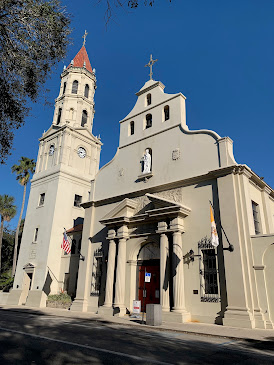
In 1565 the Spanish crown sent Pedro Menendez de Aviles to destroy the French held Fort Caroline on the St. Johns River in what is now Jacksonville, Florida. On the feast day of St. Augustine of Hippo (August 28th) his crew spotted land and on September 8th he claimed the land in the name of Philip II and named the city St. Augustine in honor of the Saint. 

In 1586 Sir Francis Drake, an English privateer and explorer, brought the Anglo-Saxon War to St. Augustine. At the sight of his fleet approaching Governor Pedro Menendez Marquez ordered the residents to evacuate. Drake's forces seized some artillery, robbed the garrison, and razed the town to the ground. 

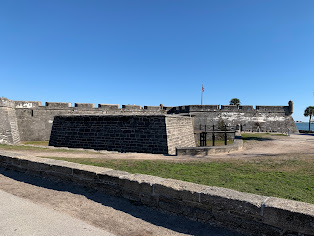
In 1686 pirate Robert Searle sailed his ship, the Cagway, to St. Augustine. In the fight 60 citizens were killed and Searle and his men raided storehouses, churches, and the homes of the residents. After this and looking at the history of attacks on the small settlement Spain began building the Castillo de San Marcos on the western shore of Mantanzas Bay to defend the city.


It was completed in 1695 and is the oldest masonry fort in the continental US. In 1702 James Moore, Governor of the Carolina Colony, moved to attack St. Augustine. After a 58 day siege and still no progress taking the fort Moore's forces set the city on fire and retreated.

In 1740 James Oglethorpe governor of Georgia again tried to take the city and fort but again they held on and the fort did not change hands.

At the end of the Seven Years' War Great Britain, France, and Spain signed the 1763 Treaty of Paris and in that Treaty Britain finally took control of Florida including St. Augustine. Control was short lived though and through the 1783 Treaty of Paris Spain regained control of Florida. Spain maintained control for 40 years before signing it over to the United States. 

As more settlers came to the area skirmishes increased between them and the Native Seminole, Creek, and Miccosukee people. There were three Seminole Wars with the longest being the Second War between 1835 to 1842 during that time American settlers forced the Natives first to a four million acre reservation in Florida and then to Oklahoma.  During the wars Seminole prisoners were held in the Castillo de San Marcos.

In 1861 the American Civil War began and Florida ceded to the Confederacy. In 1862 Union troops took control of the city and held it for the duration of the war. 

Today it is also known as the Ancient City....

It has been raised, sacked, sieged, burned, and fought over by the Spanish, French, English, Pirates, and both the Confederate and Union armies. Its place as the oldest European city in the United States is evident in the architecture of its oldest buildings.


Pictured above is the original gate of the city built in 1739. Those gates withstood 150 years of raids, regime changes, siege, and a Civil War. 

In 1883 St. Augustine would be changed forever when Henry Flagler came to visit the Ancient City. Henry Flagler, co-founder of the Standard Oil Company, came to the city in 1883 and spent the winter in the more temperate Florida sun. He liked the town and saw room for growth. In 1885 he formed the Florida East Coast Railway which he would continue to build upon for years: at first buying existing railroads and then beginning to lay his own track. He saw the east coast of Florida as an area ready for growth and a great escape for wealthy northerners looking for some place to visit and relax. 

By 1887 he also completed work on two large luxury hotels the Hotel Ponce de Leon and the Hotel Alcazar.  He used Spanish Renaissance Revival and Moorish revival architecture to keep the old world feel of the city. Soon tourism would become the primary industry of St. Augustine. Wealthy northerners would come for the winter and many others would stop in St. Augustine before continuing to other luxury resorts further south. The invention of the car and increased popularity of family road trips and brought families to St. Augustine for fun vacations. 

Today St. Augustine is still a popular tourist destination. Walking through the original gate you enter into a series of buildings that have been reconstructed to their original look. They are filled with small boutique stores, restaurants, and a lot of ice cream shops! 
The History of the Lighthouse:

When the Spanish had first settled at St. Augustine they built a watch tower or beacon at the end of Anastasia island that was documented by Baptista Boazio in 1589 when he drew a map of the area showing the raid of Sir Francis Drake. 


In 1737 they upgraded the wooden structure to one made of coquina, a rock composed of fragments of shells from various shellfish. In 1780 the tower was noted in a Jacques-Nicolas Bellin engraving  "A Plan of the harbour of St. Augustin." 

In 1824 a new tower was built on Anastasia Island and in the early 1850s it was upgraded to a Fresnel Lens which improved the range of the light. However tragedy struck in 1858 when the Lighthouse keeper Joseph Andreu was on scaffolding to white wash the Lighthouse. The scaffolding gave way and the keeper fell to his death. He was buried in the Tolomato Cemtery, Catholic Cemetery, in St. Augustine.


His distraught wife, Maria Mestre de los Dolores Andreu took up the role of lighthouse keeper and became the first Hispanic-American woman to serve in the Coast Guard. In 1861 at the start of the American Civil War the prized lens was removed by Confederate sympathizers and hidden to avoid Union forces from taking control of it. The lens was not restored until 1867. Around this time Dr. Allan Ballard, who owned the property and the Lighthouse sold the property to the government partly out of fear that it was going to fall into the ocean and because the state told him if he did not agree to the price they would take the property.

As erosion continued to threaten the Lighthouse a new structure was started in 1871 and completed in 1874. During the building of the Lighthouse tragedy struck. Hezekiah H. Pittee was the superintendent of Lighthouse Construction and moved with his family to St. Augustine. In 1873 three of his children and a local friend were playing in a rail car that was used to bring supplies to the worksite. As the rail car approached the end of the track the brakes failed and the children were thrown in to the sea and pinned under the cart. Mary age 15 and Eliza age 13 as well as their friend were drowned before they could be rescued. Only four year old Carrie was rescued from the accident.  

On October 5th 1874 William  Russel, who served as light keeper at the old and new Lighthouse lit the new first order Fresnel lens. It could be seen between 19 and 24 nautical miles depending on the weather. The new tower was well timed as the old one fell in to the ocean in 1880. The ruins still exist underwater and is currently an archeological site. 

In October 1875 William Harn after a career in the military where he lead troops in several major battles including Gettysburg became the light keeper until his death from tuberculosis in 1889. 

In 1901 Peter Rasmusson took over as light house keeper and has the longest tenure of any keeper at 23 years. He and his wife Mary frequently had visitors to the Lighthouse from Flagler's hotels who would stop by to see the 165 foot structure. In a memo sent to the Light-house inspector in Charleston SC Rasmussen listed the increase in visitors over several years.


The tourists came from Flagler's hotels using the wooden bridge that was built across Matanzas Bay connecting St. Augustine to Anastasia Island and the Lighthouse. In 1904 it was renovated to allow for a trolley to run over the bridge further facilitating tourism.  The Lighthouse did close to visitors from February 6, 1917 till after the end of WWI when Peter received orders in the name of national security. A few years later in 1924 Peter Rasmussen retired from his role of keeper and John Lundquist, who had served as an assistant keeper previously in 1893-1901, became the head keeper. 

In 1936 Cardell D. Daniels was the keeper at the Lighthouse when on March 1st it was electrified. The Lighthouse keeper would no longer have to make the long trip up 219 steps to the top carrying buckets of oil or kerosene. 

In 1981 the Lighthouse and Keepers' House were included on the National Historic Register and became protected buildings. In 1994 thanks to the hard work of the Junior Service League of St. Augustine, the Keepers' House and Lighthouse were opened to the public as a museum and for the first time ever visitors could climb to the top of the Lighthouse. 

And finally as mentioned above, and what started this journey for us, in 2006 the tv show Ghost Hunters, about a team of paranormal investigators, filmed their highest rated episode at the Lighthouse. During the episode they captured on camera a shadowed figure peering over the rail in the Lighthouse.

The Paranormal History:

The whole area of St. Augustine has a deep history filled with turmoil and strife. Th'e historic city gate, Castillo de San Marcos, old Huguenot Cemetery, and the old Catholic Cemetery stand today as reminders of that past. Specifically there are several stories on the Lighthouse property. The first is the possible ghosts of Maria and Joseph Andreu. When Maria heard about her husbands death she ran to the top of the Lighthouse and cried. Then as the story goes she heard a voice tell her to 'take up the light' and she recognized that voice as her husband. Maria is rumored to have been seen on the grounds by visitors to the Lighthouse and numerous pictures have been taken of a woman in white with long dark hair at the top of the Lighthouse. Joseph is often thought to be one of the possible inhabitants seen as a shadow figure in the Lighthouse. 

Another possible spirit is Dr. Allan Ballard, the previous owner before the state took control. It is said upon hearing the low price offered he replied: "I will never leave this property." 

There are numerous stories of playful spirits and children's voices as well as wet footprints in the Keepers' House. These could be the spirits of the two young girls who drowned in the accident.


The smell of cigar smoke in the Keepers House is sometimes attributed to William Harn and other times Peter Rasmussen. Both men could also be the figure captured on film by the Ghost Hunters or it could be William Russel, the first keeper who is seen standing to the right in this photo.


Our Findings:

While we did not do a full investigation we did take lots of photos and I looked around with my Seek Thermal but did not see anything strange. We did take this awesome photo which shows the shadow of the Lighthouse cast on the overcast night sky, not paranormal but very cool looking.


And while we were at the top about to come down we both heard a male voice despite the fact that at the time there was only us and one employee who was female in the Lighthouse.


The Huguenot, Protestant Cemetery, and Tolomato, Catholic Cemetery contain graves of some of the earliest residents of St. Augustine including several of the Lighthouse Keepers. Both are only open one Saturday a month so we know we will be making at least two more trips to St. Augustine to see those locations. Each time we plan to explore the Lighthouse and the city more.


Sunday, January 30, 2022

Travelers: Lotz House Overnight Investigation


Johann Albert Lotz was born in 1820 in Germany where he worked as a master craftsman woodworker. In 1848 Johann moved to the United States, first stopping in New Orleans where he met his wife Margaretha. Shortly after that they moved to Franklin TN and bought a small plat of land from Fountain Branch Carter. There Johann built his showcase home. The house is two stories and features four large columns in the front reflecting the Greek revival style. Inside he built three fireplaces of varying degrees of woodworking to show his skill. He also built a magnificent walnut railing on the staircase with the first post being a piano leg. On the top he carved his name and the year. Everything from the cabinetry and furniture in the home could be used to show potential clients his range of skill.


 Johann and Margaretha had five children of their own Paul, Augustus, Matilda, Julius, and Julian. Also living in the home were Margaretha's two children from a previous marriage, Joseph and Amelia. It's a beautiful home and location sadly the family would not be able to enjoy it properly. Years later on April 12th, 1861 the American Civil War began and the Lotz house would be at the center of one of the bloodiest battles.

Before the battle Julius and Julian passed away from either sickness, drowning, or possibly poison by playing in a creek that had been contaminated. Sources are unsure but I believe they were 3 or 4 years old.

The Union army under the command of Major General John Schofield arrived in Franklin around 4:30am on November 30th. They began setting up their position with their backs to the Harpeth River while repairs were done to the bridges that would allow them to cross and continue north to Nashville. They had been moving all night as they tried to reach Nashville before Confederate General John Bell Hood could cut them off from the 30,000 reinforcements that  Major General George Thomas had waiting in Nashville. Due to over confidence and a failure of command or orders being followed (it is unclear) the Union army was able to pass by Confederate troops at Columbia and Spring Hill. This set up the two sides for a meeting 12 miles further at Franklin.


On the morning of the battle the family woke to discover thousands of Union troops. The river however was impassible at the time because of recent rain fall and they could not cross until repairs were done to bridges. With no choice the soldiers began fortifying their position and preparing for battle with over 20,000 Confederate troops. The Carter family, hurriedly sent a message for the Lotz family to come to their home and shelter in the cellar.


Almost 12 hours after the Union troops had arrived in Franklin Hood and his army also arrived in Franklin. Some say Hood was angry at his commanders and troops for allowing the Union to pass in the night and so ordered his men to battle immediately. Others say it was not anger but determination to prevent the joining of two large union forces from meeting in Nashville. Either way this would start one of the bloodiest battles of the Civil War sometimes referred to as the Gettysburg of the West.

At some point the Confederates broke through the Union line and brutal hand to hand combat began around the Lotz and Carter Houses and gardens. The Union troops were able to hold their defenses and by 11pm both sides were exhausted. Hood and his men pulled back to regroup and rest. Schofield and the Union took this chance to continue their march to Nashville. Technically that left Franklin in Confederate control but it was not a victory. The Confederate side had 6,252 casualties with 1,750 killed. Among them were six of Hood's Generals one of which was Patrick Cleburne who was arguably one of the best division commander's on either side and today has a small park just a block from the Lotz House named for him.

This was the most exciting investigation we have had so far. We left knowing we had good communication and probably one of the best S-Box interactions we will ever have. But beyond the evidence we collected one thing that stands out in our mind is how much the staff and especially Thomas Cartwright love and care for the spirits. It was evident in every interaction Thomas had whether it was the others using dowsing rods trying to communicate with Eula Lee Carothers or with Mark using his GeoPort.

While we waited for the whole group to arrive Meg and I split up and began taking photos inside the home. Meg went upstairs and was taking a series of photos in the "red room". In her fourth photo a figure can be seen in the back of the mirror. In the following video I go through the photos and then attach the real time audio recording. 


Later in the night one of the Lotz House employees told us that there are numerous reports of seeing soldiers in that mirror.


After Thomas gave a history and tour of the home we began investigating. I left stationary cameras in the downstairs gift shop, the stairwell, and the upstairs "red room." With those areas covered we went upstairs to the "children's bedroom." There we used our EMF detector to try and communicate with any spirits present.


Every investigation before this we would leave and be like "nothing much happened but we will listen to the recorders and see what we got." Not this one! We had three of the best S-Box interactions we have ever seen! Really I can't see how they can get much better. To explain what we were doing our S-Box or Spirit Box sweeps very quickly through radio stations so that words of sentences heard are across multiple stations. Meg was listening to the S-Box with noise cancelling headphones so that she could not hear my questions. At one point in this first session I thought we were communicating with several Civil War soldiers. I asked what other battles they had been in and after a few moments Meg listed three cities that also had battles. I asked what state they were from and a few moments later she said a state. She couldn't hear me and I was floored by how accurate the responses were. It took every bit of constraint to not stop and tell her how awesome this was going. I uploaded the whole S-Box session on youtube as well as a short version where I took out the long pauses between questions because I realize some people don't have 20+ minutes.

Full version:


Short version:


After investigating in a few other rooms we returned to the bedroom where we had such a great S-Box session and tried again. This also did not disappoint. This session was again quite long so I have condensed it in this video. One of the high points of this one was when I asked the soldier if they were here as a hospital. They responded with the word "ether" and then when I asked about their injury they answered "foot" and "they took it". Meg also had the word "sick." Also she heard the phrase "General Hood Killed us." Now before the battle the Union troops moved through the night past where the Confederate army was and were spotted by scouts. According to some accounts Hood says he gave a command to attack but others said no command was given. As I said above overall the battle was a loss and the army of the TN never fully recovered. We also got responses asking for a priest which may have been from a soldier named Willard Tolliver who the staff has identified even researching to find what unit he may have served in.

S-Box Session 2: 


Speaking of Hood we also heard a response on the GeoPort that a different group had brought that was possibly about General Hood:


We had a third S-Box session but this time it was at the end of the night and most everyone else had stopped investigating so we played the S-Box out loud since it would not interfere with other investigations and we had several other people in the room with us investigating. 


We also made contact with past residents of the house. We were upstairs trying to reach out to Johann Lotz and we received an answer from the Geoport:


And finally in this compilation we possibly made contact with Thomas Carothers.


Since we were making contact with soldiers Meghan decided to read an A.E. Housman poem about soldiers.


Overall this was an amazing experience that has us excited to return. When talking about the paranormal I often say I know I will never have any evidence that will convince a skeptic but this maybe the closest I can possibly come with the photo and S-Box sessions. 

Another reason we love the home though was, again, the staff. Everyone we met not only loved the location but they respect and care so much for the spirits that still reside there. I think that helps foster communication. 


Tuesday, January 11, 2022

Be Kind... Just be kind

 Meet George!


After Thanksgiving passed I started putting up decorations for Christmas including our 6 foot tall snowman that Meg had named George last year when we bought him. It was a Friday and by the time it got dark I had a few decorations up but I had started late so wasn't finished. Nevertheless I plugged them in and let them light up the night. This picture is from last year but it is pretty true to where George was located again. He was at the end of the rocks just 10 feet or so from my front porch. The plan was to collect snowmen slowly and put them on the right side of the house.

It was a warm night so I had the door that leads to the second floor porch open because Tennessee weather is ever changing and I wanted to enjoy the unseasonable temperature as much as possible. At around 2am I woke to a loud banging noise like something being thrown into the bed of a truck. I jumped up and looked out the door before putting on my glasses. Parked in front of my neighbor's house was a pickup truck and I couldn't see what was in it but the bed looked very full. I moved away from the door and grabbed my phone to call the police as I went downstairs to my garage door. While on the phone with the dispatcher I gave my info and what I could about the truck including that the bed looked full and I heard banging like things being thrown in it. I also said I would be home and willing to speak with an officer. Looking out my garage door I could see the truck was gone so I went outside. I walked toward the street in front of my house and then turned back to look at my house and that was when I realized that George was gone. What I had seen in the back of the truck was most likely our tinseled snowman. I immediately posted on the neighborhood Facebook page and NextDoor.


Then I sat on my front steps waiting for an officer to come. I would learn the next day that at least two other neighbors had decorations stolen. I waited for almost an hour before finally going back to bed. A little while later a sheriff drove around the neighborhood but did not call me or stop by the house. Saturday morning I called our non-emergency number and reported the actual theft of the snowman. Sadly he was never found. 

But for about a week (well and even now but in a different way) the theft of George became a focus. At the time I drove up and down highway 24 after people said they saw the snowman on the side of the highway. I was hoping he had blown out of the truck and maybe I would find him tucked into the tree line or something. I posted on a few neighborhood Facebook pages and responded to people on NextDoor. I was very much obsessed and for good reason. First George was expensive. He was a solid 8 hours of work to earn the money to buy a 6 foot tall tinsel snowman. I had to work an entire day to buy what someone stole in under five minutes. Second whoever stole him came right up to my house to grab him. They were within 10 feet of my house and 20 feet of my door. And three Meg, who was still upstairs overheard them yell/laughing "they are going to have a Merry Christmas" so they were callous. I talked to anybody who would listen about this theft. I was upset.

Was it worth getting so upset over... maybe not. It was, after all, just a decoration and neither I nor Meg were hurt. I started thinking myself down questioning why I was so upset. I imagined that people reading the posts and responses would think it is silly (#firstworldproblems). It was just a decoration. And that some reading it, maybe some reading this would think "I wish my biggest problem was a stolen Christmas decoration." But here is the thing I realized. It wasn't. But that didn't make it not important. And it wasn't my biggest problem, not even close, but it felt like the most unnecessary and it also felt like one I could solve. Because I couldn't solve my biggest problems. There was nothing I could do for those. I can do my best to mitigate my biggest problems and not let them control my life but I can't solve them. But this one I felt like I could and I should be able to solve it. I felt like I could do something about it. Like drive up and down the highway looking for George. 

And then I thought of this meme which has become one of my favorite and a go to for understanding different mindsets and events. 


I saw this on Facebook and unfortunately I don't remember where to properly credit it. 

I think my reason for posting this and writing this is just to say "be kind" you don't know what someone else is going through. What may seem insignificant could mean the world to a different person. 

Saturday, January 8, 2022

A walk through Waverly Hills Sanatorium


When we first decided to give paranormal investigations a try one of the first locations we went to was Waverly Hills Sanatorium. We hoped our second visit would be a private investigation that would allow us to investigate the building alone. However we decided to return for another public investigation to become more familiar with the layout and make a plan for our future private investigation. The first two hours of the night was a detailed tour. The whole group was split in half and we were in the group that started at the morgue. Our tour was given by Jason and Josh. As we walked around the building they shared stories of paranormal accounts, history, and their own experiments and experiences. It was a great tour that gave us a lot of information about the building and those who still reside there. Jason seemed to care deeply for the residents which showed through the stories he told. Josh offered his help to the group and shared his current experiments and different plans that he had to investigate the building.  He invited anyone to take part in his experiments.

We had some specific plans and as soon as the tour ended we got to work. We walked along the first floor to the morgue where Meg slid on to one of the storage tables. 


As I was setting up the stationary camera another group had wandered to the morgue. One jokingly said "Are you going to lock us in" to the tour guide and while he answered we hear another voice say "Yes"


Once Meg was settled I left to walk down the entire length of the body chute. Let me tell you that is a walk I think I only need to make once. The passage way has steps on one side and a ramp on the other. Staff could walk back and forth on the steps and use the ramp to move a cart back and forth with supplies or deceased patients. Walking down the chute was fine except for one moment when I stepped into a giant spider web. Coming back up the chute is no joke. I tried to walk on the ramp for a bit because I thought it would be better then tackling the steps again in total darkness. The ramp was slippery and as I walked it felt like I was being pushed backwards and towards the wall. And that wasn't anything paranormal it was just the slant and grade of the ramp. Overall the walk was uneventful except for when I walked right in to the before mentioned giant spider web.


Another area we planned to visit was the fifth floor. Half that floor served as the children's ward with a playground on the roof. The first time we visited Meghan had read a children's story and we planned on reading another story by the same author. Meg settled down with  our light up catballs that we first used at the Lotz house in front of her.


At one point while Meg was reading a small light appeared next to her knee and then faded away which I will have at the end of the blog in a compilation video. 

I started taking a video of her reading but then moved on to explore the rest of the floor. The fifth floor is one of the most visited floors because of room 502. There are many different theories about what happened outside that room and on that floor. In 1933 a nurse was found hanging from a light fixture and many questions still continue today. When we were first here we had an EVP, Electronic Voice Phenomena, that said "hanged". This time looking back at my photos taken with my IR camera I believe I have a figure looking back through the window into the area. I had taken two photos in a row.

Photo 1:


Photo 2:


Close up:


The night was a clear night so Meg left her camera taking a picture of the stars while she read the story.


The rest of the night was going to be simple. We would walk each floor twice first by walking up the solarium and then back through the dark center hall. It was on the fourth floor that Jason's tour really had its biggest impact on me. We were all stopped at the stairwell looking down the hall and you could see the shadows moving back and forth across the hall. Now the shadows in Waverly are very active and there are good reasons why people so often report seeing shadow figures... they do interact with you. Jason told a story about how after Waverly had closed a geriatric hospital had been opened up and there was terrible abuse and neglect. During a visit in 1981 a fire marshal mistakenly exited the elevator on the fourth floor, the building was only cleared for occupancy up to the third floor. There the marshal found "the forgotten ones" as Jason called them. As we watched their shadows move back and forth Jason told us he promised to tell that story to every tour and that they would not be forgotten again. As we listened back to our recorders we think we have an EVP from that hall.


A few minutes later we had another EVP that sounded different on both recorders. In this video I play one recorder, then the other, and finally both at the same time with the audio over each other.


With each investigation I feel like we really get to delve in to different theories about hauntings and the history of locations. With this investigation the idea of Egregores kept coming to mind. It was fresh on our mind because shortly before we went Meg had been reading a magazine article with Adam Berry and Amy Bruni commenting on the subject. The theory of the Egreore is that by continually telling the same story it can actually be brought into existence. For example one of the most popular "ghosts" of Waverly is a young boy named Timmy who is said to play with the many balls that can be found throughout the building. While there may very well have been a boy named Timmy at some point there were hundreds of children that lived at Waverly at one point or another. Is the ghost child really named Timmy, maybe? Or is Timmy a creation of the story telling. 

There were several moments were we tried to empathize with the patients and medical professionals who lived and worked at Waverly. One way was acknowledging that we have names like Timmy or Lois Higgs who people will go and ask for them but that there are many others who we don't know the names of that lived and died at Waverly.  


At the end of the night we stopped across from where the old cafeteria was and I read a poem by Robert Frost called Desert Places. There we think we have another EVP.


For more clips (including the light while Meg was reading) watch this compilation.


Going through evidence review is long and boring at times. It involves listening back to hours of recordings or just watching videos of nothing happening. But finding an EVP or something strange in a video is worth it. Also it is worth it to know that we are being as thorough as possible. We both carry recorders so that we can verify what we hear on one with the other. In one instance it really paid out. While listening to Meg's recorder we thought we had an intelligent answer; however listening to mine we heard the same sound and it was me going through my bag.


For future videos please consider liking and following us on facebook, twitter, instagram, tiktok, and youtube