With each paranormal investigation we try and do at least some historical research to understand the location and area. So once I bought two tickets to a public investigation at Harriman Hospital in Harriman, TN we began researching not just the building but the whole area.
Harriman is located in Roane County in East Tennessee.
TN became a state on June 1st, 1796 and five years later in 1801 Roane County was formed. The area's main geographical features are the meeting of the Tennessee, Clinch, and Emory Rivers into Watts Bar Lake and it sits on the boundary between the Tennessee Valley and the Cumberland Plateau.
The American Civil War has been characterized as neighbor versus neighbor and that was keenly felt in East Tennessee. On June 7th, 1861 future President Andrew Johnson spoke against secession on the steps of the Roane County Courthouse in Kingston, TN. The next day the county voted on the manner and voted 1,568 to 454 in favor of remaining in the Union. Unfortunately the statewide vote finished at 102,172 - 47,328 in favor of secession. East Tennessee was out-voted and the state joined the Confederacy. On a side note if you ever get the chance to visit the Civil War Battlefield in Vicksburg there is a fantastic statue representing Kentucky click here for my blog from that trip.
Robert King Byrd was a local farmer, experienced military man, pioneer, trader, and political figure. He was the son of Joseph Byrd who had served as Roane County Sheriff and had assisted in the 1836 forced removal of the Cherokee Nation from the area. Robert was against secession because he believed the Union should stand. However he also owned slaves but when faced with a choice between the two he would rather preserve the Union. Of his eight brothers four would serve in the Union army while two joined the Confederacy. Byrd had made a name for himself during the Mexican War and faced with a threat to the Union he founded the 1st Tennessee Infantry and lead almost 2,000 men for the Union from 1861-1864, which included the majority of the adult male population of Roane County. His troops and leadership played major roles in several battles including Mills Springs, Cumberland Gap, Sander's Raid on Knoxville, Stone River, and the Battle of Atlanta. Under Sherman in Atlanta his troops were the first to cross the Chattahoochee six miles upstream of Pace's Ferry. At Cumberland Gap he was shot in the left side below his heart but returned to his command four weeks later. At Stone River his horse was shot from under him and his clothes had bullet holes but he was unharmed and commended on his bravery by two generals.
In 1864 he returned home to Roane County and his wife Mary. During the war she had also left home after a warrant for her arrest was issued by the Confederates as a "dangerous enemy of the South." Oliver Perry Temple, an attorney and organizer of East Tennessee Unionist as well as co-founder of Rugby TN, described Mary by saying "[n]o one could look into her piercing eyes without recognizing that there was within her frail form an unconquerable will and a dauntless spirit." Robert would live in the area and spend his days trying to preserve and repair the damage done to the Union until his death in 1885. Due, in part, to his work Tennessee was the first Confederate State to rejoin the Union on July 24th, 1866. In his own words "I went into war to save my country from the foolishness of my friends... We saved the country. Now, in the name of God, let us preserve our liberty."
The Byrd property was split by the Emory River. On one side was Robert and Mary's home. On the south side was their coal mine which was said to be the best coal in the Cumberland Plateau. Not only was the land rich with coal but it also was full of limestone. In 1889, four years after Robert passed away, Captain J.W. Ayers representing the East Tennessee Land Company purchased the property from Mary. She would stay in the area and passed away in 1902. Mary is buried in Bethel Cemetery in Kingston, Tennessee and was mentioned in the "Statement of Significance" section on the cemetery's application to be listed on the National Register Of Historical Places.
The goal of the East Tennessee Land Company, directed by Walter Harriman, was to build a planned city grounded in the Temperance Movement, a social movement against the consumption of alcoholic beverages. The other primary founders of the town were Minister Frederick Gates, Isaac Funk, AW Wagnalls, Clinton Fisk, and Ferdinand Schumacker. Gates thought the ideals of Temperance would guide the residents and businesses into prosperity. They planned the layout of the town putting the industrial area along the river for easy transport and continuing out with residential, business, and downtown areas. Walter Harriman was from the North East as were most of the founders but the location was selected due to Harriman's father. He had marched through East Tennessee during the Civil War and returned to tell his son about a spot along the Emory River that seemed perfect for a settlement.
In February of 1890 from the porch of the Byrd home a land sale was held for the 10,000 acres that would become Harriman. Over 3,000 men from 18 states came to the auction J. C Woodward of Lexington, Kentucky, was the first purchaser securing his plat at $70 a front foot. On the third day of the sale John C. Snow of Brockton, Massachusetts, purchased land for $275 a front foot and within thirty minutes was offered $300 a foot but declined. By the end of the land sale 573 lots had been purchased for $604,705. Every resident and business that purchased land or operated a business signed an agreement that they would not partake, serve, or sell alcohol. Harriman would be called "The Town That Temperance Built."
The downtown area was planned as the heart of the city. At the corner of Cumberland and Devonia street a private company planned to build a state of the art hotel. Architect Rudolph Gill was commissioned to design the property. When the private company fell into bankruptcy the East Tennessee Land Company took over the property and building of the hotel. The hotel could accommodate up to 150 people and featured steam heat and "the best table in the entire region."
The first two years of Harriman saw a growing thriving city with 4,000 residents and numerous industries. In a booklet published to commemorate the town's two year anniversary a poem entitled "Our Harriman" showed off the town's pride:
Our Harriman
Lift up your voice in glad acclaim, O ye who gather here to-day. And echo every heart the name To which we loving tribute pay.
O Harriman, dear Harriman! May peace be thine, forever thine! Brave hearts, and true, in love thy ways defend, While heaven's blessings on thy homes descend.
Here field and forest waited long
The music of the hammer's ring,
The thrill of Labor's cheerful song.
And bounty that the years might bring.
O Harriman, dear Harriman!
Thy mountain look with pride on thee;
Hope, faith and courage here have builded well,
Long may their faith and works thy people tell!
Here loyal hearts and willing hands
Have lifted high their banners brave,
And heeding Love's divine commands
Have sought the tempted soul to save.
O Harriman, young Harriman,
Grow strong and bold through all the years,
As if within thy pulses run
The blood of thine own pioneers.
O Harriman, our Harriman!
The skies above in blessings bend;
Heav'n hear thy prayer for thee that each heart lifts,
And fill thy future with its choicest gifts.
However in November of 1893 the East Tennessee Land Company declared bankruptcy. Many returned to their home states but others choose to stay and make Harriman their home. In 1918 Harriman faced one of many challenges that would visit the town over the next century. The Influenza Outbreak of 1918 effected Tennessee very severely. One town in neighboring Morgan County, Coalfield, saw 98% of residents infected with the disease. In Harriman the city's two funeral homes did not have the ability to keep up with calls and issued a printed apology to the residents.
I do not know the local numbers but in total in Tennessee alone 7,721 lost their lives due to the fast spreading illness.
In 1921 the Cumberland Hotel was destroyed by fire, the first of several fires that would plague the town.
Then on March 23, 1929, Harriman faced its greatest natural disaster. After a particularly rainy February a strong storm traveling from the Gulf northeast dropped nine inches of rain in the span of 24 hours. At noon on 3/22 the Emory river was 35 feet below its top bank. As the rain fell it began to rise reaching a rate of nine feet per hour. Harriman's idyllic spot in the bend of the Emory helped with transportation for industry. It also set it up for disaster when the water ran over its banks. As quickly as the flood waters came they then receded and by 10:30 pm on the 23 the Emory was within its bank. The rushing waters made recovery difficult and of the 20 lives lost only 10 bodies were found. In total fifty homes were washed away and over 3.5 million dollars of damage was left behind. However beyond the physical damage of the flood waters was the emotional damage and toll it took on the residents. Every resident of Harriman.
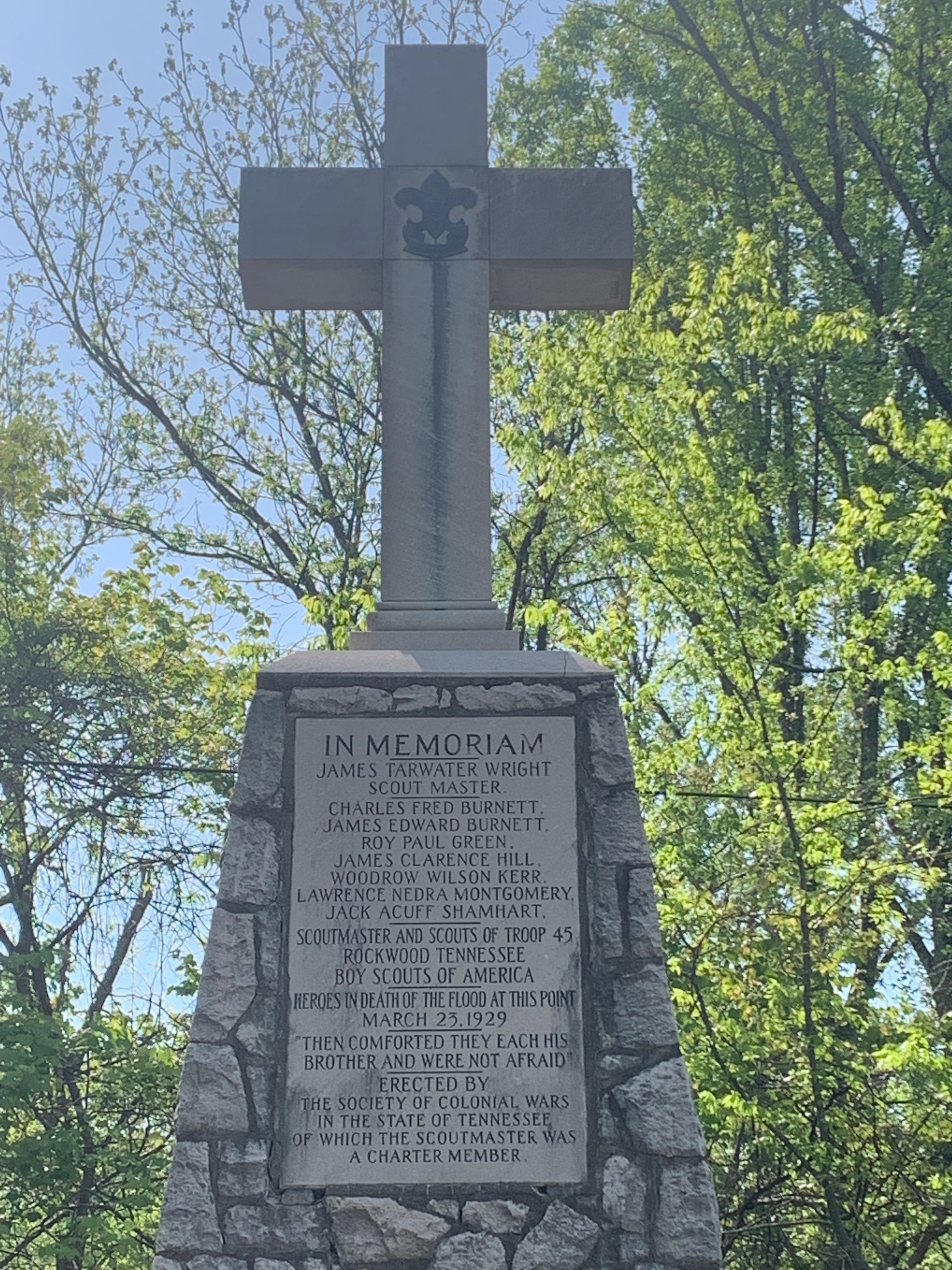
One of the worst stories of the flood was the story of Boy Scout Troop 45 that lost seven members and their Scout leader during the flood.
James Tarwater Wright had been trying to bring the troop out for a camping trip but the rainy month had postponed most his plans. When the day came for the planned camping trip to a cabin near Whites Creek he did not want to cancel. After a day of activities Dick Gilbreath brought two of the boys home. The rest and their troop leader set up for the night. Whites Creek is normally 70 feet wide. As the water rose it spread to 600 feet and the cabin was surrounded. James had the boys climb to the roof for safety. The boys who survived noted how their Scoutmaster joked and kept them calm. At first it seemed they would be able to wait out the storm on the roof. However a railroad bridge among several others upstream had been knocked loose and along with other debris began being carried by the current. The cabin was hit and broke into pieces. Some of the boys were able to grab branches and climb into trees for safety but others were thrown from the roof. James Tarwater Wright dove in after his boys and despite being a strong swimmer he was killed by the flood waters. There are some accounts of people being pulled to safety by him however he was not able to find any of the boys who had been thrown off the cabin. In total seven of the boys were killed that night.
Tom Douglas was the youngest member of the Troop and in 1978 gave an account of the night and following day. He described James keeping the boys calm and then diving in after the cabin had been broken. He also told how his brother, Willie, and another boy pulled him from the water and his brother moved him from tree to tree to keep him safe. Willie pulled others from the water and would eventually be awarded a gold medal form the Boy Scouts of America for his actions during the flood. The story of the Scouts made newspapers across the State and when visiting Harriman at any mention of the flood of 1929 it will not take long for someone to add "that is the flood with the Boy Scout Troop."
A monument was erected by local Boy Scout Troops from Harriman and Rockwood in honor of the lost boys and James Wright.
Today along the Emory River is a small water front park called David Webb River Front Park. In the park there is a bench in honor of another hero from the flood. Robert Underwood woke up to flooding near and around his home. He quickly loaded his family into a coal cart and moved them to safety. No one would have given it a second thought if he had remained with his family during that day. But he did not. Instead he returned to the rising waters with his cart and began helping others to safety. Eventually he was in the process of rescuing the Jenkins family when his cart overturned. One child, Felix Jenkins, would survive the accident however Robert and the rest of the family were killed. According to the information on the bench he is credited with saving the lives of 75 families.
Since its founding it is not just flooding which the people of Harriman have had to contend with. Fire has also struck several times. Not only was the Cumberland destroyed by fire in 1921 but the business district has been damaged multiple times. The art deco Princess Theater opened in 1926 and in 1932 it was damaged by fire from a faulty projector and then on January 25, 1939, the theater was destroyed by a fire that started in an adjacent building.
The theater was rebuilt and still stands today showing films as well as hosting live productions.
In 1938 one of the local schools was damaged by fire and had to be rebuilt. Then on January 31st, 1945, during a band recital the elementary school caught fire. The band played as long as they could before evacuating with the crowd. Besides that fire there were two other fires in town that day. A year later a temporary school was struck by fire, in 1969 another fire claimed a school in Harriman, and in March of 1969 the Baptist St. Andrews Church was damaged and had to be razed when a fire started during the service.
Destruction by fire and flood was so frequent then that during a review of the year in the Harriman Record the columnist wrote an article remarking how there had been no disaster during the previous year.
However it should be noted that was January of 1939 looking back at 1938. So as mentioned above on January 25th, 1939, there would be a fire causing over $125,000 worth of damage to the business district followed on February 3, 1939, by a flood.
On December 22, 2008, a containment pond at the nearby TVA Fossil Fuel Plant failed and 5.4 million cubic yards of coal ash was released into the Swan Pond Embayment, a recreational area used by many Harriman residents. While dredging the coal ash workers discovered barrels that had been dumped in the preceding decades from the nearby Oakridge nuclear facility. Many of the clean up workers were not aware of the full extent of hazardous chemicals in the coal ash and would eventually become ill and be forced to file a lawsuit against Jacobs Engineering. In 2018 the company was found guilty of endangering the health of the workers and their families and began paying for medical expenses.
After the Cumberland Hotel burnt down in 1921 it was replaced by a roller rink before finally being replaced by The Old Harriman Hospital (Roane County Medical Center). Throughout its time it was added on to multiple times including the addition of more surgical rooms, extended ICU, geriatric wing, psych ward, and a state of the art surgical ward.
Around 2013 the hospital was closed when a new facility opened nearby. The Harriman Industrial Board took possession of the building and thought about bulldozing it to increase downtown parking. Thankfully they did not when they discovered it would cost almost 1 million to take it down. Instead Ronnie Dee, owner of Old South Pittsburg Hospital saw the potential in the building and the rich history.
June 11th, 2022, was the Old Historic Harriman Hospital Opening night as it was opened up to Paranormal Investigators to discover the stories of the spirits who lived, died, or worked there throughout its many years.
I first heard about the "Demon House" in Hartford City, Indiana, while watching an episode of Paranormal Lockdown. In the show two investigators, Nick and Katrina, lock themselves in haunted locations for 72 hours. During the episode Nick ventured into a crawl space and found human remains; the investigation was stopped; police were called.
Having seen that episode when I saw an opportunity with American Hauntings Ghost Tours to go to that house and do an investigation of my own I jumped at the chance. Meg and I reserved our spots in what promised to be a small group which was perfect. We would avoid the contamination of a large amount of people, like in Waverly, and possibly be able to see what other people who have done this more say and do.
Now I am not going to lie the title "Demon House" scared me and I was definitely more nervous for this investigation than I was for the Crescent and Waverly. So I began doing research, trying to trace the history of the house and better understand who/what was haunting it and why this house. What exactly earned the house the nickname of "Demon House"?
My post will be split into sections, much like the blog about Waverly Hills.
1. History
Hartford City is located in Blackford County, Indiana, and serves as the county seat. In the 1830s Hartford was a few log cabins centered around a ford for Lick Creek. It was called Hart's Ford which is assumed to be origin of the town's name. In 1838 Blackford County formed and Hartford City in Licking Township and Montpellier in Harrison Township were nominated to be the county seat. Montpellier based its claim on it being the oldest community in the county. Eventually Hartford City was chosen since Licking Township was the most populated township. The area was slow to develop because it was primarily swamp land. Work began to drain the swamps and farms began to populate the area since the freshly drained swamps left behind nutrient rich land. Then in the mid 1880s Natural Gas and Oil were found and the Indiana Gas Boom began a 15 year period of intense growth. Hartford City's population would triple over the next decade as different industries would move in to the area to take advantage of the economic boom. Hartford City would also see two major rail lines cross through the town helping to aid travel.
With the newfound industry Hartford City benefitted greatly as the county sought to upgrade its seat. The original courthouse was deemed inadequate and plans were made for a new courthouse. The new courthouse and surrounding buildings were constructed in the early 1890s and are now the Courthouse Square Historic District. The Blackford County Courthouse is listed on the National Register of Historic Places and is one of the most photographed buildings in the county for its historical and architectural value.
Now specifically narrowing down on the property on August 20, 1838 Peter Wire purchased 80 acres of land that, I believe, included the property we were investigating.
My research of the house, 218 North Monroe Street, falls primarily in the 1890s - early 1900s. I found reference to there being a structure on the property dating back to the 1850s but that it was damaged in a fire in 1890s and the new home was built possibly using some of the burnt wood. I did find a fire in 1892 in Hartford City that destroyed the Crescent Paper Mill. The fire destroyed the entire mill and there were injuries but luckily no fatalities.
However I have not found anything to tell me where geographically the Mill was located. Afterwards I saw reports of lots for sale called the Crescent Additions while I don't think the house was part of the Crescent Paper Mill property I think it is nearby and could have at some time been owned by the same person, perhaps Peter Wire.
I did find the house which is lot 3 and 4 block 14 in Original Hartford City being purchased from J. Frank Taughinbaugh on February 4th, 1892, by Albert Saxon. Albert is the oldest son of John Saxon and a member of one of the first families to settle in Hartford City. The Saxons first came to Hartford City in 1839 with thirteen other families. Albert's Great Grandfather, John Saxon, was born in NY and joined the Continental Army when he was 15 years old. He came to Blackford County and claimed property as part of his bounty for serving. John passed away in 1862 at a little over 100 years old and was one of the last surviving veteran's of the Revolutionary War. Today a bronze plaque honors his service to the country at the County Courthouse.
Albert's father also named John Saxon served as Hartford City Sheriff and I have heard that he lived in the house on Monroe Street while he was Sheriff mainly because there is a rumor that he kept prisoners in the basement. However he served as Sheriff between 1877 and 1882. So unless he lived there and either rented from Frank Taughinbaugh or sold it to him only to have his son repurchase it ten years later this seems unlikely. I do think he lived there but not while serving as Sheriff especially since the next real estate transaction for the property was in Mary Saxon's name, John's wife and Albert's mother.
Other than a note in his biography that his two terms as sheriff were satisfactory to all he served I was unable to find many stories about John Saxon. He was involved in a shoot out when he and a bunch of others tracked down some suspected train robbers.
I did find obits about his wife Mary Saxon deceased in 1907 and his son John B. Saxon deceased young in 1898 and both were well loved.
Back to tracing the ownership and history of the house John Saxon passed away August 9th, 1896 and on August 11th, 1897 Mary Saxon had a real estate transaction with the next owner of the home.
The Berger's were a well respected family in the area. John Berger was a member of the Rotary Club and Oddfellows. He worked for the glass company and served as a travel agent helping people travel back and forth between Belgium and America. He also worked as a distributer for the Indianapolis Brewing Co and owned his own establishment, I found his liquor license requests year after year as well as several advertisements.
I also learned that John Berger had some political aspirations and was nominated for Councilman in 1896. Apparently his being a saloon owner caused some to argue against his nomination however he refused to withdraw his name.
Not anything to do with the house's history or the haunting but there were several times as I went through the Hartford City Telegram that the paper made me laugh. Like this exert noting that at least one "wag" voted for the two saloon owners for council and the prohibitionist for Mayor.
The Berger's would own the house on Monroe Street for over two decades but the family suffered several tragedies in that time, reading their history it certainly did seem like the family was cursed while living in that house. To start with in 1904 John's health took a turn for the worse. He travelled to one hospital in West Baden and stayed for several days before returning considered to be much improved. Unfortunately it did not last and the following year, 1905, he travelled to Silver City, New Mexico.
John's sickness was not the only trouble for the family at the time. John's brother Martial was having serious health problems. In 1904 Martial had been locked outside and suffered severe frostbite. After that a horse stepped on his injured foot and caused gangrene to start. As a result a March 25, 1905 article Martial Berger had to have his leg amputated from the knee down. Two years later on September 11, 1907 Martial Berger passed away of pneumonia. Like his brother he had come to Hartford City in the late 1880s to work at the glass company.
Also in 1905 John Berger's son George was attacked while out with his friends. George and one friend were both shot and George may have actually been dead for a brief moment. It is certainly clear that at the time it was expected George would die. He did not die and made a full recovery as did his friend Andre. I found many articles about both of them as they were musicians who played in several cities in Indiana.
In 1908 lighting struck the house. It did not cause damage or harm anyone in the home but it did put out over 100 telephones and woke up the family.
Then a year later on October 13, 1909 the next tragedy struck the family. Libbie Berger, daughter of John, and Fred Nicaise had been married in 1894 just after Thanksgiving. Unfortunately after giving birth to a son who passed away shortly after being born Libbie also passed away from complications of pregnancy and diabetes.
Shortly after she passed away her remaining children moved in to the house on Monroe to live with their Grandmother.
At some point in the early 1900s the Bergers began renting the upstairs apartment to a family of five: Ulysses, Mary, Earl, Edna, and Ernest Miars. The Miars' stay at 218 North Monroe street was also fairly tumultuous. First there was the mysterious illness of Edna. I'm not sure what was going on but I think the little girl was not seen for awhile and rumors began to spread about her health. It was certainly strange to find an article stating the child is not sick.
That was in 1904. Three years later in 1907 the Hartford City Telegram began chronicling the unstable relationship between Mary and Ulysses Miars. On March 20th, 1907 the Telegram published an article stating that Mary Miars had filed for divorce claiming that Ulysses subjected her to cruel and inhumane treatment and had thrown her out of the home a week earlier. Strangely two months later they reconciled their differences and settled the divorce.
However the reconciliation did not last long. On October 7th, 1907 Mary Miars went to the prosecutor and filled a charge of wife abandonment against Ulysses. Apparently several weeks earlier Ulysses had left Hartford City to work in Marion, Indiana for the Clover Leaf Railway Company. When given notice of the charge Ulysses said he would easily prove himself innocent "and will make strenuous efforts to show there are many startling things connected with the case not made public up to date." Two months later, December 4 1907, Ulysses filed for divorce.
A month later the divorce was granted with Mary keeping custody of the two minor children, Edna now 8 and Ernest now 5. She received $15 a month alimony as well as $15 a month in child support. For her part Mary dropped the charges of wife abandonment. Ulysses remarried a little over a month later. By the1910 census Mary and all three children had left Monroe street and moved to Jefferson street in Ward 2 of Hartford City.
With both parents claiming the other was cruel I am fairly certain that the home life for the children was not easy. I can't find it now but I had seen a picture taken of the house and the image of two small children appeared peering out an upstairs window. Online people speculated about who the "ghost children" could be. Some believed they were missing children from the 1850s however I can't find any report of missing children. Others wondered if it was the Miars children. One report claimed the children had gone missing or possibly been killed in the home, this was aided by the fact that Ulysses obituary listed only Earl as a surviving child. So I decided to try and find out what had become of the Miars family. I'm not sure when they left Hartford City but I do know that both Edna and Earnest would go on to live full lives. They were both married and Earnest had several children.
But if they lived and moved out of the house why would the children be haunting their childhood home? My thoughts are perhaps that the children looking out the window were a residual haunting, like hearing the crying at the Crescent Hotel and repeated breaths and sighs at Waverly. A coworker once asked me why we are interested in doing ghost investigations. Part of it is a desire to know and understand but the other part is to learn about ghosts and possibly help them move on to where they should be so they can rest. In order to try and do that I printed out pictures of the two young Miars graves and brought them with me as proof, in case it was an intelligent haunting that we could interact with, that they had left the house and moved on and that they could do that once again.
Now my history gets less detailed. I read that at some point in 1921 Harry and Emma Meyers purchased the home from Mary Berger and along with their son, Clayton, lived downstairs. At some point prior to 1935 Sydney and Meryl Faulkner begin renting the upstairs of the house. I found their entry in the 1940 Census, the last census available publicly since 1950 won't be released until next year.
According to his obituary in the Star Press on 8/7/1951 Harry passed away at home of a heart ailment. I don't know if they were still living in the house on Monroe street. I do know Clayton served in the Airforce during WW2 and held the rank of Technical Sergeant. He passed away in 1999 and was buried with his wife, Pearle, in Hartford City Cemetery so he stayed local. I have not found either Harry or Emma's gravesites.
I also found that between November of 2000 to September 2005 the house changed hands three times finally ending up in the hands of Eddie and Pam Norris who bought the house planning on flipping it, and thirteen years later they still own the house.
And then my history ends. I have seen reference to many things that I can not find any actual evidence to back it. For example I heard a woman hung herself in the house in the 1940s but it wasn't Meryl Faulkner or Emma Meyers. There is the story of missing children that I can not verify. Also the report of fires in the home that I have not found news reports to substantiate.
There is also word that in the 1970s some people who were into occultism lived in the house and may have practiced there.
Now also as part of my research I began looking up video of other people or groups that had investigated at the house on Monroe Street. The house was brought to wider attention by the work of Nick and Katrina on Paranormal Lockdown but I also found amazing videos by Terry Wiloby, The Fourman Brothers, Mike Flickner from SIGHS, Truth Paranormal and Ectovision Paranormal.
There were a few things that I kept hearing on the videos. One was a reference to a woman being killed. For example a voice would be recorded saying "I killed her." I also saw several videos with references to killing a baby. Now nothing I found from the history of the house gave me any clues to what was being referenced.
I did expand my search a little bit to the other homes in the area. I did this because a lot of times hauntings are connected by old property lines. So something a few blocks away may have at one time been part of the property. Now I have trouble with that because I don't understand why an arbitrary property line would effect a haunting. I guess I understand if the ghost knew of that as one property maybe it would travel the whole property but then why haunt one house and not the next door house?
However broadening my search I did find two particularly troubling stories. The first is the story of Mrs. Chris Bessinger who lived across the street from the Courthouse in the Dowell Building at 107-109 West Washington Street. It was built in 1893 and had offices and apparently at least one apartment. On May 3rd, 1899 Mrs. Bessinger gave birth to a stillborn baby. Rather than pay for a funeral they threw the baby into the office outhouse. And according to the paper Mr. Bessinger didn't understand what he had done wrong. To me this disregard for life is the closest I found to an actual evil act.
The second event that I found is the story of Ada (Wright) Green who on April 12th, 1899 took her own life by ingesting strychnine. Strangely enough Ada was living in the Dowell building with the Bessingers. Could this be the baby and the suicide that has been referenced in the videos I found online?
My research certainly revealed a lot of pain and personal tragedy in a very small area so maybe there is something going on but for every sad story in the newspaper there were happy stories as well. This is just a snap shot with a focus on negative events. I read about weddings, dances, social clubs and gatherings, and awards and scholarships given out.
I easily could have focused on the happy times of the Berger family take for example George Berger, the young man who was shot. George survived and went on to continue as a member of the Hartford City Band, owned a theater, and married.
Another happy event in the family history would be Mae(y) Berger, Mary and John's youngest daughter, graduated from the local Catholic high school with a business degree on May 15th, 1907.
The Telegram is also filled with society events like the card club that Ida Berger was a member of that would gather at different homes and play hearts. Ida was apparently quite good because she won a lot of prizes.
Elmer Berger, John and Mary's oldest son, was married September 12, 1906 to Caroline Hartley. And Mae Berger, John and Mary's youngest daughter, was married January 25th, 1911.
That is everything I learned about the house. But it is not everything I know about the property. Long before there was a house on Monroe Street there was swamp land in north eastern Indiana. I have found maps that show the Great Black Swamp stretching across Ohio all the way to Fort Wayne, Indiana. And this lead me to wonder about the bodies found on the property (not including the bones found in the crawl space). Could the bodies found in the back yard be from people who were lost in the swamp? Or perhaps they were early settlers who travelled through and were killed by disease like malaria from mosquitos.
2. Equipment
The main pieces of equipment I was focused on using were the three hunting cameras, three recorders, and the S-Box.
The hunting cameras were going to be stationary in three different rooms to help give us coverage. Since I had watched videos I had an idea as to where I wanted to place them. One was definitely going in the basement looking towards the crawl space were human remains had been found on Paranormal Lockdown, one was going to be in the second floor room with the window where the two children had been seen, and the third was on the first floor in a back bedroom that people seem to hear noises from a lot.
With the recorders Meg would carry one on her all night and I would have the other. Unlike in Waverly we bought bands so that the recorders were hands free on our wrists. In Waverly we had a lot of distortion from moving our fingers and changing our grips on the recorders. The third recorder was for burst EVP that we could do and listen back to immediately.
The S-Box is still new to us but we had some success with it in Vicksburg so we wanted to continue to try it out.
3. Investigation/ Evidence
We arrived at 218 north Monroe Street about an hour and a half early partly to look at notes and prepare and also to get some exterior photos before others arrived. We drove up the alley behind the house and parked next to a dumpster on the property. As we began reviewing notes Eddie Norris, the owner, came out the door and greeted us and invited us in. Luckily we got an unplanned interview and tour with Eddie while we waited for others to arrive. I got to discuss some of what I had found out about the house and he gave me some further information to research and use in our investigation.
About ten minutes before go time Lisa from American Hauntings arrived with a burst of energy. She was awesome throughout the night telling us about some of the techniques that her team used and just in general checking on how we were doing. Once the rest of the group arrived we went on a group tour with her and Eddie of the house but not before a quick blessing and prayer.
Despite the name Demon House and how I had psyched myself up there really wasn't any part of the night where I felt scared. I did feel like something had been touching me in the kitchen when we had been touring with Lisa and the group but there was never any feeling of dread or concern at all.
As far as investigating we tried to balance our time between each of the floors so that we hit each floor roughly every other hour or so, with the exception of the basement which had a steep staircase that we decided to only travel it a couple of times. Also it was filling with water because of the rain. On each floor we used the SBOX as well as tried some burst EVPs. Over the course of the night we felt tired and cold but we were up all night in a house in Indiana where it was 55 degrees so that made perfect sense.
At one point towards the end of the night Meg heard a disembodied voice but couldn't understand it. There were a few times when we heard taps or a bang but there were other people in the house and it was raining which interfered with sound. Also we found that each different group of people at times felt drawn to certain areas of the house. For example one of the times when we really felt like going to the basement a different group got an EVP saying "the basement" and another person also wandered to the basement. The same thing happened later with all of us traveling to the second floor at the same time despite investigating separately. We left happy that we had gone but knowing if we were going to have anything it was going to have to come from EVP and the cameras we had placed on each floor. So after driving home and a few packed weekends we finally settled down for our evidence review.
And right off the bat things looked promising!
As we were touring the building we came to a door that Eddie thought had been left open. Upon listening to the recorder we had two EVPs.
After the tour we began our investigation. The next interesting recording we had was from the first floor. One of the other investigators had a teddy bear called "Boo Buddy" that can sense changes in the environment and will ask questions to try and interact with spirits. Boo Buddy asked a question and a few moments later we hear a faint response. Here is the video:
On the second floor we tried out the SBOX which we hadn't used very much but had liked some of the interactions we had back in Vicksburg (Vicksburg Road Trip):
We switched rooms on the second floor and recorded a faint EVP answer to a question Meg asked:
Later we returned to the front room on the second floor where I think two children were photographed in a window. I began the session by trying to connect to the children. As I said before I had found and printed out pictures of their graves as proof that they had grown up and left the house.
While stopped in the first floor kitchen we recorded an EVP and then some sounds that I really don't know what they are. I kind of have an explanation for one because there are reports of people hearing a dog or feeling a dog rub at them or pull on them. Sure enough one of the sounds we have sounds like a dog panting excitedly.
Next we headed down to the basement to check on my camera and to investigate a bit. There was more water in the basement from the rain that night and we could hear it very clearly on metal pipes. We used the SBOX and had a burst EVP session. Again we didn't really feel uneasy or anything but it was interesting that several others were feeling like they should come to the basement at the same time.
We asked questions about who lived there and if they remembered the fire since some of the supports in the basement are darkened like from smoke and people believe it is from fire. First I have the video from the SBOX session:
And some EVPs:
After investigating in the basement we went back upstairs for a little bit to try and space out where and when we investigated. This is some more of us trying to experiment with the SBOX.
This is the last video I have from the night and it is one of my favorite interactions. It is also the first time listening back to our evidence that I thought there was anything sinister. Toward the end of the video we are telling what ever is present in the house it does not have permission to come home with us. We mention the repair's Eddie is doing and we get a few responses that honestly were a bit chilling.
Is there a demon in the house? I don't know nothing in the history or in our experience makes me think so but there certainly has been a lot of tragedy in the house and I know some people have been sent running from the house. I was told by one group on Youtube that Eddie prefers the name Mysterious House instead of Demon House and maybe that is a better name. After-all given the night we had and the evidence we collected I would say there is something there but I have no idea what.
What do you think?
Now what's next? Well while searching the Hartford City Telegram I found a simple one sentence article that said:
If anyone reading this knows the story of Thos Johnson I would love to hear it.
I also already have tickets to visit Octagon Hall in Kentucky and plan to revisit Waverly Hills Sanatorium in August.