Monday, January 29, 2018

Behold: Falcon Heavy


So we took a road trip to see the Falcon Heavy on historic Launch Pad 39A. And spoiler alert: we saw it. This picture was taken by me putting my brand new binoculars on Meghan's tripod and carefully holding my i-phone up to the eye piece. 

But let me go back before that. Long before that. When we were around 8 or so our parents brought us to Florida on vacation to see Disney, Sea World, and the Kennedy Space Center. We remember Disney and Sea World pretty well but all we remembered from Kennedy Space was that the trash cans were full and there were bees. I don't know if maybe we were too young, or not yet interested enough in the information presented, or if it was just the shock of Disney overpowered our experience.  I mean the interest was there because a few years later my parents bough us our telescope and we liked science fiction like Star Trek, so the real thing should have made an impact. We remember when we were 12 or 13 talking with a good friend about possibilities of people going to Mars. So as I look back I'm not sure why the KSC did not result in more of a memory. But maybe it is good that it didn't because my lack of a memory fueled my desire to return.  That and the historic Falcon Heavy sitting upright on the pad waiting for it's test fire and historic launch.

The test fire was scheduled for Monday in the afternoon. So we left Nashville after Meg got off work Sunday night and began the 12 hour drive. I was off a few hours earlier than her and tried to catch some sleep in the car which worked because we reached Cape Canaveral around noon. We would have been there in time to see the test fire but due to our politicians inability to function as adults the American Government had shut down which meant the test fire was on hold until they could get a long. So instead we just explored Cape Canaveral and Playalinda Beach.

In the days leading up to the road trip I checked online and asked people for recommendations of things to do and see near Cape Canaveral. One recommendation was to see the Astronaut Memorial in Titusville, which is also listed as one of the top spots to view a launch. So we headed over to 8 Broad Street in Titusville and saw the Memorial to the seven Gemini Pilots.


The boardwalk there was badly damaged by the hurricanes this year and was fenced off from visitors. But I did get to take my binoculars out and explore the horizon a bit.


From the park we left to head to Playalinda Beach which took us through the Merritt Island Refuge. At the first pull off we stopped so that I could use my binoculars and look across the water at Canaveral while Meghan took some pictures of the wildlife. We ran into a gentleman there Lane Hermann of Space Head News, who is a local historian on the space program. As we talked he told us about a few points of interest in the Kennedy Space center to pay attention too. He also showed us some pieces he has collected over the years from various rockets. I have to say it was amazing to us to be holding a piece of a rocket. He also showed us his book on the Enterprise and the test shuttles Lane Hermann. 

As we left and began down the road to the beach I passed a gigantic alligator at the side of the road so I pulled over as soon as possible so Meghan could bravely go back and photograph it. I didn't feel any strong need to go back near it so I stayed by the car to look at the Falcon Heavy which was visible just across the water and is when I took the above picture. Meg had great success with the alligator as well.


When she came back to the car she turned her attention to seeing what photos she could catch of the Falcon Heavy. 


Meet the Falcon Heavy! There is a lot that is amazing about it but specifically to me the two most amazing parts are the fact that the Falcon 9 rockets which make it up will return and re-land themselves (two at Cape Canaveral and one on a ship in the Atlantic Ocean). And second the fact that private companies like SpaceX have taken interest in the space program means that NASA can focus on the next step of deep space exploration. 

Now at this point it is Monday at maybe 2pm and we already have had a successful road trip. I mean we could have turned around and been totally satisfied with the trip! But that isn't the end Meg had a lot of success with wildlife photography and we had a lot more exploring to do.


Meg snapped a picture of this little fellow on Playalinda Beach.


And at one of the other pull overs she saw this beautiful bird enjoying the wonderful weather.


On the way out of the park we saw this armadillo hanging out in the grass. At this point I realized that the armadillo is really just a well armored rabbit and look how cute he is.  

Now whenever planing a road trip I look for roadside attractions along the way and at out destination. Other than the obvious must sees listed at the Cape was a large boulder that had been painted to look like the earth, on one side. The other side was painted black and it is unclear whether it was left blank on purpose to represent night or if the painter just lost interest. Either way we headed over to see it ourselves. 


After that quick stop we started to go to the hotel when a warning light came in on Meg's car to check the tire air pressure.  Luckily we had seen a Tire King as we were driving around the Cape and we returned to it. The staff added some air to Meg's front left tire and we reached the hotel. After check in we left to find a bite to eat. 

Another thing I like to do on road trips is find local craft breweries to try and maybe get a growler to take home. Online I had found Florida Beer Company Now they don't serve food there so we picked up sandwiches to bring with us, they also encourage people to have food ordered in and there are a number of local food spots ready to deliver. 


And that ended day 1. We went back to the hotel completely exhausted and ready to sleep. We were getting up early the next day to go to The Kennedy Space Center. 


As we drove to the Space Center in the morning Meghan's air pressure light came back on. The day before I wasn't worried because we had been on a long car ride but to have the light come back meant there had to be a problem. I'm going to be honest, as I parked at the Kennedy Space Center I was worried we may come out to find a completely flat tire. Not worried enough to lose time at the Space Center and get it fixed before we went in of course. 


We got there early and parked in one of the first few spots. The parking lots are sectioned off and named for different Astronauts. We were parked in the lot named for Walter 'Wally' Schirra. 


As we waited for the doors to open we looked at the countdown clock which now counts the last minute before the Center opens every day but in the early days of space travel it had counted down to the Gemini and Apollo launches.  Being there early also gave us time to try and plan our day to get the most out of the day visit. Our plan was to see the Rocket Garden right as we entered so that Meg could get photos and play with her fisheye lens for her Cannon Rebel. After that would be boarding the bus at 10:00am to head to the Apollo/Saturn building. We would return to the Atlantis building and then try and get to the "Meet an Astronaut" where Norm Thagard would be speaking about his many experiences at 3pm. That was the plan at least. 


Rocket garden was a success Meg's fisheye lens allowed her to get the full rockets in the shot and being there early minimized people being in the shots. Now at 9:30 was a 20 minute guided tour of the rocket garden and even though it might have meant a later bus we decided to take the tour. If there is one thing I can stress about the Space Center it is take the time to wait for the guided tours! It was worth it. When we got to the line for the bus it wasn't very long but we let people in front of us so that we could wait for the next bus to be the first one's on. This way we could get the front entrance side seat. It allowed us to see out the windshield instead of just the side tinted windows. As the bus went around the driver pointed out several points of interest like the giant platforms that rockets will sit on to be moved from VAB (Vehicle Assembly building) to launch pads. We also saw a manatee hanging out just after our bus driver finished saying she doubted we would see one. 


Crawler

VAB
The bus could not go to 39A because of the Falcon heavy sitting on it but we still got pretty close.


 Then the bus pulled up at the Apollo/Saturn V building. Again there was a guided tour and it was sooooooooo worth it. We ended up spending much longer in this area then originally planned but I learned so much about the history of Space travel. I knew the most famous names like Neil Armstrong and Buzz Aldrin but there was so much I didn't know.


We got to relive the launch of Apollo 8. As different voices came over the recording different stations would light up. 

Then we entered the main room and there was the gigantic Saturn V. We looked up at the Apollo badges hanging from the ceiling. 


One thing that really resonated with me was the feeling of optimism and unity that surrounded the space program. The Apollo 11 badge was a great example of that with the bald eagle representing America rather than having the astronauts names listed. Also the words on the plaque that was placed on the moon "Here men from the planet Earth first set foot upon the Moon July1969, A.D. We came in peace for all mankind."


We also learned a lot more about the Apollo 1 crew and tragedy. I had known of the accident but not much. 


"If we die we want people to accept it. We are in a risky business, and we hope that if anything happens to us, it will not delay the program. The conquest of space is worth the risk of life."- Gus Grissom


To read Gus Grissom's words were chilling. There are a lot of qualities that the first Astronauts shared like courage, determination, and perseverance, The also had an amazing understanding of the history they were creating and their own part in it. There is a beautiful elegance in Neil Armstrong's first words on the moon. "That's one small step for man, one giant leap for mankind."


As we returned to the main campus of the Kennedy Space Center we saw but were unable to photograph a bald eagle perched in a tree next to a gigantic eagle nest. Apparently it is one of several nests in the refuge but the only one actually visible from the road.

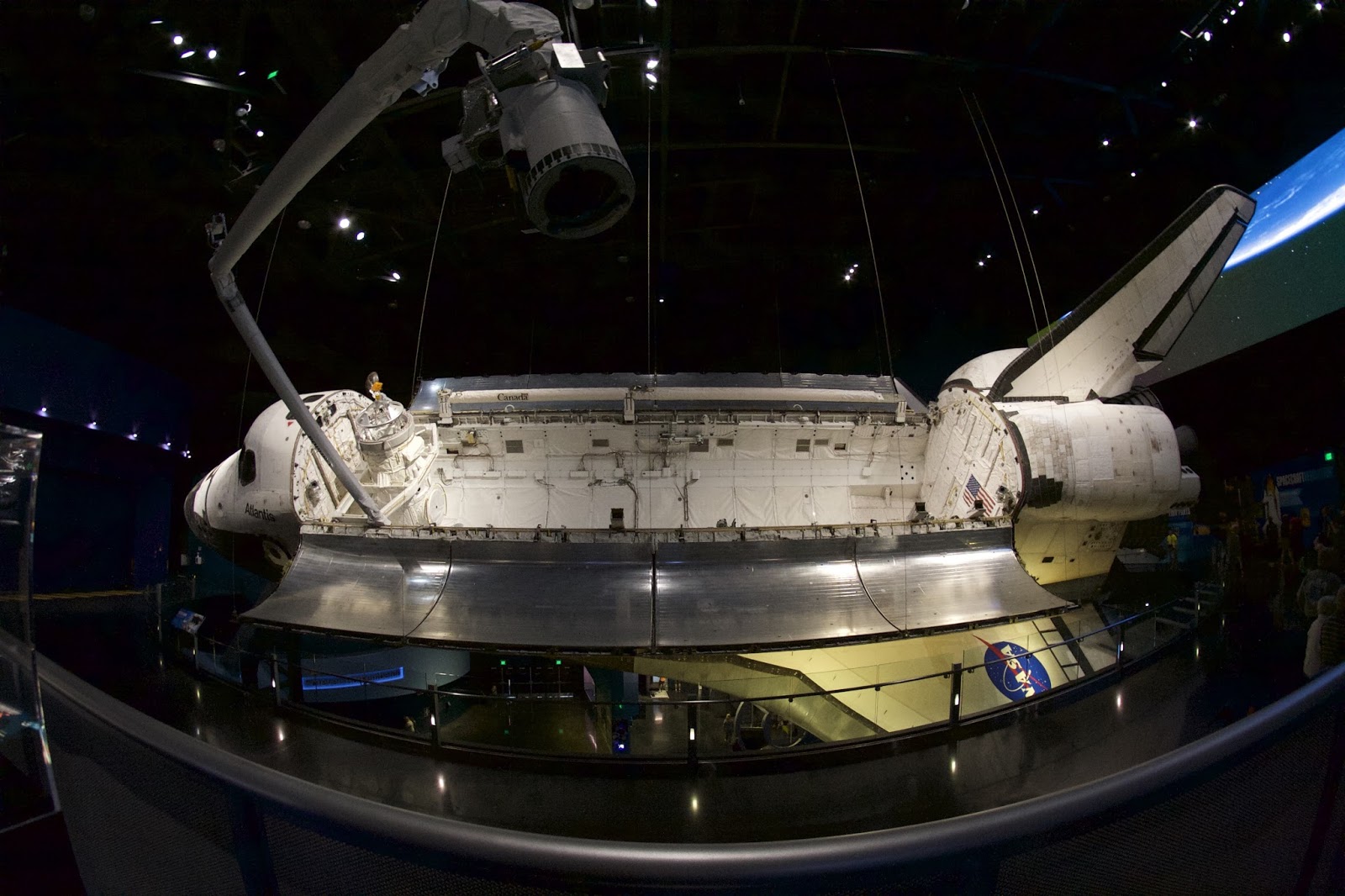
From there time seemed to fly we went into the Atlantis Shuttle display and experienced what being launched into space would actually feel like. Unfortunately because of spending so much time in the Apollo/ Saturn V building and then at Atlantis  we missed the Astronaut meet and greet. But like I said above I learned so much I think it was worth taking the extra time to go through exhibits. For this reason though I would certainly recommend spending two days at the Space Center for anyone planning to go. We didn't take advantage of the I-Max movies either but those were never actually part of our plan.


Since we missed hearing Norm Thagard speak we went to the exhibit on Mars next and took a look at replicas of Curiosity and the other Mars rovers before heading over to the Astronaut Hall of Fame.


And that brought us to 6pm and the Space Center closing. We went outside and I was relieved to see that our tire was not flat. On the way we passed a wild pig just to complete the wild life bingo card. We went to a different Tire King and discovered that somewhere during our trip we had picked up a nail in the tire. Luckily it wasn't bad and the repair was quick. Now it was time to look for dinner and for some reason I really wanted a salad. Like a giant amazing salad. Meghan searched for restaurants with salad bar and found Sonn'y Barbecue.


Well! We went for the salad bar but we will go back for the barbecue. Don't get me wrong the salad bar was perfect and hit the spot and the barbecue was amazing! Also Meg tried another local brewery Playalinda's Tropical Wonderland. So after a delicious meal we headed to Playalinda's location to try some of their beers.


Then we went back to the hotel. In the lobby is an astronaut statue so we stopped to take photos with it. As I was taking Meg's photo I joked "Ok smile both of you." I got to say. It's a bad joke that would definitely make my Dad proud. A passing guest gave his approval of the joke too.


The next day we got up early because we had two more museums to go to before driving home to Nashville. 

The first museum was the Air Force Space and Missile Museum. A small museum dedicated to the many other launch pads at Cape Canaveral. This museum was loaded with information. The volunteer on duty was Chuck Anderson and he shared lots of personal stories and great information. It is free admission with a donation box at the entrance and a gift shop. I'm so glad we took the time to stop here and look around. Each launch pad had a different display with many different interesting facts.  


 Also and I did not know this before we went there but right next door is SpaceX's Launch and Landing control building! On the door was one of the best signs I have ever seen which showed a picture of someone walking through the door with another person following very closely behind and it warned "Watch for Tailgaters".


Then we went to the next museum American Space Museum. Another small museum which was jam packed with memorabilia and very much worth the trip. Our tour guide here was John and again he was wonderful and the tour was incredibly informative.

 After that we had to leave the cape to head home but we had one more stop to make and that was in Kissimmee, Florida. In 1942 after the attack on Pearl Harbor when Dr. Charles Bressler-Pettis wanted a symbol of unity. He sent out letters to state governors to send him rocks. He was sent rocks from all the states from the governors and from individual citizens. The rocks were incased in concrete and stacked into a pyramid.


Another photo using the fisheye lens. In case you can't tell I love Meg's photos with that lens. It is fun to watch her take them too. She has to walk right up to the subject to take a photo and then to see a full photo result is awesome.


There were also several rocks from foreign countries.


Then we were heading home to Nashville. We had a good break and chance to stand when we stopped to visit family in Atlanta and leave behind some astronaut ice cream. We probably got home around 4am pretty tired but it was worth the trip. We spent 24 hours driving and 48 hours in Cape Canaveral. I think we made the most of our time and the best part is we are doing it all over again.

Shortly after we got home February 6th was announced as the launch date for Falcon Heavy. So after work on Sunday 4th while most people are watching the end of the Superbowl Meg and I will be hitting the road again to go back to FL and witness history!

And for no particular reason at all here is one of the best youtube videos in existence as Chris Hadfield covers David Bowie's "Space Oddity. " In honor of the future of space exploration:


Monday, August 28, 2017

The next 7 years of my next 30 years (as far as Solar Eclipses go)

In the days leading up to the Solar Eclipse I found myself thinking, "wow soon it will be over." And that would be it. The build up to the event- which included me getting to talk at a library, school, and park about solar eclipses- had been a whirlwind and it was quickly coming to an end.

I got to play the part of an expert and be a guest speaker and I kept saying to my Mom, and sister, and friends that my "15 minutes (days) of fame" would soon be over. And I thought I would feel sad or depressed. A lot of people had asked, "what will you do when it is over?" Because it has literally been all I've talked about and thought about for the last two weeks.

Well here I am a full week after the event. No sadness or depression like I expected, but now a renewed interest. I want to see it again. Once was not enough. And I don't want to wait until 2024 like I thought I would be fine with doing leading up to August 21st.

That was the plan see this one and then think about 2024, for which I will probably head to Texas Hill country to see because that is where the 2023 annular path intersects and I can scout a location for 2024 in 2023. But at some point in the days after the eclipse I realized I don't want to wait that long. I had not even considered the eclipses in 2019 and 2020.

Weather and timing still has 2019 ruled out but 2020; that's a different story. I like car trips. I hate planes. Planes make me feel claustrophobic and trapped. But here I am seriously considering, more than considering, seriously committing to doing what I must to see the Total Solar Eclipse of 2020 either in Chile or Argentina. I have emailed three different tour companies who specifically plan tours for Solar Eclipse viewing.  I know I want to travel in a group for several reasons. The first being my own safety since I am not experienced in travel and the tour company will know better than I the safe viewing locations and hotels.  Second they will have done the research for factors I can't even think of right now: after all they are a specialty tour with the eclipse as the focus. They will take into account weather and other factors that can create the best viewing experience.  Third there will be extras like lectures and speeches by experts in a variety of fields but most importantly in eclipse viewing. And finally I will be in a group. I think experiencing the eclipse with a group of people added to it! I know a lot of people seem to want quiet and to be alone with nature, which I understand and may do in 2024. But for this next one I wouldn't mind a group of strangers altogether to witness a beautiful moment in celestial alignment.

So what does that mean for me now? Well I already contacted those three companies that do tours because I need to know how much money I need to save. I'm guessing somewhere in the realm of $5000-6000 should be the tour and airfare. So going with the high number I need to start putting away at least $200 a month into a savings account. I've got my passport already so that's good. I need to learn Spanish. Just because I am traveling in a tour group doesn't mean I shouldn't know the local language. Languages have never been easy for me, heck I've been speaking English all my life and I still have grammar difficulties. I bet you can find them in my posts and that is with me re-reading and getting others to read them for me.

What else do I want to do? Well one of the talks I gave on the eclipse was filmed and shown on a really really local news show (a three minute clip of the hour long talk at least) and while I was thrilled to say I was a guest speaker featured on the news (I can exaggerate right?) I'll be totally honest and say I wasn't thrilled with me. I need to get in better shape and lose weight. And I want to do that now. The good news is cutting out things that negatively impact my weight like soda, beer, and fast food will positively help the other goal of saving $200 a month.

I've still been at a loss of words for trying to explain the wave of emotions that came with experiencing this total eclipse. I said right after that I have never truly understood the phrase "awe inspiring" until the eclipse. I didn't have the fear that some talk about. I mean there was a strangeness and I felt chills at how still it was but I wouldn't call it fear just an awareness at something strange happening. Also some people say they feel small or insignificant in the face of Totality but I feel the opposite. I feel a larger connection to the world. I feel like I need to cherish that moment and every moment. I've been thinking in terms of words like 'renewed', 'connected', and 'alive'. Especially when I think about the monumental amount of factors (size of the sun, moon, earth, distance between the three, location on earth, weather, and everything else) that had to be just right to see Totality. I have a strong feeling of thankfulness that I was able to, given all those different factors, be privileged to see it.

I often see people with small children or babies and watch how easily amused or surprised the little ones are by just normal surroundings. I think to myself, "how nice it would be to have that wonder of a small child and be so impressed with the world again." Well now I am.

I have always wanted to see the Northern Lights. But now I am wondering what other amazing sights of beauty are there that I haven't even considered.


News starting at three minute clip from my talk (when the whole thing is posted I will share that too)


Also what should I research and become an expert in next? Could be anything. There was awhile where every night before bed I would pull up a random wikipedia article. Maybe I will go back to that for some inspiration.

Wednesday, August 23, 2017

It came. I saw. When is the next one?

Well the day that I had been anticipating for over a year and a half has come and gone.


The night before I could barely sleep. I lied awake, checked my phone, and talked online to other people who were, like me, waiting to fall asleep and anticipating what would happen in the morning. And then it was morning. There were several things I knew I wanted to do early to get them out of the way. For instance run to Walmart to get some last minute groceries. I pulled into the Walmart and there weren't a lot of shoppers but it did seem like more than a normal Monday. I wondered how many of these shoppers were here today to chase the eclipse. I saw one young man on line at Self Checkout buying a pop-up tent and smiled. Several of the employees were wearing eclipse tee shirts and when I left the woman at self checkout wished me a happy Eclipse Day.

Next I had to run to the dump to get rid of some trash I had accumulated over the weekend. But the dump was closed: no note at the gate or anything but you know what, it's ok. If they were closed to allow their workers to enjoy the day I'm cool with that. I can go to the dump today anyway. On the small road to the dump were two cars parked facing the sky. It was 8:00 am and I think they were eclipse chasers who had picked an open view and were waiting.

Then there was the post office. I had been blessed with three great opportunities to speak at different events in the area leading up to the eclipse and I wanted to send them thank you notes for allowing me to come. So I had postcards from greatamericaneclipse.com and I put the forever stamp in commemoration of the eclipse on each one and mailed them so they would be postmarked for that day. I don't think I have mentioned the stamp in any post before so I will take a moment here. It is a photo by Fred Espenak who is an eclipse chaser, retired Emeritus Astrophysicist from the Goddard Space Flight center, and expert photographer. The stamp is heat sensitive so when it is cool you see a darkened moon over the sun with the corona around it. However if you place your finger on the moon it will change and reveal the moon with craters covering the sun.


I also mailed a post card to myself and my sister.

Then I went home to finish preparations. In the days before the eclipse I had gone out to my backyard during the time when it would be Totality to try and judge where people would want to be to see the show so I began moving my patio furniture out kind of where I thought it would be best. And then of course people could move them but at least I had them in the area. I also moved my Morning Glory and Moon Vine into the backyard along the fence. Looking around I realized exactly how big my yard was and it was perfect for a party.


A really good friend of mine from NY who now lives in Iowa had made the trip on Sunday. He is more like family and in true family fashion as soon as he showed up I put him to work :-) He helped me put together and move the last of the patio furniture while I finished putting a sun shade on my gazebo.


Gazebo and Table for shade
The morning seemed to fly by... partly because we urged people to get here early because of traffic concerns so while I was out with last minute errands Meg was home making eggs, bacon, and pancakes for the early arrivals.

One of my neighbors brought a pair of binoculars with a board behind them to project the eclipsing sun on it and two pin hole projectors he had built out of cardboard boxes. Other neighbors brought over chips, various sides, and desserts.


As 11:30 approached my kitchen and yard were filling up. At that point I called people together to give a quick presentation on the eclipse and what we could expect to look for as well as an important stress on eye safety. I didn't go into the history of it because I needed to get my video camera set up on the morning glory and moon vine and we had a little less then 30 minutes before the eclipse would begin. Leading up to the party I had worried about keeping people entertained during the partial phase but turned out I didn't have to worry about it as people broke off into groups talking with each other. The kids were playing with bubbles that my Mom had brought. I had built two corn hole boards but never got them into the back yard from where they had been in my drive way (it's ok they will get used at other parties).


I set up our Solar Telescope and Meghan got it lined up so that people could take a look at the eclipsing sun.


We had chips and a veggie platter out for snacking on and told people that we would do the barbecue after Totality this way Meg was free to photograph and observe.  We had a ton of soda which had been donated to the party by our city hall, since this party had been listed on the website as the town party even though only my immediate neighbors took us up on the offer. I had three 5 gallon containers of lemonade, ice tea, and just plain water and kept urging people to stay hydrated.

The weather had been so cool these past few weeks until of course Monday.  And I was worried about people getting too hot... but that concern was quickly removed when the temperatures began dropping. Really! At least 10 degrees and one friend said it was 12 or 13. The wind also stilled.

A video showing the crowd.


As the partial phase was going on I would grab a pair of glasses and glance up at the partial covered sun and check the time to be sure of how far we were from Totality. About ten minutes before Totality my neighbor, Glenn, was doing a live stream from my backyard and I got to go talk on that about what we were expecting, after we argued about whether Yankees or Red Sox are better (the answer is Yankees). But in it you can see the way shadows are changing and looking crisp, lighting and colors are different, and this amazing silence around us. Everything was so still. It made sense to me what Edmund Halley meant when he described a, "chill and damp that came over the crowd causing a sense of horror."

Live Feed

My guests were better than me at checking on the flowers and eventually a call came out from that area of the yard that it was working. Now I have sped the video up as a time lapse but it still is a little over 12 minutes. Unfortunately the Moon Vine didn't open :-( And I don't really see the change in the Morning Glory but I think it is because I was too zoomed out. I was trying to catch too much. I was hoping to get the flowers, I wanted to see if I could catch shadow bands, and I wanted the sky to see the changes in it. So in hindsight I wish I had closed in on the Morning Glories more. But the video is still neat as you watch you see people periodically come over and look at them. I slow down the video when everyone is commenting on it, around minute 3-6, and I slowed down the video for Totality starting at minute 8.  One cool thing and I didn't realize I was going to get this is that I have Jupiter in the sky. There is a vine of the Moon Vine that points into the sky. As Totality comes you will see a small dot appear, that is Jupiter. Also I caught the ambient sound (or lack of it) and the changes in lighting and shadows. But best of all is the reaction of all the people in my yard as the clap, cheer, and exclaim at everything they are seeing and experiencing. At the very end you hear the first chirps of one of the birds doing its morning song. I do apologize because I don't have a real movie editing software so I was able to remove the sped up sound from one clip but the ones I had to slow down I couldn't remove sound from. So it sounds like an army of chipmunks in the video.


A little more then four minutes before Totality I was just taking video of the yard and different people were talking about the changes they were noticing in nature.  My neighbor Glenn noticed the crickets chirping and then Meg and I began discussing the difference in the lighting.


And then we had Totality!!! The moment we had all been waiting for was finally here. Now our eyes are the best cameras we have and video and photos do not do the whole experience justice. So keep that in mind with this video. What I did capture was the people's reactions. I mean cheering, clapping exclaiming... one little boy excitedly covering his eyes with his glasses as the sun disappears. My friend John threatening that if the kids aren't good he won't let the sun come back. And all the cool things to see and feel: Venus, Jupiter, Bailey's Beads, The Diamond Ring, The Corona, the horizon, and the stillness. And to me it felt like so much time, like more than 2 minutes and 25 seconds. At one point my neighbor, Glenn , asked how much time was left and I remember thinking it was almost over but we still had 45 seconds!


Here is a clip that was on the Tullahoma news from my talk at the monthly "Lunch and Learn". In this part of the talk I discuss the Corona in art and then just about what I imagined the experience would be. Watching it I think it was a good description of how special this moment would be. The video should start at around 11:50 and is about three minutes.


During the Partial and Total phase Meg was taking photos of the event. And the photos she took were amazing!

Meghan Keohane

Meghan Keohane


The picture above shows the partial sun with three sun spots. The picture on the right has a fourth dot under the sun spots that we believe may a plane.


Meghan Keohane

Here is the sun doing it's best Cheshire Cat grin.


Meghan Keohane


Meghan's beautiful shot of the Corona (crown of the sun).


Meghan Keohane


This is a wonderful shot of the Diamond Ring with prominences.


I have been trying and trying to think of how to put my feelings and emotions at that moment into words. And I still feel like no words (just like pictures) can do justice in describing my feeling. So far the best thing I can say is that I have heard the phrase awe-inspiring used so many times and I have used it in the past. But I have never truly understood what awe-inspiring meant until August 21st 2017. In the video I say I have chills. And I did. I also, as I knew I would, was crying. I noticed nature like I had never ever done before. And I felt connected to it. That I was allowed  to view a special moment between the sun and moon. And we were all part of something so grand. That at that precise moment in time the celestial bodies had lined up in such a way to allow us to see true splendor. We were privileged to be a part of it. And I will share that moment with the friends, family and neighbors forever. I will hear their cheer and applause in my mind when I think of the beautiful corona for the rest of my life.


I feel like something in me was awakened. This eclipse is just the beginning.

And now it is over and it is time to plan for 2023 Annular and 2024 Total eclipse.

Thank you everyone!

Tuesday, August 15, 2017

Here Comes the Moon: The Total Eclipse, Eclipse in History and The Corona in Art

We are less than one week away from August 21st, 2017, when a lucky or determined portion of the world's population will be treated to one of the greatest sights in nature: a total solar eclipse. I have been researching and reading about this for well over a year and I wanted to put that information together in one place so here it is:

The first and most important part of advice is that 100% Totality is the goal. That is the amazing once in a lifetime moment that people have been talking about. 99% is not anything close to 100%. I have seen it put best by one of the members of on eclipse travel group that I joined when he said matching 5 numbers in the lotto is good. Matching all 6 is life changing! If you can get to the path of Totality, people are traveling across the ocean and driving thousands of miles for this, it is worth it!

A solar eclipse happens when the Moon comes in between the Sun and Earth.


The Earth's diameter is 7,917.5 miles wide, the Moon's diameter is 2,159 miles wide, and the Sun's diameter is 864,575.9 miles wide. The distance between the Earth and Moon is 238,900 miles and the distance between the Earth and Sun  is 92.96 million miles (or 8 light minutes.)

Those are large numbers that are hard to wrap your minds around . . . like trying to imagine 100 otters on a plane (thank you John Finnemore*). So let's scale this down a bit.

If the Earth had a 1 inch diameter the Moon would only have a 1/4 inch diameter since it is roughly one quarter the size of the Earth. Now between the Earth and the Moon you can fit 30 Earths. Which means with the 1 inch and 1/4 sized bodies the two would be 30 inches away from each other.


Now to add the Sun into this imagine the Earth was a little larger and had a 4 inch diameter. In order to keep the correct scale the Moon would now have an inch diameter. At that size the two should be 120 inches away from each other. The Sun would be the size of a three story building and would be half a mile away.

Seems impossible right? Something as small as a 1 inch in diameter Moon will be able to block the entire three story sun. Pick a spot in the distance of wherever you are (maybe something large across the room from you). Hold up your thumb like you are giving someone the thumbs up sign, straighten your arm, and hold your thumb in front of your face. Now slowly move your thumb back towards your face as your thumb gets closer to you it will cover more and more of the chosen object. Once it gets to the correct distance it will completely cover the object. That is how a solar eclipse happens.

Now I wrote that the solar eclipse happens when the Moon travels between the Sun and Earth. But we all know the Moon orbits the Earth and one lunar cycle is 29 days. So there is a point every month when the moon is positioned in such a way as to be between the Earth and Sun. But a solar eclipse doesn't happen every month. Why is that? The answer is the Moon's orbit is at a 5 degree tilt. Because of this tilt most times when the Moon crosses between the Sun and Earth the Moon's shadow will fall above or below the Earth. It has to be at a particular point in orbit in order for the shadow to land on the Earth.

Now there are two types of solar eclipse. There is the partial/total eclipse that we will be experiencing on Monday and there is an annular eclipse.

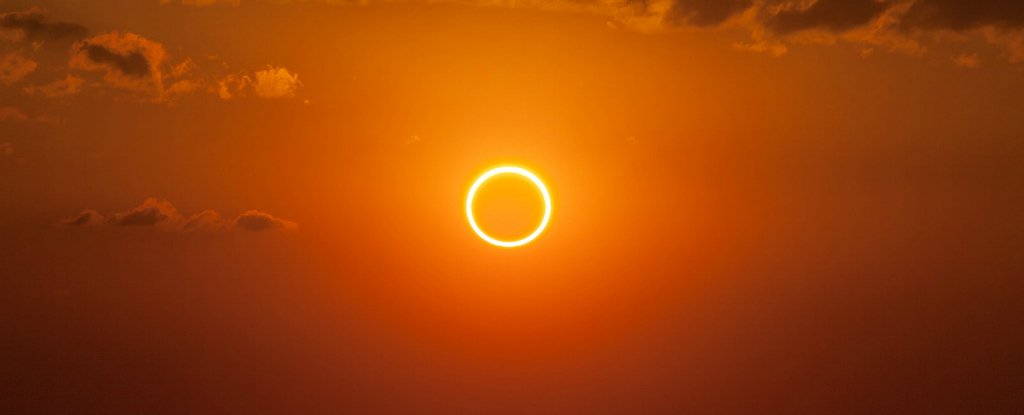
Annular gets its name from the latin word anulus which means ring. It is named that because the most famous moment of that type of eclipse is the 'ring of fire'.

sciencealert.com

Now not only is the Moon orbiting the Earth at a 5 degree tilt but it also follows an elliptical path so at some points the Moon and Earth are closer to each other (perigee, or 221,000 miles) and at other points they are further (apogee, or 252,000 miles).  Remember before with your thumb? If the Moon is too far away from the Earth it will be too small to cover the Sun. It has to be at the closest point in its orbit in order to be able to cover the Sun and cause a total eclipse.

The entire contiguous states will experience at least a partial eclipse as we fall under the penumbral shadow of the moon. Only a 70 mile wide band will fall under the umbral shadow and experience Totality. This band will go from coast to coast starting in Oregon and leaving the land in South Carolina. The Moon's shadow will take 100 minutes to travel the entire distance of the states and touch 14 different states. Less than 1% of Earth's surface will be under this band. That is how rare it is to have one so close. A lot of times these eclipses will take place over an ocean or in a less densely populated (or unpopulated area).

Greatamericaneclipse.com

Now some important dates for US solar eclipses:

The last time a solar eclipse travelled from coast to coast in America was 1918.
The last time a total solar eclipse passed through the 48 lower states was Feb 26th, 1979.
The last time a total solar eclipse touched the USA at all was July 11th, 1991, when an eclipse passed over Hawaii.
The last time a total eclipse passed over TN (my home state) was August 7th, 1869.
The last time a total solar eclipse passed over Nashville, TN (where I am) was in 1478.
On average it takes 375 years for the same location to repeat.

Now before I start trying to describe what will be experienced during Totality I need to take a moment to mention eye safety. We all know not to look at the Sun we live our daily lives constantly managing to not blind ourselves by the Sun. But an eclipse is a novelty. You don't have pain receptors in your retina so you will not feel pain if you injure your retina and the damage may take a few hours to develop. So you may try and take a quick glimpse at the Sun and think that wasn't so bad. Maybe look around and realize you are seeing normal so be emboldened to look again this time for longer. It's a false sense of safety. You could be doing damage and not know it. Never never never never never look at the Sun. There are safe ways to view the eclipse. For example several companies have been producing eclipse glasses that meet the requirement of ISO12312-2 filter for direct observation of the Sun. Even wearing those glasses you should look for three minutes max and then give yourself a break. You can also use shade 14 welding glass. However if you don't have either of those things by now you will have a hard time finding them.

There are other methods for watching the partial phase of the eclipse. For one you could watch it reflected in the water. The water will cut down glare enough to make it safe to look and you would see in the reflection as the Moon's disk covers more and more of the Sun. You could also use something as simple as a colander and watch through the pinholes made from shadows on the ground. Even the shadows of tree leaves will begin to be crescent shaped as the Sun is covered up. But you only need these methods and tools for the partial phase. If you are in the path of Totality you will not need anything to view the total eclipse.

Now I get to the real fun part! Describing what we can expect to experience during the three hours of eclipse.  First there are 4 important moments C1, C2, C3, C4.

C1- First Contact. This is when the Moon's disk first begins to cover the Sun. This is the start of the partial eclipse and you need your glasses to view the Sun directly. Now at first you won't notice anything and in fact a partial eclipse could pass without you ever noticing it. I remember in NY in 1994 thinking I should do something, make a pinhole projector with paper plates,  to see the eclipse but I never actually did do that. This phase lasts for a little under an hour and a half as more and more of the Sun is covered. Eventually you will begin to notice some darkening and the shadows will begin to change like I wrote before you will see mini-eclipses in the the trees shadows. Nature will begin to react as well. Birds will begin night songs and head back to their nests, crickets will start to chirp, larger animals may begin acting like it is night. I am performing an experiment of my own. I bought a Morning Glory vine and a Moon Vine. The Morning Glory opens in the morning with the Sun and closes at night. The Moon Vine is the opposite. I am going to try and see (if I have blooms on them) if the plants will react to the partial and total eclipse.


You also may notice a change in the temperature as it could drop on average 5 degrees. Also the wind may change directions. This is called Eclipse Wind and was noted by Edmund Halley during the 1715 eclipse when he described, "a chill and damp that brought some sense of horror to the spectators." The cause of Eclipse Wind was not fully known and verified until March 20th, 2015. when during a partial eclipse over the UK researchers from the University of Reading and 4,500 citizen scientists took detailed notes and information about changes in the temperature and wind. Analysis of the data showed that Eclipse Wind was caused by changes in the boundary layer,  the area of air that separates high-level winds from the ground. Giles Harrison, one of the University researchers stated, "warm air stops rising from the ground, causing a drop in wind speed and a shift in its direction."

Another phenomenon that will be experienced in the last 90 seconds of the partial phase is called Shadow Bands. I have to admit I have been obsessed with them ever since I learned of them from a video by a blogger:


Now these are not seen or reported with every eclipse perhaps because so many people are busy looking up in that last minute that they do not look. The Shadow Bands are described as thin wavy lines that look like snakes which undulate on plain surfaces. They have also been referred to as Diffusion Bands. I assume it has something to do with the Earth's atmosphere causing some kind of interference and the way light is seen through it but I don't know. And neither does NASA right now. If you go to their website you will see a list of questions such as:
Do the shadow bands move in the same direction across an area?
Do they move parallel or perpendicular to the direction of the sun?
Do they follow the geographic direction of the wind?
Do they maintain the same speed?
What is the distance between the bands as they move?
How does intensity change?

Just like in 2015 when ordinary citizen scientists observed the wind and helped researchers give the cause maybe through many observations scientists can get some answers about these Shadow Bands?


Now I just put up a white vinyl fence around my property so I am hoping that I will be able to capture the Shadow Bands on video. We will see.

Now we are at the point where Totality is seconds away. The Sun is almost completely covered by the Moon and the phenomenon called Bailey's beads occurs. This is named for Francis Bailey an astronomer who first described the beads during the May 15th, 1836, eclipse. They look like a string of red beads of light around the Moon's disk and that is light coming through the craters of the Moon's uneven surface.

Fred Espenak www.Mreclipse.com


Immediately following the beads is what is called the Diamond Ring effect when the Sun's light is focused through the last crater of the Moon and flashes out looking like the diamond on a ring.

Fred Espenak www.Mreclipse.com

Immediately after that is C2- Totality! Now if you are not in the specific band that will be able to see the total eclipse then what would happen now is more and more of the sun would return to sight as the Moon's disk passes over the Sun. If, like me and countless others, you are in or have travelled to the path of Totality then you will be able to see the Corona or Crown of the Sun.

The Corona is a hot outer layer of the Sun described as a white/silver/blue light given off by the Sun that can only be seen during a total eclipse because normally the Sun is so bright. It has been described to look like a cross emitting from the Sun or resembling the wings of a bird. This is an amazing moment. In videos you hear people cheering at the moment. It's been described as overwhelming. I'm pretty sure I will cry.

Fred Espenak www.MrEclipse.com

Just like the 2015 eclipse gave researchers an opportunity to measure and record changes in the wind this eclipse is going to give researchers an amazing opportunity to study the Corona. You can count on the fact that during the entire 100 minutes that the Moon's shadow crosses the US the Corona will be recorded by photographs and video. Changes in the strength, duration, and direction of the emitted light will be noted.

Also visible during the Total portion of the eclipse will be the night sky . .. . except it will be during the day :-) planets and stars will be visible! Once the Sun is covered Venus will become the brightest object in the sky. Fainter and harder to find will be Jupiter, Mars, and Mercury. Also you may be able to pick out bright stars like Capella, Sirius, and Betelgeuse. Here is an image from Sky and Telescope Magazine as to what the sky above Hopkinsville will look like.

Sky and Telescope Magazine
Now the Sun has been quiet lately but you could see red flames extend out from the Sun. These are Solar Prominences. Also at the height of Totality if you look around you may see a 360 degree sunset around your horizon. If you are up high in mountains you could potentially see the Moon's shadow actually racing towards you.

If you are in Hopkinsville, KY you will have the longest time of Totality so 2:44 to enjoy all you can of this amazing sight.

Now we reach C3- Residual and the whole thing repeats in reverse. The Diamond Ring will flash, Bailly's Beads will reappear, Shadow Bands will wiggle around on the ground, and the lighting and temperature will return to normal over the course of an hour and a half and then it will be C4 and the eclipse will be over.

Now that is what we know about Solar Eclipses today. But in ancient times (well and not so ancient times) the Solar eclipse was viewed very differently. It wasn't until the 1700's that people started looking to an eclipse as a moment to be viewed and travelled too. For many ancient cultures the eclipse was a  cause of anxiety. It was a bad omen or sign of trouble yet to come. They feared the eclipse. That was a fear like many fears born from a lack of knowledge. They couldn't explain it, didn't understand it, and it was jarring. Night in the middle of day! It is still jarring to some people today and that is knowing what we know now. An eclipse brought a feelings of fear and foreboding but it is that fear and foreboding that has lead to modern astronomy as we know it today.

Most of the myths and stories told by ancient cultures to explain the eclipse are violent, many involving something eating the sun. This was a way of explaining what was not understood. For example the Pomo tribe word for eclipse means "Sun got bit by Bear". A bear was walking on a journey and began to fight with the Sun. As the two fought the bear bit the Sun causing the eclipse. In Vietnam a giant frog, or evil spirit described as a frog, tries to eat the Sun. For the people of Mongolia it was a dragon called Arapto who tried to eat the Sun. In ancient Korea a king from far away sent a dog, Bulgae, to capture the Sun and Moon. The dog tried to bite the Sun and discovered it too hot. He tried to bite the Moon and discovered it was too cold. He returned to his master empty handed but was sent back out again to continue and try and catch them.

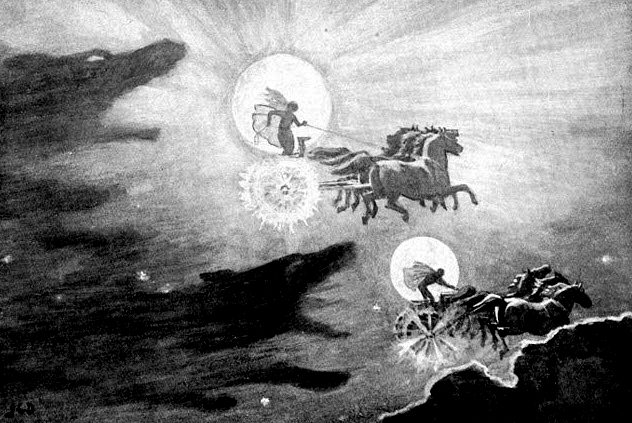
The ancient Norse believed the Sun and Moon were two entities named Sol and Mani who travelled across the sky in horse drawn chariots. They were constantly chased by sky wolves called Skoll and Hati. An eclipse would happen when the sky wolves caught one of the two. If the wolves ever caught and ate both of them it would signal the beginning of Ragnarok.


In some stories the gods were fighting with each other like the story told by the Inuit of the Arctic where the sun goddess Malina was fighting with her brother the moon god Annigan. As she walked away from the fight he chased after her and when he catches her there is a solar eclipse.

Ancient India combined eating and fighting with their particularly gruesome eclipse story. The god Brahma told the other gods and a group of super-humans (asura) that at the bottom of the ocean was a potion that would grant anyone who drank it immortal life. The catch was that the two groups had to work together in order to reach it since neither group had the ability on their own. Well it took a few tries but eventually with the aid of a tree and a mountain they were able to recover the potion. Now the god Vishnu decided to try and trick the asuras so that the gods could have the potion all to themselves. Vishnu disguised himself as a beautiful maiden and had the two groups each form a line so that the potion could be distributed evenly. However while the asuras were distracted he began to only give the potion to the gods. One of the asura, Swarbhanu, realized the trick and joined the line of gods. Vishnu handed him the potion and he very quickly began to drink. The Sun and Moon realize the deception and try to warn Vishnu. So Vishnu becomes enraged and cuts of Swarbhanu's head. However Swarbhanu had already begun drinking the potion so his head became immortal while his body died. Now his immortal head chases the Sun and Moon seeking revenge. When he catches them he eats them. But being only a head with no body they fall out his neck and take their place back in the sky.


The stories however aren't always violent. According to the Aborigines of Australia the Sun is a woman and the Moon an man. When they come together in an embrace there is an eclipse.

Behind every story is a little bit of truth. The myths show that even the ancients understood there was some kind of celestial movement causing the eclipse. There was something in that motion that couldn't be explained and so was attributed to gods or other powerful beings but the idea of the Sun and Moon embracing shows movement.  But there was knowledge that they lacked. Nicholas Copernicus (1473-1543) hadn't put forth his evidence for a heliocentric universe. Johannes Kepler (1571-1630) hadn't yet discovered his laws of planetary motion including the fact that planets followed an elliptical orbit. Newton hadn't published his Theory of Gravitation (1687), Edmund Halley hadn't yet used Newton's theory of gravitation in 1715 to prove Kepler's planetary motion and Einstein hadn't improved on all of that yet with his study of Relativity (1915) and spacetime.

Those discoveries of modern astronomy and physics have their roots in the fear and anxiety that solar eclipses caused ancient civilizations. The ancients didn't have those answers so they had to make them up. The ancient Indians tracked the progression of the Sun, Moon, and five visible planets (Mercury, Mars, Venus, Jupiter, and Saturn) and then they added the paths of Rahu and Ketu (the head and body of Swarbhanu) called dark planets because there was something they could not explain in the movements of the bodies they observed.

Because the ancients so feared the eclipse they needed to learn how to protect or strengthen themselves from whatever was to follow. And in order to protect themselves they needed to know when they would happen. The Ancient Babylonians would substitute someone for their king before an eclipse in hopes that whatever bad omen the eclipse foretold would befall him and not the real king. For months sometimes the impostor would dress, act, and eat as if he were the true king. So how did they know when to pick a new substitute for the king?  Through their observations they discovered a pattern called the Saros Cycle, a period of just over 18 years (6,583.3 days to be exact). Any two eclipses separated by one Saros cycle will share a similar geometric.

The Saros cycle is also seen in works by the ancient Indians and ancient Chinese. While it didn't allow them to know the cause of the eclipse it did allow them to recognize the pattern and therefore predict them... most of the time. There is an epitaph found in China to two astronomers which has been translated to:

"Here lies the body of Ho and Hi
Whose fate though sad is visible,
being hanged for they could not spy,
Th' eclipse which was invisible."
possibly referencing 2137 BC eclipse

The Ancient Chinese emperor would perform rituals and prepare special meals leading up to a solar eclipse. The people would bang drums and pots in order to try and scare away the dragon which was said to be trying to eat the sun, the word for eclipse means to eat. Astronomers would write statements or questions on Oracle Bones, pieces of bone or shell, and then place a hot bronze pin on them and read the cracks. One Oracle Bone that was discovered read:

"Three flames ate the sun, a big star was seen." June 15th, 1302 BC.

The three flames may refer to prominences from the sun and the star could have been any of the visible planets. By recognizing patterns the ancients were able to prepare and their preparations have left behind records that can be used today to not only build a better understanding of what they saw in the sky but overall history. In China there was a Chronology Project where experts in history, linguistics, archeology, and astronomy came together to try and discover exact dates of major events in history. For example there was a rough idea as to when the final battle between the Shang dynasty and the Zhou dynasty took place. But it was a span of 112 years. Using carbon dating on some Zhou pottery that time was condensed to 30 years. Then astronomical observations were used to discover the exact date of the battle and the birth of the Zhou Dynasty as Jan 20th, 1046 BC.

sample of an Oracle Bone
In another area of the world the Greeks were also using the pattern recognized in the Saros Cycle to predict eclipses. An artifact called the antikythera mechanism was found in a shipwreck. It was made up of a series of gears that would turn and keep track of the changing skies.

Antikythera mechanism

Thales of Miletus, a Greek philosopher and astronomer, has a story about him that says he fell down a well while star gazing, but it was worth it since he was able to use mathematics to predict the May 28th, 585 BC, eclipse.

Greek history is littered with references to Eclipses. During the Peloponnesian War Nicias was planning a retreat but stopped when an eclipse occurred. As a result Athens suffered a huge defeat to Sparta. Herodotus, Greek historian, noted that the 585 eclipse stopped a battle between the Lydians and Medes.

In Homer's Odyssey Theoclymenus warns that "The sun has been obliterated from the sky, and an unlucky darkness invades the world." 300 years later Aristotle was quoted as saying, "If someone had said he had performed his ablutions in vain because the sun did not go into eclipse, he would be ridiculous. Solar eclipses are not what washing is for," 4th century BC

And on the other side of the world the Mayans made predictions that went beyond their civilization. They were off by only one day in a prediction for the July 11th 1991 eclipse.

Finally I have said that I have never seen Totality and that is true but I have seen many versions of the Corona and the eclipsed sun through art.
Sketch of 1800 corona

Image from 1991 eclispe


Both pictures show the Corona looking like the wings of a bird.


An image of the Corona looking like a cross in the sky, the possible inspiration for the Maltese Cross and the Egyptian symbol Ankh.


Nazca pottery shows the solar eye surrounded by emitted light of the corona.
 And this Nazca geoglyph shows the bird like wings from the side of the eclipsed sun and a tail.


A Steele found in Kalah, Iraq shows a winged sun with a cross in the center.


Now that you have read all of this if you are thinking, "man if only I had known sooner what this event was, how amazing it could be. If I had only known I would have taken off work or planned in a way to see it." I'm going to give you good news. We won't have to wait 375 years for another solar eclipse. On April 8th 2024 there will be another American eclipse. This one will travel from Texas to the north east. Not quite the amazing coast to coast action of this one but still a second chance for all those who decide that next time will be there time.

Also save your glasses on November 11th 2019 Mercury will transit the sun so you will need the glasses again!


* The reference is to a British radio program called Cabin Pressure written by John Finnemore and featuring the voices of John Finnemore, Benedict Cumberbatch, Roger Allam, and Stephanie Cole.

Resources:
Great American Eclipse for maps and general info
Mr. Eclipse for photography information
Eclipsophile for weather and climate information
Being in the Shadow psychologist and eclipse expert

Mercury Transit
The Mask of the Sun by John Dvorak
In the Shadow of the Moon Anthony Aveni